

If you're selling your Tennessee home yourself, the state hands you one document that can protect you or sink you: the residential property disclosure form. Getting the Tennessee residential property disclosure form right as a FSBO seller isn't paperwork busywork. It's the legal record of what you knew about your house, and it governs what a buyer can later claim you hid.
Here's what most FSBO sellers get wrong before they even start. The form your title company hands you is often the Tennessee REALTORS® Form RF201 — copyrighted and member-restricted. You may not be licensed to use it. Tennessee gives unrepresented sellers a free, legally sufficient alternative: the statutory disclosure language under T.C.A. § 66-5-210. Most online FSBO checklists overlook this. We won't.
This guide walks the form top to bottom. One note up front: this is general information, not legal advice. For your specific sale, confirm the current statute text and consult a licensed Tennessee closing attorney.
How to Fill Out the Tennessee Residential Property Disclosure Form (T.C.A. § 66-5) as a FSBO Seller: Field-by-Field GuideGeneral information, not legal advice. Statutes can change — confirm current section text on the official Tennessee Code site, and consult a licensed Tennessee closing attorney or title company for your specific sale. Last reviewed: July 2026.
What the Tennessee Residential Property Disclosure Act Actually Requires
If you're selling residential property with one to four dwelling units, Tennessee law requires you to give the buyer a written property condition disclosure before the contract becomes binding (T.C.A. § 66-5-201).
The standard is good faith. You're disclosing what you actually know — the known and material defects in the property's condition. You are not required to hire an inspector or go digging for problems you've never noticed. If you genuinely don't know the age of the roof, "Unknown" is a legitimate answer. Guessing is where sellers get burned.
A few things to flag:
- Timing matters. The disclosure must reach the buyer before you both sign a binding purchase contract (§ 66-5-201). Late delivery complicates the deal and invites disputes.
- "Material" means it matters to the deal. A defect is material if it would affect a reasonable buyer's decision or the property's value.
- You answer for what you know. You're not liable for latent defects you had no knowledge of (§ 66-5-202). You are liable for misrepresenting things you did know.
RF201 vs. the Statutory Form: The Copyright Trap
Form RF201 — the disclosure most Tennessee agents use — is copyrighted by Tennessee REALTORS® and licensed to its members. As a FSBO seller, you're generally not authorized to use it.
You don't need it anyway. Tennessee law publishes the statutory alternative text directly in the code at T.C.A. § 66-5-210. You can reproduce that language, title it as your disclosure, and deliver it to your buyer. It satisfies the Act because it is the Act.
| RF201 | Statutory disclosure (§ 66-5-210) | |
|---|---|---|
| Who owns it | Tennessee REALTORS® (copyrighted) | Tennessee General Assembly (public law) |
| Who may use it | Association members | Anyone, including FSBO sellers |
| Cost | Member access | Free |
| Legal effect | Satisfies the Act | Satisfies the Act |
Both forms ask the same substantive questions because both are built on the same statute. Use the free one. Confirm the exact section text against the current Tennessee Code before you print.

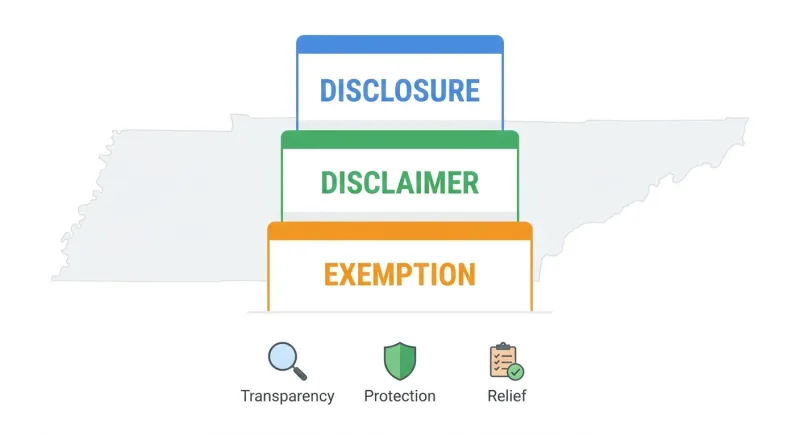
Disclosure vs. Disclaimer vs. Exemption: Which Path Is Yours?
Not every Tennessee seller fills out the full disclosure. The law gives you three routes.
| Route | What it is | Form | Governing statute |
|---|---|---|---|
| Disclosure | You affirmatively report known condition, item by item | RF201 / statutory text | § 66-5-210 |
| Disclaimer | You sell "with all faults," declining to make representations (where allowed) | RF203 | § 66-5-202 |
| Exemption | Your sale type is exempt from the Act entirely | RF204 | § 66-5-209 |
Exemptions (§ 66-5-209) cover specific transfer types: court-ordered sales, transfers between co-owners, certain estate transfers. Most ordinary FSBO home sales do not qualify. If you're unsure which route applies, ask a Tennessee closing attorney.
Field-by-Field: Walking the Disclosure Form
The statutory disclosure is organized into sections covering the home's systems, its structure, and the land. For each item you'll mark Yes, No, or Unknown — and often add a short note.
Appliances and Systems
What it asks: Condition and working status of included appliances and major systems — electrical, plumbing, heating, cooling, water heater, and built-in appliances conveying with the sale.
How to answer: Mark the working status you actually know. If the dishwasher runs but the heating element quit, say so.
Common mistake: Checking "working" for an appliance you haven't used in months. If you can't vouch for it, note that honestly or mark Unknown.
Structural Components
What it asks: Roof, foundation, walls, floors, basement, drainage, and any history of water intrusion or structural repair.
How to answer: Disclose known leaks, cracks, prior repairs, and moisture issues — even ones you fixed. Past-but-repaired is still a known fact the buyer is entitled to.
Common mistake: Treating "I repaired it" as "there's nothing to report." If you re-roofed after a leak, disclose the leak and the repair. Silence on a prior defect reads as concealment.
Environmental and Land Conditions
What it asks: Water source and sewage disposal, known environmental hazards, drainage and soil issues, easements, boundary disputes, flood zone status, and HOA/PUD membership.
How to answer: Pull your well or septic records, your survey, and any HOA documents before you start this section.
Common mistake: Leaving fields blank because you're not sure. Unknown is the honest answer when you don't have records, and it protects you better than a guess. Never leave a required field empty.
Tennessee-Specific Disclosures Most Sellers Miss
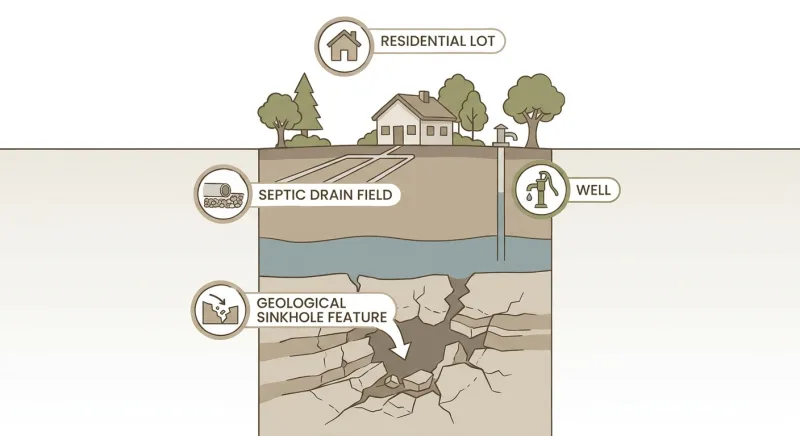
Sinkholes. Tennessee law specifically requires sellers to disclose a known sinkhole on the property (T.C.A. § 66-5-212). This is karst country — don't treat it as optional.
Septic and bedroom capacity. If your home is on a septic system, your subsurface sewage disposal permit sets the number of bedrooms the system is rated for. The Tennessee Department of Environment and Conservation (TDEC) issues these permits. Marketing a 4-bedroom home on a 3-bedroom septic permit is a misrepresentation waiting to happen. Disclose the permitted capacity.
Exterior injection wells. If the property has one, document it with TDEC records.
PUD / association. If you're in a Planned Unit Development or HOA, disclose it and the associated obligations.
Underlying all of this is the Tennessee Consumer Protection Act (§ 47-18-104(b)), which can turn a knowing misrepresentation into a consumer-protection claim — not just a contract dispute.
The Good-Faith Standard: A Framework for Defensible Answers
"Good faith" (§ 66-5-201) does not require you to investigate. It requires you to be honest about what you actually know.
For any item, run a three-tier knowledge test:
- Do I actually know this is true or false? → Answer Yes or No.
- Have I seen signs but never confirmed? → This is where judgment lives.
- Do I genuinely not know? → Answer Unknown.
The middle tier is the dangerous one. If you've seen a water stain but never had the roof inspected, "No, there's no roof problem" is a statement of fact you can't support. The honest move is Unknown plus a note: "Water stain observed on bedroom ceiling 2024; cause not determined; no inspection performed." That converts a guess into a documented, good-faith disclosure.
One caution: overusing Unknown on things you obviously know invites a bad-faith argument. If you've lived in the home ten years and mark the HVAC "Unknown," a buyer's attorney will ask how that's credible. Answer what you know plainly, mark true unknowns honestly, and never use Unknown to dodge a defect you've already dealt with.
The Disclosure Is a Living Document
Your disclosure describes the property's condition as of when you sign it. If something changes before closing, your duty doesn't freeze at signing.
A pipe bursts after delivery. The HVAC dies during the inspection period. You can't let the buyer close on a snapshot you know is now false — amend the disclosure and deliver the update. An accurate-when-signed disclosure becomes a misrepresentation the moment you stay silent about a change you know about, triggering a potential buyer's right of rescission and liability under the Act.
The inspection-report trap. Once a buyer's inspector surfaces a defect you genuinely didn't know about, you now know it. If the deal collapses and you re-list, your disclosure to the next buyer must reflect what that inspection taught you.
"As-Is" Does Not Mean "As-Unknown"
An as-is clause allocates repair responsibility — it tells the buyer you won't fix things. It does not waive your duty to disclose known defects under the Act. You can sell as-is and still be liable for concealing a known cracked foundation, because as-is governs who pays for repairs, not whether you told the truth.
Selling as-is while hiding a known defect combines the worst of both — you've waived nothing and created fraud exposure, including under § 47-18-104(b). If your strategy is "I'll sell cheap and disclose everything," as-is plus a thorough, honest disclosure is a clean, defensible position.
Edge Cases: When the Standard Rules Bend
Inherited property and estate sales. If you inherited the home and never lived in it, you may qualify for exemption under § 66-5-209. But exemption from the form is not immunity from fraud — common-law misrepresentation and the Consumer Protection Act still reach you if you lie in response to a direct buyer question.
Co-owners who disagree on what's "known." Knowledge under the Act is individual. The fix: both titled owners complete and review the same disclosure — one form, both signatures, both memories pooled.
The property your tenant knows better than you do. Courts don't treat "I'm an absentee owner" as a free pass when you've received repair requests in writing. Those maintenance texts and emails are a record of what you knew. Review your repair correspondence before answering the structural and systems fields.
Sequencing the Disclosure in a Self-Managed Timeline
| Stage | Disclosure action | Why it matters |
|---|---|---|
| Pre-listing | Complete the statutory disclosure (§ 66-5-210) | Ready to deliver the instant interest turns serious |
| Showing / offer | Provide to buyer before the contract becomes binding | Late delivery undercuts informed consent and your protection (§ 66-5-201) |
| Under contract | Amend if a new material condition arises | Living-document duty stays active to closing |
| Pre-closing | Reconfirm no changes since last version | Closes the gap between last update and settlement |
A practical habit: attach the completed statutory disclosure to your listing packet from day one. When a buyer writes an offer, the disclosure travels with the negotiation, not after it.
Why Filling This Out Yourself Is the Safer Play
When an agent hands you Form RF201, they're handing you a document their trade association drafted for their members' workflow. You still answer every field. You still carry the liability. The agent's signature absorbs none of your obligation under the Act.
Balance three things:
- What you know — your actual knowledge of the property's condition.
- What the statute requires you to say — the specific fields under § 66-5-210.
- What you honestly don't know — the Unknown column, a legitimate, protected choice.
"Unknown is a feature, not a failure" is the single reframe most FSBO sellers miss. If a fact sits outside what you know, you don't guess and you don't leave it blank — you mark Unknown and you're covered.
Once the disclosure is squared away, the rest of the sale is logistics — precisely where a flat-fee MLS listing fits a Tennessee FSBO: you've done the legally careful part yourself, with no reason to pay a full commission to get your home in front of buyers.
Frequently Asked Questions
Can a FSBO seller use Tennessee REALTORS® Form RF201?
Generally, no — Form RF201 is copyrighted by Tennessee REALTORS® and licensed for member use, so unrepresented sellers shouldn't reproduce it. Instead, use the statutory disclosure language at T.C.A. § 66-5-210, which is free and satisfies the Act.
Where can I get the Tennessee property disclosure form for free?
The free, legally sufficient disclosure language lives in the Tennessee Code at T.C.A. § 66-5-210. Read the current statutory text on the Tennessee General Assembly's official code site and build your disclosure from those required items — no membership or purchase needed.
Is a seller disclosure required for FSBO sales in Tennessee?
Yes — most sellers of residential real property must deliver a written property condition disclosure to the buyer before a binding contract is signed (T.C.A. § 66-5-201). Selling without an agent doesn't exempt you. A limited set of transfers fall under the exemptions in § 66-5-209.
What happens if I don't disclose a known defect?
You can face liability for misrepresentation, including exposure under the Tennessee Consumer Protection Act at T.C.A. § 47-18-104(b). A buyer who relied on your silence about a known material defect may seek damages or rescission. When unsure, answer "Unknown" rather than guess.
Can I sell "as-is" and skip disclosure?
No — an as-is clause limits certain buyer remedies but does not waive your duty to disclose known material defects under the Act. You still must complete the disclosure in good faith (§ 66-5-201).
Do I have to disclose a death or a sinkhole on the property?
Sinkhole history and known sinkhole features must be disclosed under T.C.A. § 66-5-212. A death on the property is generally not treated as a material defect requiring disclosure in Tennessee, but answer any direct buyer question honestly rather than mislead.
Conclusion
Filling out the Tennessee residential property disclosure form means answering each field honestly, in good faith, before you have a binding contract. Work the statutory items in § 66-5-210 top to bottom and use "Yes," "No," or "Unknown" with intent.
Three things to keep front of mind: skip Form RF201 and build from the free statutory text; treat the disclosure as a living document and amend it if you learn something new before closing; and don't assume "as-is" erases your duty to disclose what you already know.
Practical next step: pull the current § 66-5-201 through § 66-5-212 text from the official Tennessee General Assembly site, confirm section numbers haven't shifted, and draft your disclosure from the statute itself. A licensed Tennessee closing attorney or title company should review anything you're unsure about, especially septic capacity, sinkholes, and injection wells.
Answer honestly. Update it if things change. That's the whole job.