
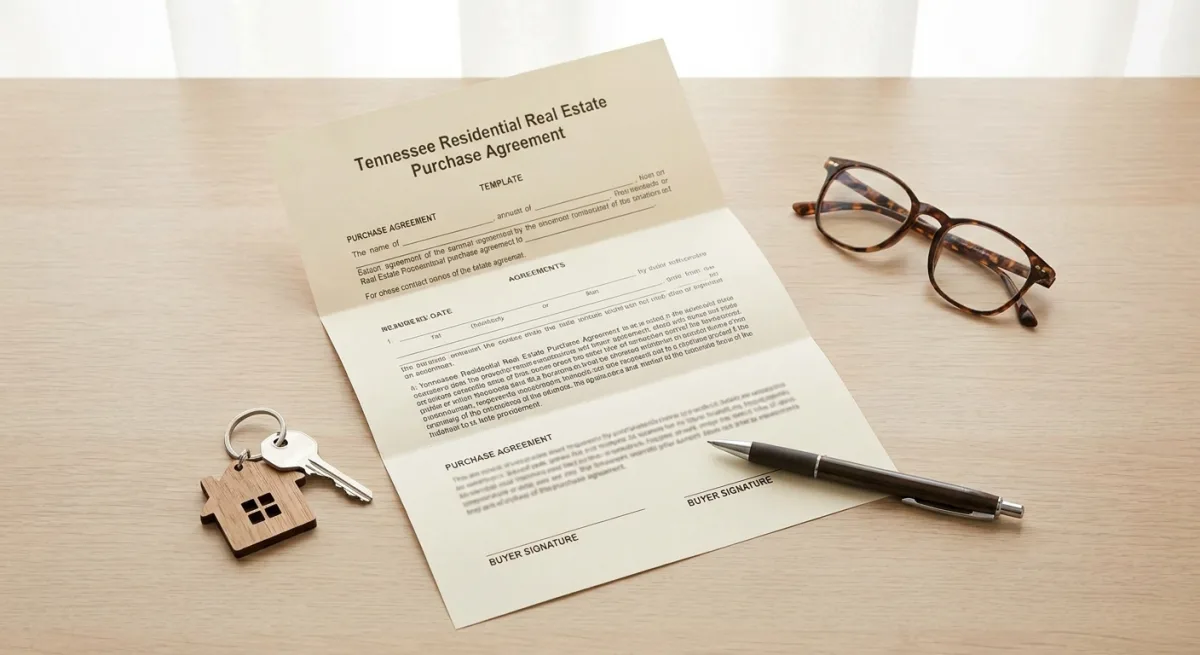
General information, not legal advice. Consult a licensed Tennessee real estate attorney before signing any contract. Last reviewed: July 2026.
You found a buyer. No agent, no commission. Now you're staring at a form called the RF 401, wondering if you can even legally use it.
Short version: In a Tennessee FSBO sale, the contract is usually drafted by the buyer's real estate agent using the RF 401, or by a licensed Tennessee attorney you hire. The RF 401 is a copyrighted Tennessee REALTORS® form restricted to authorized licensee users, so an unrepresented seller can't simply download and fill it out. This guide walks the form field by field, your legal options, and the mistakes that quietly sink FSBO deals.
What Is the Tennessee RF 401?
The RF 401 is the standard Purchase and Sale Agreement published by Tennessee REALTORS®. It's the binding contract covering price, timeline, contingencies, and who holds the money. Agents on both sides recognize it; title companies and closing attorneys expect it. That standardization is why it matters in a for sale by owner Tennessee deal.
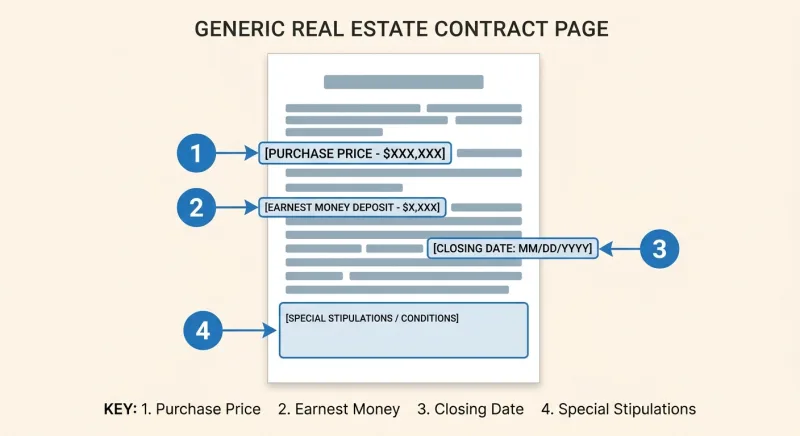
The form covers:
- Property description and address
- Purchase price and how it's paid
- Earnest money amount and holder
- Closing date and possession
- Financing, appraisal, and home inspection contingencies
- Special stipulations (custom terms)
- The binding agreement date
The Copyright Restriction Nobody Warns You About
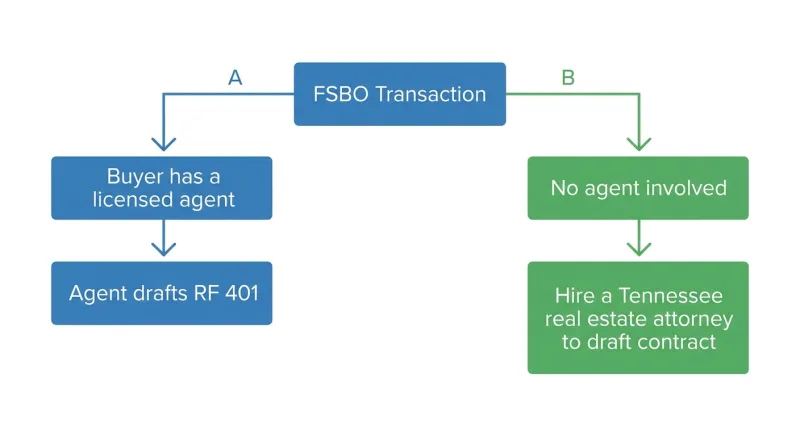
The RF 401 is a copyrighted work owned by Tennessee REALTORS®, restricted to authorized licensee users — agents who are current members. When a website hosts a downloadable RF 401 and invites you to "fill it out free," they're handing you a document you likely have no license to complete as an unrepresented seller.
That silence creates the single most expensive FSBO mistake in Tennessee: a seller drafts a contract on a form they can't authorize, and its enforceability gets questioned exactly when it matters — during a dispute.
The reframe: the RF 401 is a destination, not a starting point. You don't chase the form. You build the conditions that lawfully produce it.
Who Actually Drafts the Contract in a Tennessee FSBO Sale
The right question isn't how do I fill out the RF 401 — it's where does the RF 401 come from in a sale without a listing agent. Three legitimate paths exist.
Path 1 — The buyer's agent drafts it
The most common outcome. You have no agent; the buyer does. That agent is a licensed member and can lawfully complete the RF 401. You're not filling anything out — you're reviewing and countering. Cost to you for the contract itself: $0. You may still agree to pay a buyer's agent commission (typically 2.5%–3%, fully negotiable).
Path 2 — A Tennessee attorney drafts a non-member contract
No buyer's agent? Commission an attorney-drafted purchase and sale agreement — a different document, lawfully yours, built for the same transaction. Typical range: a few hundred dollars to about $1,500 depending on complexity.
Path 3 — A compliant non-association template
A Tennessee-specific purchase agreement that is not the copyrighted RF 401, with optional attorney review before signatures. The winning move isn't grabbing a bootleg RF 401 PDF — it's using a form you're actually allowed to use.
Line-by-Line: Key Fields and the FSBO Mistakes That Cost You
| Form Section | Key Fields | Common FSBO Mistake |
|---|---|---|
| Property Description | Legal address, county, deed book and page | Using only the street address; omitting the legal description, which stalls title work |
| Purchase Price | Total price, financing type | Leaving financing type blank, so contingencies don't match the buyer's situation |
| Earnest Money | Amount, earnest money holder | Naming an informal holder instead of a title company or attorney trust account |
| Financing / Appraisal | Loan type, approval deadline, appraisal contingency | No appraisal clause on a financed deal, leaving the seller exposed if the home appraises low |
| Home Inspection | Inspection period, resolution window | Vague or missing deadlines; typical inspection + resolution runs 7–14 days |
| Closing Date | Specific calendar date | A date too tight for the lender to fund, triggering default disputes |
| Possession | When buyer takes possession | Assuming closing = possession; post-closing occupancy left undefined |
| Binding Agreement Date | Date the last party accepts | Left blank — yet every deadline is calculated from it |
| Special Stipulations | Custom terms (repairs, fixtures, warranty) | Vague language ("seller to fix issues") instead of specific, enforceable terms |
You're Not a Drafter. You're a Reader.
In most Tennessee FSBO sales, you never draft — you defend. When a buyer's agent hands you an RF 401, you're reading someone else's numbers, in their client's favor, and your leverage lives in the fields you push back on.
- Purchase price and earnest money — evaluating whether the deposit (often around 1%–2% of price, fully negotiable) proves real skin in the game.
- Financing and appraisal contingency — reading how many exit doors the buyer built in, because every contingency is a way they walk with earnest money intact.
- Inspection and resolution period — clocking the window (commonly 7–14 days) where repair negotiations must resolve.
- Special stipulations — the freeform box where the most damage hides. What's written in binds you. What you forget — a repair credit, a rent-back, a fixture exclusion — is gone.
FSBO sellers lose money in the fields they didn't negotiate, not the fields they filled out wrong.
The Contingency Cascade: How One Deadline Trips the Next
The dates interact. The financing contingency, appraisal contingency, and inspection resolution period all run against the binding agreement date — not the offer date, not closing. Get it wrong and every downstream clock is wrong.
Picture a 30-day close with a 10-day inspection resolution and a 21-day loan approval deadline. If your buyer's inspection stretches to day 12 because you wrote the wrong binding date, they may still be inside their window while you think it expired. You send a "cure or terminate" notice one day early — and now you're the party who breached notice procedure.
The most common title-agent flag: sellers who set a closing date before the loan approval deadline. Close on day 20 when financing must clear by day 21, and you've handed the buyer a built-in escape hatch.
Build your dates backward from closing:
- Set the closing date first.
- Set the loan/financing deadline at least 5–7 days before closing.
- Set the appraisal contingency to resolve before the financing deadline.
- Set the inspection resolution period earliest — typically 10–14 calendar days from binding.
Sequence it right and a deal that's going to die dies cheap and early.
Special Stipulations: Where FSBO Deals Are Won and Lost
Anything typed in the special stipulations box generally overrides the pre-printed language above it. Courts in Tennessee treat specifically negotiated language as stronger evidence of intent than boilerplate.
Stipulations that create more problems than they solve:
- Vague repair promises. "Seller to fix roof" invites a fight. Write scope, dollar cap, and completion date.
- Verbal side agreements. If it isn't in special stipulations or an addendum, it doesn't exist. The RF 401 is an integrated contract — prior verbal promises drop out under the merger doctrine.
- Conditions with no deadline. "Contingent on buyer selling their home" with no date is an open-ended option. Always attach a drop-dead date and a right to keep marketing.
Every stipulation should answer who does what, by when, and what happens if they don't. Miss any of those three and you've written a dispute, not a term.
Earnest Money: The Default Trap Nobody Explains
Read how your earnest money clause characterizes the deposit on buyer default:
- Liquidated damages / sole remedy: you keep the deposit and the deal is done. Fast, capped, clean — but you cannot then sue for more.
- Non-exclusive remedy: you keep the deposit and retain the right to pursue actual damages or specific performance.
If the market dropped and reselling will cost you $20,000, a "sole remedy" deposit of $4,000 is a bad trade — locked in the moment you signed. Decide your remedy posture before you fill the box.
Three Tennessee-Specific Rules FSBO Sellers Miss
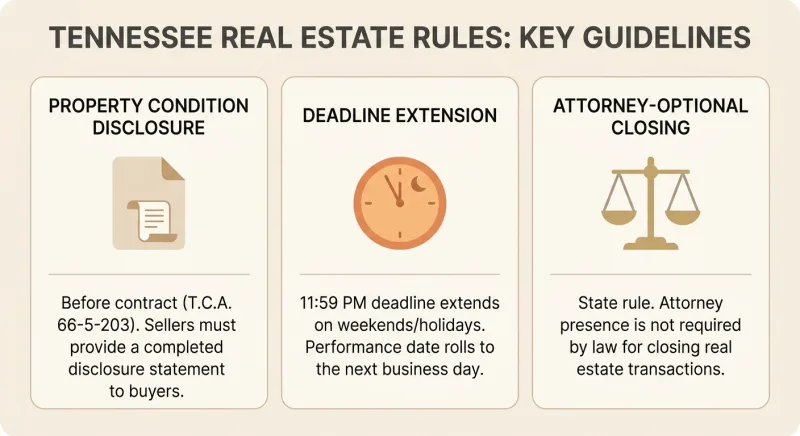
1. The property condition disclosure is required by statute
Tennessee law (T.C.A. § 66-5-203) generally requires residential sellers to furnish a property condition disclosure before the contract becomes binding. This is separate from the RF 401. Skip it and you create liability that follows you past closing.
2. The 11:59 PM deadline and weekend extension
Deadlines run in calendar days, typically expire at 11:59 PM on the stated day, and roll forward when a deadline lands on a weekend or federal holiday. FSBO sellers counting in "business days" miscount against a contract that runs in calendar days with a late-night cutoff.
3. Tennessee is attorney-optional, and the buyer chooses the closing agent
No attorney is required at closing, though many use one. Under RESPA Section 9 (12 U.S.C. § 2608), a seller cannot require the buyer to use a particular title company as a condition of sale.
Notice, Delivery, and the Wholesaler Edge Case
Every deadline on the RF 401 is really a notice deadline. If the form requires email or hand delivery and the buyer texts you a signed termination, that may not be valid delivery. Match your method and address to exactly what the form names, and save timestamps.
Also watch whether the contract is assignable. If the buyer line reads "John Smith and/or assigns," you may be dealing with a wholesaler who intends to sell your contract to a third party before closing. Wholesalers often negotiate long inspection windows and weak earnest money, then terminate if they can't flip it — costing you weeks of market time. A special stipulation making the contract non-assignable without written seller consent closes that door.
When the RF 401 Is the Wrong Form Entirely
The RF 401 is built for standard residential resale. Some deals sit outside its design:
- Owner financing / land contracts — needs a separate note and deed of trust.
- Septic, well, or shared-driveway properties — disclosure needs exceed the standard framework.
- New construction or major renovation — warranty, completion, and permit terms aren't native to the form.
- Estate, trust, or multi-owner sales — signature authority and title issues need review first.
On any of these, an attorney review stops being optional.
Are Free Tennessee FSBO Contract Templates Safe?
A free template isn't dangerous because it's free — it's dangerous because of what it silently assumes. Three failure modes repeat:
- The bootleg RF 401 — the real association form, stripped of copyright warning, questionable to use.
- The generic national form — fifty-state boilerplate that never mentions T.C.A. § 66-5-203.
- The abandoned template — uploaded in 2016, never reviewed against current statute, still ranking on page one.
The contrarian point: a free, compliant, current Tennessee template plus a $300 attorney review beats a "professional" RF 401 you have no authority to complete.
Get the MLS Listing Right First — Then the Contract Follows
The contract is the last step. The fastest way to reach serious, financed buyers in Tennessee is a flat fee MLS listing — your home on the same MLS agents use, at a flat cost instead of a full listing commission. That's how you attract the buyer (often one with an agent who can lawfully draft the RF 401), which quietly solves your contract problem too.
Frequently Asked Questions
Who drafts the contract in a FSBO sale in Tennessee?
In a Tennessee for-sale-by-owner deal, the contract is usually drafted by the buyer's real estate agent (who can legally use the RF 401) or by a licensed Tennessee attorney. An unrepresented seller cannot lawfully fill out the RF 401 themselves.
Can I use the RF 401 without a realtor?
No. The RF 401 is a copyrighted form owned by Tennessee REALTORS® and licensed only to its members and their clients. If neither side has an agent, you'll need an attorney-drafted agreement or a compliant non-member template.
Is a free Tennessee FSBO contract template PDF safe to use?
A free template is safe only if it's a legally compliant, non-copyrighted agreement — not an unauthorized copy of the RF 401. Look for one that includes earnest money holder, closing date, financing and appraisal contingencies, and the Tennessee property condition disclosure required under T.C.A. § 66-5-203.
How much earnest money is typical in a Tennessee FSBO sale?
Earnest money is negotiable and often runs around 1% of the purchase price. What matters more than the amount is naming a neutral holder — usually the closing agency or title company — in the contract itself.
Do I need a real estate attorney to sell my house without an agent in Tennessee?
Tennessee doesn't require an attorney to close a residential sale, but a single review is cheap insurance on a six-figure sale.
What is the 11:59 PM deadline rule in the RF 401?
Performance deadlines generally expire at 11:59 PM on the stated date, counted in calendar days, with extensions when a deadline lands on a weekend or federal holiday.
This is general information, not legal advice. Confirm every statutory and form reference against current primary sources and consult a licensed Tennessee real estate attorney before signing. Last reviewed: July 2026.
Sources & legal references (verify at publication):
- Tennessee REALTORS® RF 401 form terms and printed copyright notice
- T.C.A. § 66-5-203, Tennessee residential property condition disclosure
- RF 401 time-computation clause, including weekend/federal-holiday extension language
- RESPA / 12 U.S.C. § 2608 (Regulation X), buyer's right to choose the closing agent
- Tennessee common law: customized or handwritten terms typically override pre-printed boilerplate; merger and integration doctrines under which the final signed contract supersedes prior verbal agreements