
Selling a House by Owner in Tennessee: What Paperwork You Actually Need
Selling a house without a realtor in Tennessee starts with one non-negotiable law: the Tennessee Residential Property Disclosure Act, T.C.A. § 66-5-201 et seq. Get the paperwork wrong and you don't just lose a sale — you hand the buyer grounds to rescind the contract or sue.
To sell FSBO in Tennessee, you need a written purchase agreement, the Tennessee Residential Property Condition Disclosure (T.C.A. § 66-5-210), a lead-based paint disclosure if the home was built before 1978, a valid deed, settlement and title documents at closing, and any HOA or lien payoff statements. Two of these carry immediate legal weight: the disclosure protects you from later lawsuits over material defects; the purchase agreement becomes binding the moment both parties sign.
One thing up front: a flat-fee MLS listing gets your home in front of buyers without a full-service commission — but it does not remove your legal duty to disclose. That obligation is yours as the seller. Always.
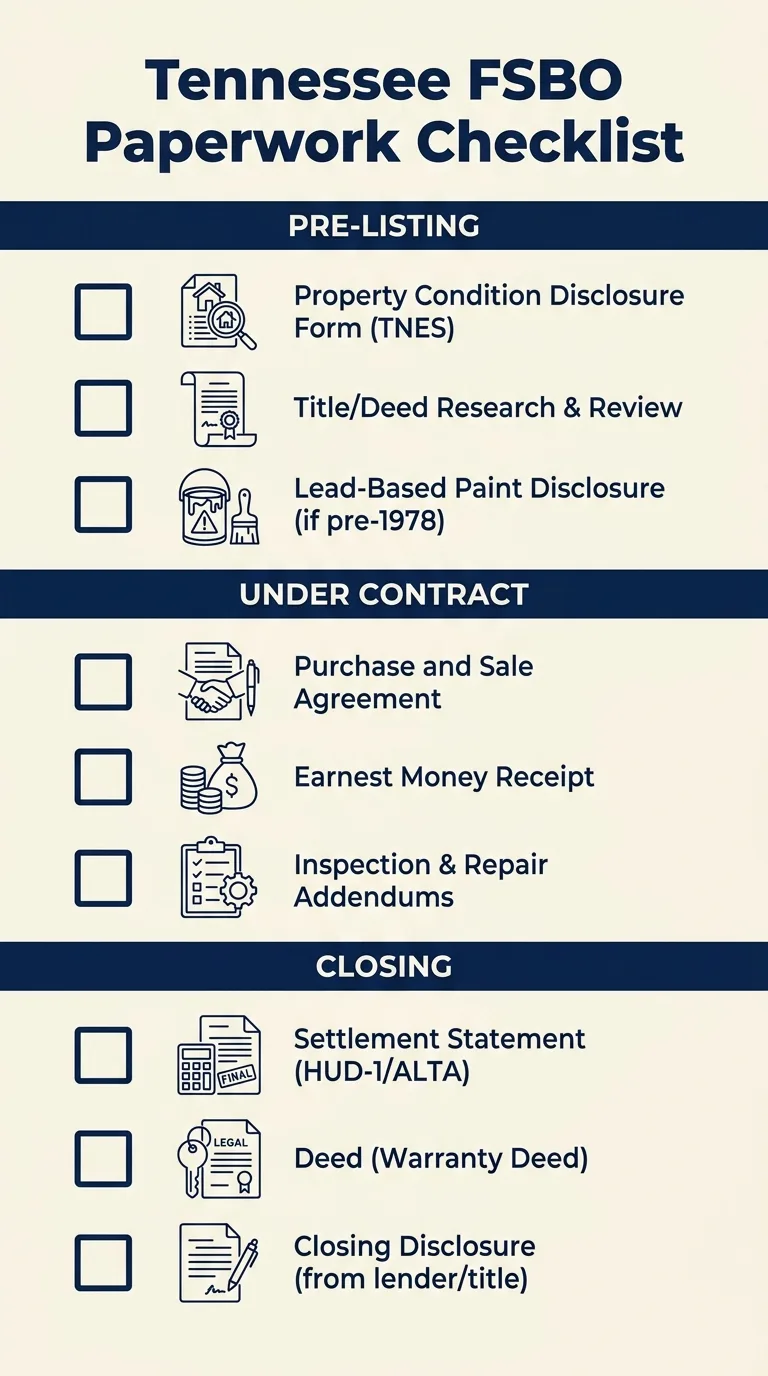
The Complete Tennessee FSBO Paperwork Checklist
Pre-Listing
- Tennessee Residential Property Condition Disclosure — the standard state form (T.C.A. § 66-5-210). Required for most residential sales.
- Property Condition Disclaimer Statement — the "as-is" waiver (T.C.A. § 66-5-202).
- Residential Property Condition Exemption Notification — for sellers who legally qualify to skip disclosure (T.C.A. § 66-5-209).
- Lead-based paint disclosure — federally required for homes built before 1978 (40 CFR Part 745). Include the EPA "Protect Your Family From Lead in Your Home" pamphlet.
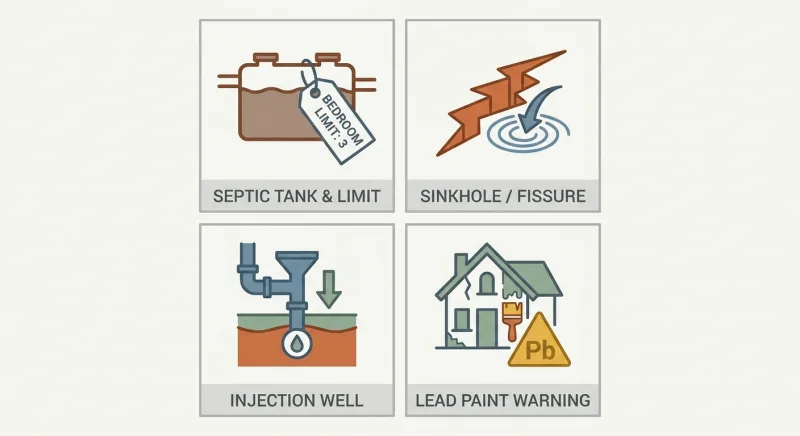
- Septic/subsurface sewage disposal permit — if on septic, know your permitted bedroom count. Advertising more bedrooms than the permit supports can trigger consumer-protection liability for newly constructed properties (T.C.A. § 47-18-104(b)(42)).
- Current deed and prior title paperwork — confirms you can legally convey the property.
Under Contract
- Purchase agreement — price, earnest money, contingencies, closing date, escrow terms.
- Counteroffers and amendments — any changes to signed terms, in writing.
- Home inspection response documents — repair requests, credits, or waivers.
- Additional TN-specific disclosures — sinkhole, exterior injection well, soil percolation, and PUD covenants where applicable (T.C.A. §§ 66-5-212/213).
Closing
- Property deed transfer — conveying title to the buyer.
- Settlement statement — itemizes every dollar at closing.
- Lien and mortgage payoff statements — from your current lender.
- Transfer and recordation tax documentation — paid at recording (Tennessee Dept. of Revenue).
The Purchase Agreement & Binding Contract
A complete Tennessee purchase agreement includes purchase price and financing type, earnest money deposit held in escrow, contingencies (financing, appraisal, inspection, sale-of-buyer's-home), closing date and possession terms, prorations for taxes and HOA dues, and default and remedy language.
Most agents use the Tennessee REALTORS® standard forms (RF series) — well-drafted but copyrighted, generally accessed through a member or brokerage. As an FSBO seller, you don't need them. An attorney-drafted agreement, a title company's form, or a compliant owner packet works just as well. Whatever form you use, read it line by line.
Disclosure vs. Disclaimer vs. Exemption: Your Three Legal Paths
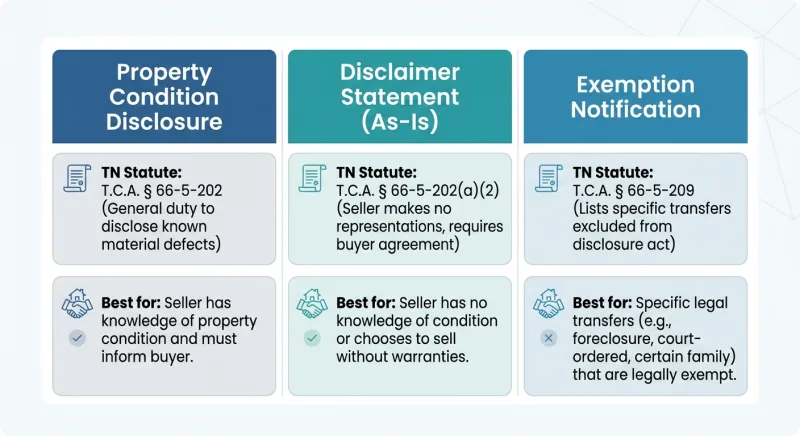
| Path | Governing Statute | What It Is | Best For |
|---|---|---|---|
| Property Condition Disclosure | T.C.A. § 66-5-210 | Complete the state form disclosing known material defects | Nearly every standard residential sale |
| Property Condition Disclaimer (As-Is) | T.C.A. § 66-5-202 | Buyer waives disclosure; you sell "as-is" with no representations | Estate sales, distressed properties, sellers who never lived there |
| Exemption Notification | T.C.A. § 66-5-209 | You legally qualify to skip disclosure entirely | Specific exempt transfers — e.g., certain court-ordered or fiduciary sales |
The disclosure is the default. You fill out the standard form honestly — roof, foundation, systems, past problems you know about. You're not required to inspect or investigate; only to disclose what you know. The disclaimer lets you sell without representations, but the buyer must knowingly accept it, and "as-is" doesn't let you hide a defect you know about. The exemption path is narrow — confirm you qualify against the statute or with a closing attorney. When in doubt, disclose. It's the safest path and the form is free.
The Timing Mistake That Voids Deals
The Tennessee Residential Property Condition Disclosure must be delivered to the buyer before the purchase agreement becomes binding, not at closing (T.C.A. § 66-5-201 et seq.). Deliver late and the remedy lives in the buyer's hands. Standard transaction forms often grant a rescission right, and the statute permits termination for misrepresentation (T.C.A. § 66-5-208). A buyer who got cold feet can use your late disclosure as a clean exit.
Sequence it right:
- Draft the disclosure before you list.
- Deliver it with the offer package or before signature — get a dated acknowledgment.
- Keep the signed, timestamped receipt in your closing file.
That dated acknowledgment is your single best defense against a "seller never disclosed" claim.
Where the Disclosure Duty Actually Follows You Home
Tennessee's statute limits your liability to defects within your actual knowledge — you're not required to inspect to discover problems you don't know about (T.C.A. § 66-5-201 et seq.). But a defect you papered over, a repair you personally made, a leak you watched happen — those all live inside actual knowledge. Writing "unknown" on something you demonstrably experienced converts an honest gap into willful misrepresentation, which survives an as-is clause.
Amending the disclosure after something changes
When a defect appears between disclosure and closing, your original form is stale. Sitting on new knowledge is exactly the fraud the statute punishes. The move is a written amendment, delivered promptly. Yes, it can reopen the buyer's rescission window on the newly disclosed item — but a reopened window is survivable. A concealed-defect lawsuit after closing is not.
The As-Is Clause Isn't a Force Field
The mental model is layered:
- As-is contract term → limits the buyer's right to demand repairs or walk on inspection.
- Disclaimer statement → limits your representations under the disclosure act (§ 66-5-202).
- Neither → limits fraud liability, federal lead disclosure, or Tennessee's item-specific mandates.
A disclaimer of "property condition" doesn't touch the federal lead rule or Tennessee's bedroom-advertising restriction (T.C.A. § 47-18-104(b)(42)). Choose the disclaimer when you have thin knowledge of the property — an estate sale, an inherited home, a rental you never lived in. But in a normal residential sale, a clean, honest disclosure often nets more than a disclaimer, because it removes uncertainty from the buyer's pricing.
The 3-Year Non-Occupancy Exemption: Read the Fine Print
The exemption under T.C.A. § 66-5-209 removes the obligation to deliver the standard disclosure form. It does not remove the duty to disclose a known material defect, and it does not touch federal lead-based paint requirements for a pre-1978 home. An out-of-state landlord who never occupied a 1965 duplex still owes the federal lead disclosure under 40 CFR Part 745.
Edge cases that break the exemption: new construction first sales carry different obligations; transfers between co-owners or by court order are exempt from the form but not from fraud exposure; a landlord who moved back in briefly resets the analysis. Treat the exemption as narrow procedural relief, not a liability eraser.
The Tennessee-Specific Disclosures National Guides Miss
The septic bedroom trap. Under T.C.A. § 47-18-104(b)(42), advertising more bedrooms than the septic permit supports for a newly constructed home can be treated as a deceptive practice. Check your permit before writing the listing.
Sinkholes, injection wells, and percolation. T.C.A. §§ 66-5-212 and 66-5-213 address conditions generic national forms omit. Karst geology is a Tennessee reality; a Delaware-based checklist doesn't know that.
PUD covenants. If your property sits in a planned unit development, those covenants and associated fees belong in the buyer's hands before the contract binds.
Each of these is why "just download a national FSBO packet" quietly fails Tennessee sellers. The forms look complete. They aren't.
A Flat-Fee MLS Listing Does Not Erase Your Disclosure Duty
A flat-fee MLS listing gets your home on the market without a full-service commission, but your disclosure obligations under § 66-5-201 et seq. stay with you. The listing method never changes the law.
Flat-fee is the unbundled middle ground: full market exposure without a full commission, with access to compliant Tennessee contract and disclosure forms. The obligation stays yours. The tooling gets easier.
Frequently Asked Questions
What paperwork is required to sell a house by owner in Tennessee?
At minimum: a written purchase agreement, the Tennessee Residential Property Condition Disclosure (T.C.A. § 66-5-210), a lead-based paint disclosure if the home was built before 1978 (40 CFR Part 745), and the deed plus settlement documents at closing. HOA, lien-payoff, and septic records apply where relevant.
Is the Tennessee property condition disclosure form free?
Yes. It's a state-prescribed document under T.C.A. § 66-5-210. You never have to buy it from a broker.
When must a Tennessee seller deliver the property disclosure?
Before the buyer is bound by the purchase agreement — not at closing. Under T.C.A. § 66-5-201 et seq., delivering it late can give the buyer grounds to terminate. Get it into the buyer's hands early.
Can I sell my Tennessee house "as-is" without disclosing defects?
Not exactly. You can deliver a Property Condition Disclaimer Statement instead of a full disclosure, but Tennessee law still prohibits knowingly concealing a known material defect. "As-is" limits some obligations; it doesn't license fraud.
Does using a flat-fee MLS listing remove my disclosure duty?
No. The seller's disclosure obligations under the Tennessee Residential Property Disclosure Act stay with you regardless of how the property is marketed.
Do I need a real estate attorney to sell FSBO in Tennessee?
Not legally required, but many sellers use a title company or closing attorney to handle the deed, settlement statement, and recording at the County Register of Deeds.
The Bottom Line
Selling your house yourself in Tennessee isn't about paperwork volume — it's about the right documents, in the right order, with nothing skipped: a compliant purchase agreement, the Tennessee Residential Property Condition Disclosure (or a valid disclaimer or exemption), a pre-1978 lead-based paint disclosure where applicable, Tennessee-specific items like septic and sinkhole disclosures, and a properly recorded deed at closing.
The single mistake that sinks FSBO deals is disclosure timing. Deliver the property condition disclosure before the buyer is bound. Get that one thing right and you've already avoided the error most sellers make.
Statutes cited are current as of 2026 and subject to legislative amendment; confirm against official Tennessee Code Annotated text before relying on them. This is general information, not legal advice — a Tennessee closing attorney can confirm how these rules apply to your specific sale.