
Do You Need a Lawyer to Sell a House by Owner in Tennessee? Closing Attorney Requirements Explained
No — Tennessee doesn't legally require you to hire a lawyer to sell your house by owner. Most FSBO sales close through a licensed title company acting as the settlement agent. But one detail trips up sellers: under Tenn. Code Ann. § 23-3-101, drafting a deed for valuable consideration is considered "law business," so a licensed attorney typically handles that piece.
Here's what actually happens at a Tennessee FSBO closing — what the law demands, what you practically need, and where an attorney earns their fee. We run a flat-fee MLS operation here in Tennessee, so we sit at the table where these questions get answered. One note up front: this isn't legal advice — confirm specifics with a Tennessee real estate attorney.
Is a Closing Attorney Legally Required for FSBO in Tennessee?
No. Tennessee is a "title company" or escrow closing state, not an attorney-closing state. You can sell your home by owner and never sit across from a lawyer.
Unlike Georgia and the Carolinas — where an attorney is required to conduct the closing — Tennessee lets a licensed title insurance agent handle the settlement: clearing title, holding escrow, preparing the closing disclosure, and recording the deed. In most Middle Tennessee closings (Nashville, Franklin, Brentwood, Murfreesboro), a title company runs the whole show.
Custom shifts by region. Parts of East and West Tennessee lean more attorney-led out of local habit, not statute. If you're selling in Knoxville, Chattanooga, or Memphis, ask local settlement providers how deals typically close in that county.
The requirement isn't "hire a lawyer." It's have a competent settlement agent — and in Tennessee, that's usually a title company.
The Three-Layer Rule: Required, Necessary, and Just Smart
Most articles ask "do you need a lawyer?" and stop at "no." That's technically right and practically useless. Three separate things happen in a Tennessee FSBO sale, and only one is a legal mandate:
Layer 1 — Legally required: nothing. No Tennessee statute forces a FSBO seller to hire a closing attorney.
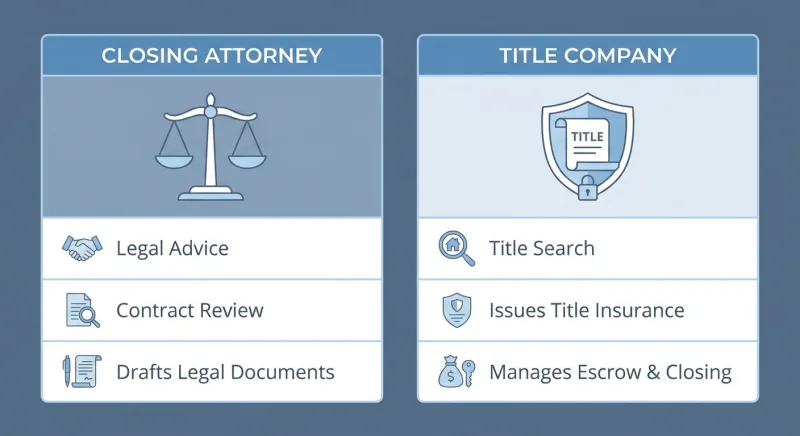
Layer 2 — Practically necessary: a settlement agent. Somebody has to hold the money, clear the title, issue title insurance, and record the deed. Skip it and no lender will fund, no buyer's title insurance will issue, and the sale simply doesn't close.
Layer 3 — Optional but smart: attorney review. Contract review, deed drafting, and anything unusual — probate, seller financing, divorce, a title defect. Worth paying for in specific situations; overkill in a clean cash-or-conventional sale.
Who Can Legally Draft the Deed in a Tennessee FSBO Sale?
Under Tenn. Code Ann. § 23-3-101, drafting a deed of conveyance for someone else, for compensation, is engaging in "law business." That's why many Tennessee title companies route deed prep to a staff or contract attorney and fold the fee into closing costs — you often never see it as a separate line item.
Three legitimate paths to a recordable deed:
- A licensed Tennessee real estate attorney. The clean, standard route.
- A licensed Tennessee title agent, operating within the transaction they're insuring.
- You, the owner, preparing your own deed. Doing your own legal work isn't practicing law on someone else's behalf.
That last option tempts DIY sellers. Be careful. A self-drafted deed with wrong vesting language, a bad legal description, or a missing element can cloud title for years — and it doesn't fail loudly at closing; it fails later, when a title examiner finds the defect.
Two 2025–2026 Law Changes Every Competitor Missed
You now get to choose your settlement agent
Tennessee's settlement agent choice law (SB 394 / HB 569), effective July 1, 2026, strengthened a buyer's right to select the settlement agent. Selling by owner, you and the buyer negotiate this directly — neither party can be strong-armed into a provider they didn't choose. For a seller already saving thousands with a flat-fee MLS listing, that choice compounds.
Practical move: pick your settlement agent before you're deep in negotiations, and name them in the purchase and sale agreement. The biggest FSBO closing delay we see isn't legal — it's a seller who found a buyer and then scrambled to find a closer two weeks before the deadline. Confirm current bill status before relying on it.
The 2026 deed fraud law changes who prepares your deed
Effective July 1, 2026, Tennessee's deed fraud law (SB 1707 / HB 1762) adds a verification layer to recorded deeds. A recorded deed generally needs a sworn declaration of the preparer — a notarized affidavit identifying who drafted it. Allowed preparers track the § 23-3-101 logic exactly: a licensed Tennessee attorney, a licensed title insurance agent, or the property owner via sworn declaration. The County Register of Deeds verifies preparer information at recording, consistent with duties under Tenn. Code Ann. § 8-13-108.
If a title company or attorney prepares your deed, this is handled as part of normal workflow. If you're preparing your own, you'll need to complete and notarize the sworn declaration before the Register will record it. Verify the exact affidavit format with your county's Register of Deeds, since recording standards vary.
Edge Cases Where an Attorney Stops Being Optional
The "no lawyer needed" answer holds for a clean, arm's-length sale. It breaks down in specific situations:
Title defects or clouds. A break in chain of title, an old unreleased mortgage, a boundary dispute, or a missing heir's interest requires a real estate attorney — sometimes a quiet title action.
Estate, probate, or trust sales. Selling inherited or trust-held property layers probate and fiduciary rules onto the deed source and signing authority.
Seller financing or land contracts. If you're carrying the note, the promissory note, deed of trust, and default terms are legal instruments a title company won't draft or advise on.
Divorce, judgments, or co-owner disputes. Liens from a divorce decree, tax judgments, or an uncooperative co-owner all need legal handling before title transfers cleanly.
Non-standard contract terms. Custom contingencies, unusual repair credits, or a 1031 exchange warrant attorney review before you sign.
The pattern: none of these are about deed mechanics. They're about risk a settlement agent isn't licensed to resolve.
The FSBO Closing Chain in Tennessee
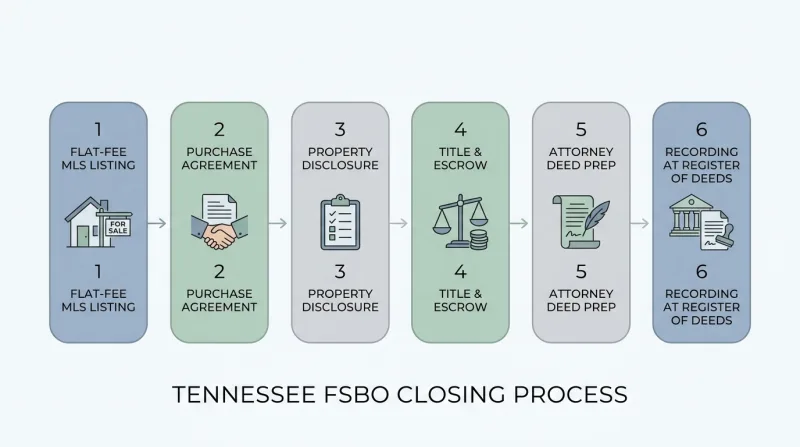
- List on the MLS through a flat fee MLS Tennessee service so buyers and their agents find your home.
- Negotiate and sign the purchase and sale agreement, naming your chosen settlement agent.
- Deliver the residential property disclosure required under Tenn. Code Ann. § 66-5-201 et seq.
- Title and escrow work runs at the title company: search, lien clearance, title insurance, closing disclosure prep, escrow of funds.
- Deed preparation by a licensed attorney or title agent — or yourself, correctly, with the sworn preparer declaration.
- Sign, fund, and record at the County Register of Deeds.
The failure point is almost never step 1 or step 6. It's the handoff — sellers who nail the listing and freeze at the closing table because they never lined up a closer. Solve that early and the rest is signatures and wire confirmations.
Frequently Asked Questions
Is a closing attorney required for FSBO in Tennessee?
No. Tennessee law doesn't mandate a lawyer to close a FSBO sale. Nearly every FSBO closing runs through a licensed title company acting as settlement agent, which handles escrow, title clearance, and recording. An attorney is optional but smart for complex deals.
Who drafts the deed in a Tennessee FSBO sale?
Preparing a deed for someone else is law business under Tenn. Code Ann. § 23-3-101, so a licensed Tennessee attorney (or the title company's affiliated attorney) drafts it. You may prepare your own deed conveying your own property without an attorney.
How much does a flat-fee closing attorney cost in Tennessee?
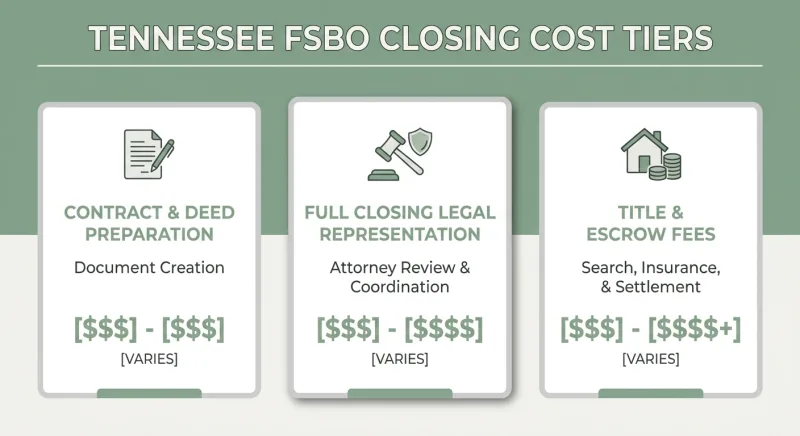
Expect roughly $400–$800 for contract or deed review and preparation, more if the attorney handles the full closing. Request a written flat-fee quote before you commit.
Who pays the closing attorney in a Tennessee FSBO sale?
It's negotiable and spelled out in your purchase and sale agreement. In many Tennessee closings the buyer pays for title insurance and closing services, while each side covers its own attorney review. Put every cost split in writing.
Can a title company close a house sale without a lawyer in TN?
Yes. Tennessee is a title/escrow state, and licensed title companies act as settlement agents on most FSBO closings — handling escrow, title search, title insurance, and recording. They rely on a licensed attorney for the actual deed preparation.
The Bottom Line
The law doesn't force you to hire a lawyer to sell by owner in Tennessee, but somebody has to do the real closing work. In most closings, that somebody is a licensed title company. The one task the law fences off is deed preparation, which counts as law business under Tenn. Code Ann. § 23-3-101 — so a licensed attorney typically drafts it.
An attorney is genuinely worth the money when your deal isn't routine: title defects, probate, seller financing, divorce, or a contract with unusual terms. For a clean, arm's-length sale, a good title company plus optional contract review usually covers you.
Line up your settlement agent early, get a written flat-fee quote before you sign anything, and make sure your purchase and sale agreement and property disclosure are done right. A flat fee MLS Tennessee listing gets your home in front of buyers without a full-service commission; a flat-fee closing attorney or title company gets it closed cleanly.
This isn't legal advice — confirm specifics with a Tennessee real estate attorney and your local Register of Deeds before you rely on anything here.