

Selling Your House FSBO in Tennessee: What to Expect in 2026
If you're planning a for sale by owner Tennessee sale in 2026, here's the honest version up front: you can absolutely do this yourself, and you can save real money doing it. The listing-side commission you'd normally hand a full-service agent runs about 2.5–3% of your sale price. On a $400,000 Nashville home, that's roughly $10,000–$12,000 staying in your pocket.
But saving money isn't the same as skipping steps. Tennessee has specific rules that trip up sellers who wing it, and the biggest FSBO disadvantage has nothing to do with paperwork. It's exposure. A home nobody sees sells for less.
Quick answer: Selling FSBO in Tennessee means listing your home without a full-service agent — handling pricing, disclosures, showings, and negotiation yourself. You typically keep the 2.5–3% listing commission. Tennessee is a title-company closing state, so no attorney is required. The one thing you can't skip: getting your home onto the MLS so buyers and their agents can actually find it.
Can You Sell a House by Owner in Tennessee?
Yes. Tennessee has no law requiring you to hire a real estate agent. Tennessee is a title-company closing state, which means a licensed title or escrow company handles the closing — no real estate attorney required for a standard residential sale. That removes a cost and a hurdle FSBO sellers face in attorney-closing states like Georgia or the Carolinas.
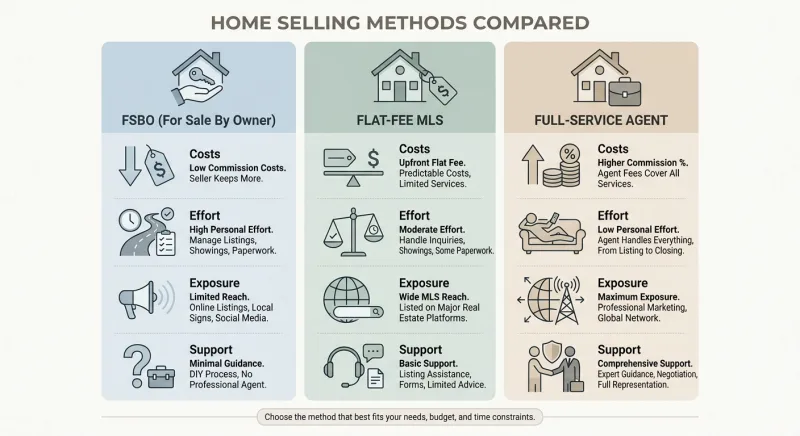
The question isn't can you. It's how much of the process you want to run yourself. There's a spectrum: pure DIY FSBO on one end, a full-service agent on the other, and a flat-fee MLS listing in the middle that gets your home on the MLS without the full commission.
If you've already got a buyer lined up, jump to Step 6.
Is FSBO Worth It in Tennessee?
The short answer: yes, if you get real market exposure and price the home right. The NAR reports that FSBO homes sold at a lower median price than agent-assisted homes — competitors love that stat. But it's skewed. It lumps together:
- Homes sold privately to relatives or friends at a family discount
- Homes in lower-value rural markets where FSBO is more common
- Homes never listed on the MLS at all
Once a FSBO home gets full MLS exposure, the pricing gap narrows sharply. The "FSBO discount" is mostly a "no-exposure discount." On a $400,000 sale, keeping the listing commission is roughly $10,000–$12,000. A flat-fee MLS listing costs a few hundred dollars. If getting on the MLS closes most of the pricing gap, the DIY route wins clearly.
Where FSBO is genuinely harder
- Buyer-agent commission decisions. You'll decide what, if anything, to offer a buyer's agent (Step 5).
- Showings and scheduling. You're the one coordinating and being available.
- Contingencies and appraisal gaps. When an offer comes in below appraisal or an inspection surfaces problems, you negotiate it yourself.
- Paperwork discipline. Missing a required disclosure creates real liability.
None of these are beyond a motivated seller. If exposure is your only real worry, flat-fee MLS solves it for a flat cost.
Step 1: Price Your Tennessee Home Accurately
What this is: Setting a listing price based on real comparable sales, not a guess or a Zillow estimate.
Start with comps — recently sold homes, not active listings — that match yours on the things buyers pay for:
- Location and neighborhood (same subdivision is ideal)
- Square footage, within roughly 10%
- Bedroom and bathroom count
- Lot size, age, and condition
- Sold within the last 3–6 months
Pull sold prices, then adjust for differences. A comp with a finished basement yours doesn't have should nudge your number down; a comp on a busy road should nudge it up.
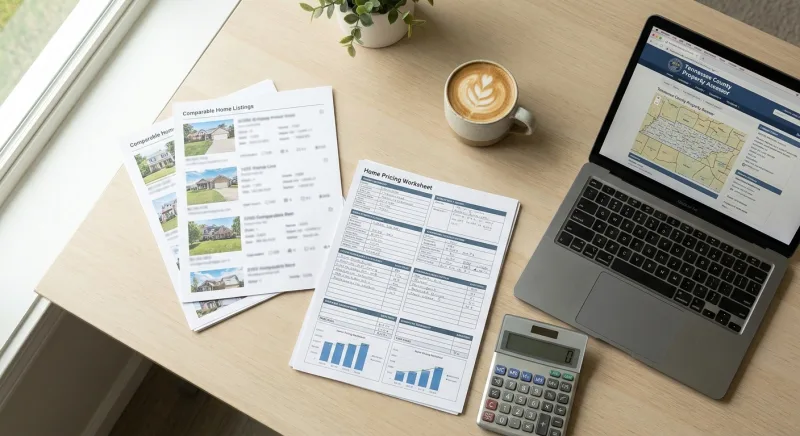
Your County Property Assessor publishes property records and assessed values online, county by county. Davidson, Williamson, Shelby, Knox, Hamilton, and Rutherford counties all have searchable databases. For actual sale prices, the MLS is the cleanest source. Public sites like Zillow and Redfin approximate it but lag on data.
Also watch days on market (DOM). If comparable homes are selling in a week, you have room to price at the top of the range. If they're sitting 60 days, price to move.
Next action: Build a one-page pricing worksheet with 3–5 sold comps, your adjustments, and a target range. Set your list price at the top of what the comps defensibly support.
Step 2: Prep the Home and Complete Required Tennessee Disclosures
What this is: Getting the house show-ready and completing the seller disclosures Tennessee law requires.
Prep first: declutter, deep clean, handle obvious repairs, boost curb appeal, and take good photos in daylight. Buyers form an opinion in the first ten seconds of scrolling.
What disclosures are required to sell a house by owner in Tennessee?
Tennessee law requires most sellers to give buyers a completed Residential Property Condition Disclosure (Form RF 201) under the Residential Property Disclosure Act, T.C.A. Title 66, Chapter 5. On this form you disclose known conditions and defects — roof, foundation, systems, water intrusion, past repairs, and more.
If you qualify for a legal exemption (such as an estate sale or an inherited property you've never occupied), you can use the Exemption Notification (Form RF 203) instead. If a buyer waives their right to the full disclosure, use the Disclaimer Statement (Form RF 204). Use RF 203 only when it honestly applies — it is not a shortcut to avoid disclosing things you actually know.
One misconception worth killing: selling "as-is" does not switch off disclosure. It means you won't make repairs; it does not mean you can hide a known leaking foundation. A known material defect must still go on RF 201 regardless of an as-is clause.
The septic bedroom nuance most guides miss
Say your house has four bedrooms but your septic permit was issued for three. Under the Tennessee Consumer Protection Act, T.C.A. § 47-18-104(b), knowingly advertising a residence as having more bedrooms than the septic system permits is a deceptive practice. The mechanism that bites: the buyer's lender orders an appraisal, the appraiser or inspector pulls the TDEC septic permit, and the bedroom count doesn't match. Now your listing is legally overstated and the financing wobbles.
Next action: Download Form RF 201, complete it accurately, and set it aside for serious buyers. If the home isn't on public sewer, pull your TDEC septic permit now and confirm the permitted bedroom count before you write "4BR" anywhere.
Step 3: List on the MLS (The Exposure Problem, Solved)
What this is: Getting your home onto the Multiple Listing Service so buyers and their agents can find it.
Roughly 90% of active buyers work with an agent, and those agents search the MLS. If you're not on it, most of your market never sees your home. A flat-fee MLS listing service puts your home on the local MLS for a one-time flat cost. Your listing then syndicates to Zillow, Realtor.com, Redfin, and the rest — exactly like an agent-listed home. You keep control and the listing commission.
Which MLS covers my Tennessee city?
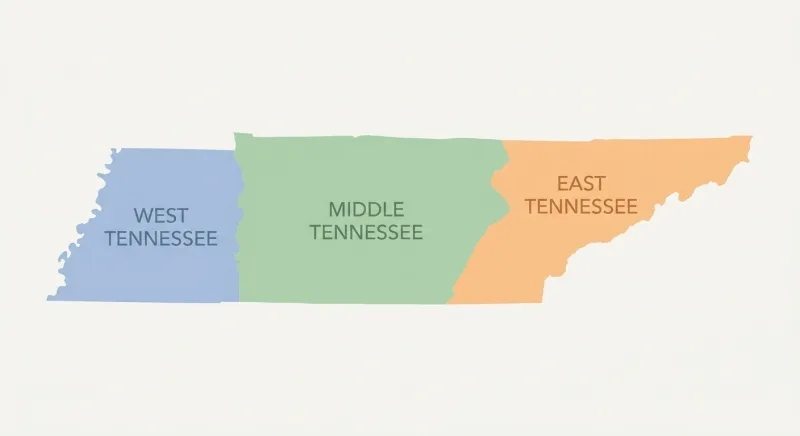
Tennessee isn't one MLS. Coverage is regional:
| Region | MLS | Covers cities like |
|---|---|---|
| Middle TN | RealTracs | Nashville, Franklin, Murfreesboro, Brentwood, Clarksville |
| East TN | East Tennessee Realtors (KAAR) | Knoxville and surrounding East TN |
| West TN | MAAR | Memphis and West TN |
| Southeast TN | Chattanooga-area association | Chattanooga |
A flat-fee service handles getting you into the correct regional MLS for your address.
Next action: List on the MLS for a flat fee with the service that covers your region, then move on to marketing.
Step 4: Market and Show the Home
What this is: Once you're syndicated, driving traffic and running showings yourself.
The MLS does the heavy lifting on reach. Your job is presentation and responsiveness. Two things quietly cost well-exposed FSBO sellers money here:
Overpricing to "test the market." Your listing gets maximum attention in the first 7–10 days, when the algorithm pushes it to saved-search buyers. Price 8% high and you burn that window. By the time you cut, your days-on-market number negotiates against you — buyers read a stale listing as "something's wrong." A price drop three weeks in nets less than a correct price on day one.
Slow or emotional response to offers. Sellers who take 48 hours to counter, or who counter with a bruised ego instead of a number, lose deals an indifferent third party would have saved. Reply fast. Keep it about the number.
Step 5: Decide How You'll Handle the Buyer-Agent Commission
What this is: Setting your approach to buyer-side compensation before offers arrive — which changed under the 2024 NAR settlement.
The August 2024 NAR settlement changed where buyer-agent commission gets negotiated. It can no longer be advertised as a field inside the MLS listing. Buyers now sign a written representation agreement with their agent before touring, stating what the agent expects to be paid. When their agent writes an offer, the request for you to cover part or all of that fee comes in the purchase agreement — a term you accept, counter, or decline.
Three ways sellers handle the fee now
Option 1 — Offer a stated amount up front. You can't post it in the MLS field, but you can note it in public remarks or tell agents who ask. Signaling "seller will consider 2.5% to buyer's agent" keeps agent-represented buyers flowing. Lowest-effort path; mimics the old system.
Option 2 — Stay silent and negotiate per offer. Say nothing about buyer-side compensation. Treat any commission request as one line item among many. On a strong offer you might cover it; on a thin one you counter it back to the buyer, who owes their own agent per their signed agreement. This is where post-settlement FSBO sellers keep the most money.
Option 3 — Net-price the deal. Negotiate the number that lands in your pocket rather than arguing about who pays the agent. One trap: if the fee gets baked into the price so it's financed, that inflated price has to appraise. The clean workaround is to keep the purchase price at true market value and address the commission as a seller-paid closing cost credit in the purchase agreement. Same dollars to you, but it doesn't fight the appraisal.
Step 6: Negotiate Offers and Contingencies Like a Third Party
What this is: Reading offers coldly and working the contingency clocks.
The inspection contingency: repair vs. credit
When the buyer's inspection turns up issues, default to credits, not repairs. A $3,000 credit costs you $3,000. Agreeing to "fix the HVAC" costs you $3,000 plus a week of coordination plus the risk the buyer disputes the workmanship at final walkthrough. Know the difference between a request and a demand, too — a standard inspection contingency lets the buyer walk for almost any reason within the window.
The appraisal gap: who eats the difference
If your $400,000 accepted offer appraises at $385,000, the lender only finances against $385,000. Somebody covers the $15,000: the buyer brings extra cash, you drop to the appraised value, or you split it. A buyer who waived the appraisal contingency has already agreed to cover the gap — read the offer for that clause before you assume you're stuck.
The financing contingency clock
Watch the loan-approval date in the purchase agreement. If the buyer's financing date passes without a firm commitment, you have grounds to demand proof or move on — but only if you calendared the date. Sellers who don't track it lose weeks to a buyer who was never actually approved.
Step 7: Close at a Tennessee Title Company
Because Tennessee is a title-company closing state, you don't need an attorney. The title company runs the title search, coordinates with the buyer's lender, prepares closing documents, and handles the money. Your seller-side closing costs: the realty transfer tax of $0.37 per $100 of value (T.C.A. § 67-4-409) — roughly $740 on a $200,000 sale — plus title/escrow fees, any prorated property taxes, and payoff of your existing mortgage. There's no listing-agent commission line, which is the whole point.
A Decision Framework: Pure FSBO, Flat-Fee MLS, or Full Service?
Run your situation through three questions:
1. Do you already have a buyer? Pure FSBO plus a title company is the cheapest correct answer.
2. Do you need the roughly 90% of buyers who search the MLS? If you're selling on the open market, the honest answer is yes — a yard sign plus a Zillow FSBO post won't reach agent-represented buyers the way the MLS does. Flat-fee MLS closes that gap without a percentage commission.
3. How much offer-and-contract work do you want to do? FSBO means you field calls, run showings, evaluate offers, and manage contingencies yourself. If that's fine, keep the commission.
- Buyer in hand → pure FSBO + title company.
- Open market, comfortable with the legwork → flat-fee MLS gives you full exposure without the commission.
- Open market, want exposure but hate paperwork → flat-fee MLS still fits; lean on the title company for closing mechanics.
The mistake is treating "I don't want to do everything myself" as a reason to give up the entire listing commission. On a $400,000 home, the listing side alone is roughly $10,000–$12,000 — a lot to pay for a problem flat-fee MLS solves for a few hundred dollars.
The 2026 Reality Most FSBO Guides Haven't Updated For
Most FSBO guides still circulating were written before August 2024. Before the settlement, the buyer-agent commission was baked in and semi-invisible. Now it's an explicit line item you negotiate deal by deal. Some buyers come with no agent at all. Some agree to cover their own agent's fee. When a buyer's agent does ask you to contribute, that's a conversation, not a foregone 3%.
Guides that tell you to "just offer 3% to the buyer's agent like everyone does" are describing a market that no longer exists. You now have to understand the negotiation instead of coasting on convention — but it's work that used to be hidden inside a commission you couldn't touch, and now it's yours to win.
Frequently Asked Questions
Can you sell a house by owner in Tennessee?
Yes. Tennessee has no law requiring you to hire a real estate agent, and because Tennessee is a title-company closing state, you don't need an attorney to close either. A licensed title/escrow company manages the paperwork and funds at closing.
What disclosures are required to sell a house by owner in Tennessee?
Most sellers must complete the Residential Property Condition Disclosure (Form RF 201) under the Residential Property Disclosure Act, T.C.A. Title 66, Chapter 5. If you qualify for a limited exemption, you may use the Exemption Notification (Form RF 203) instead, or the Disclaimer Statement (Form RF 204) if the buyer has waived their right to the full disclosure. These requirements apply whether or not you use an agent.
Do FSBO sellers have to pay the buyer's agent in Tennessee in 2026?
No, it's negotiable. Under the NAR settlement that took effect in August 2024, buyer-agent commissions can no longer be advertised on the MLS and are negotiated separately in the offer. Many FSBO sellers still offer a buyer-agent commission (often 2–3%) to attract agent-represented buyers, but you decide.
What are seller closing costs for a FSBO sale in Tennessee?
Expect the realty transfer tax of $0.37 per $100 of value (T.C.A. § 67-4-409) — roughly $740 on a $200,000 sale — plus title/escrow fees, any prorated property taxes, and payoff of your existing mortgage. Skipping a full-service listing agent saves the 2.5–3% listing commission.
Which MLS covers my Tennessee city?
Tennessee is served by regional MLSs: RealTracs covers Middle Tennessee including Nashville, Franklin, and Murfreesboro; East Tennessee Realtors (KAAR) covers the Knoxville region; and MAAR covers the Memphis area. A flat-fee MLS service lists your home on the MLS that matches your county.
Is FSBO worth it in Tennessee?
It depends on how much exposure your home gets. NAR data shows FSBO homes sell at a lower median price than agent-assisted homes, but that figure includes off-market sales to relatives and homes never listed on the MLS. Once a FSBO listing gets full MLS exposure, the gap narrows sharply.
Conclusion
Selling for sale by owner in Tennessee is a real, achievable path. Price it against real comps. Complete your disclosures correctly — Form RF 201 isn't optional. Get your home in front of buyers. Read offers carefully, decide up front how you'll handle the buyer-agent commission now that it's negotiated separately, and let a Tennessee title company carry the closing across the line.
The hardest part of FSBO was never the paperwork. It was exposure. The moment your listing hits the MLS that covers your county — RealTracs, KAAR, or MAAR — you're competing on the same shelf as agent-listed homes. That's exactly the gap a flat-fee MLS listing closes. You keep control, keep the listing commission, and still get full MLS exposure.
Pull your comps this week, gather your disclosure forms, and when you're ready to be seen, list on the MLS for a flat fee in your Tennessee city. The roadmap is yours now. So is the equity you protect.