
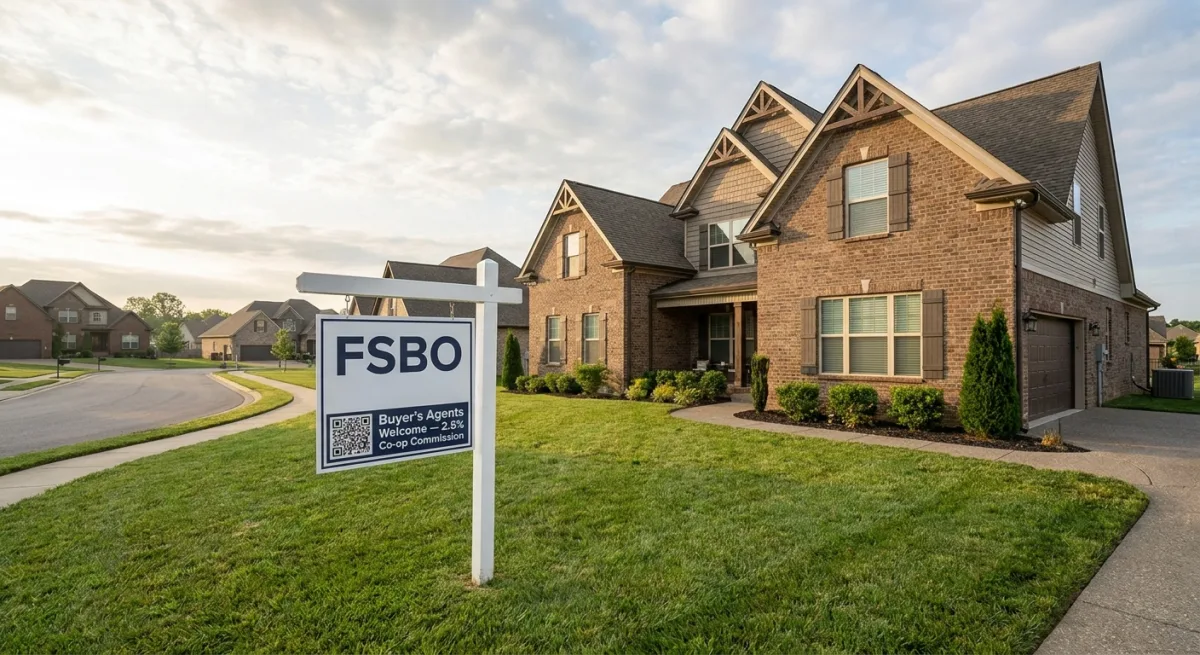
If you want to advertise buyer agent commission off-MLS in Middle Tennessee, here's the short version: it's legal, it's common, and it's the single marketing move most FSBO and flat-fee sellers get wrong. Since the NAR settlement took effect on August 17, 2024, the MLS can no longer carry an offer of buyer-agent compensation. But that offer never left the table. It just moved off the MLS — onto your yard sign, your flyer, and your single-property page, where it's fully permitted.
We run a Middle Tennessee flat-fee listing service, and we see this confusion on Realtracs listings every week. Sellers assume "no commission field" means "no way to pay a buyer's agent." That's not what changed. What changed is where and how you're allowed to say it — and the Realtracs rules are stricter than most sellers realize.
Last reviewed: July 2026. This is educational information from a Tennessee flat-fee listing service — not legal, tax, or lending advice. Confirm anything below with a licensed Tennessee real estate attorney, broker, and your lender.
Advertising Buyer Agent Commission Off-MLS: The Quick Answer
Yes. You can legally advertise a buyer's agent commission off the MLS in Tennessee — on yard signs, flyers, and a single-property website. The NAR settlement bans compensation offers inside the MLS. Every channel outside Realtracs remains fair game.
The commission field disappeared from Realtracs, not from real estate. If a buyer's agent brings you a buyer, you can still pay that agent. You just advertise the offer somewhere other than the MLS, then document it correctly in the contract.
The rest of this guide shows the how: exact yard-sign wording, a compliant flyer layout, a single-property page blueprint, the Tennessee forms that document the deal, and the one lending rule most sellers never hear about until closing.
What the NAR Settlement Changed for Buyer Commission Advertising
As of August 17, 2024, the NAR settlement prohibits offers of buyer-agent compensation from appearing anywhere in the MLS. It does not prohibit offering or paying that compensation. Off-MLS advertising stays fully legal in Tennessee.
Two things changed at once, and people blur them together.
First, the advertising channel narrowed. Before the settlement, a seller's cooperative offer lived right in the Realtracs listing where every agent saw it automatically. That field is gone. You now carry the message yourself.
Second, buyer's agents can no longer show a home without a written buyer representation agreement in place first. In Tennessee that's typically the Tennessee REALTORS® Buyer Representation Agreement, Form RF141. What this means for you: the agent walking a buyer through your door already has a signed contract spelling out what that agent expects to be paid. If your co-op offer doesn't cover it, the buyer has to.
The rule most people miss: offering a buyer-agent commission was never made illegal. Only the MLS as a broadcast tool for that offer was taken off the table.
Your job is simple to state and easy to get wrong. Advertise the co-op off-MLS, make sure buyer's agents actually see it, and write it into the purchase contract cleanly. Do those three things and you keep the same agent cooperation you always had — you're just holding the megaphone now.
Realtracs Commission Advertising Rules: What You Can and Can't Say
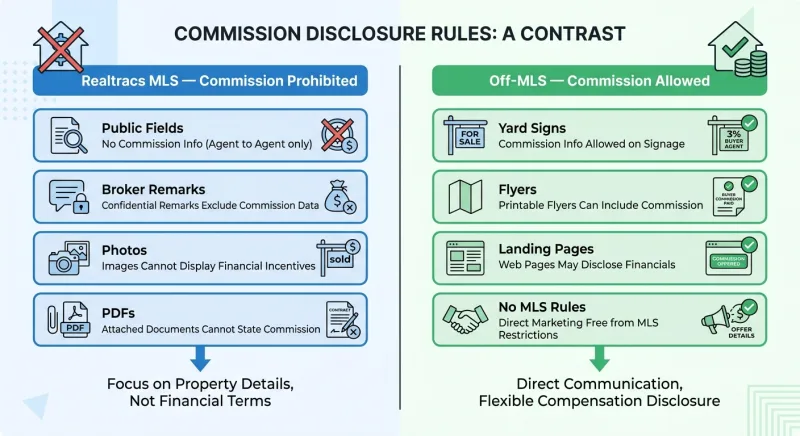
Realtracs prohibits any mention of buyer-agent compensation in the listing itself — public data fields, agent/broker remarks, photos, and uploaded documents. You can advertise the same offer freely off the platform.
Realtracs generally does not allow buyer-commission language in:
- Public-facing data fields — the structured details that syndicate to Zillow, Realtor.com, and Redfin.
- Broker/agent remarks — the private notes other agents read.
- Photos — no yard-sign shots showing a rate.
- Uploaded PDFs and attachments — flyers or documents stating a commission.
Where sellers trip up: they assume the "agent-only" remarks are private enough to slip a number in. They're still inside the MLS. Same rule applies.
Realtracs policy has shifted more than once since the settlement. Confirm the current Rules & Regulations handbook before you rely on any specific field name here.
How to Advertise Buyer Agent Commission on Yard Signs
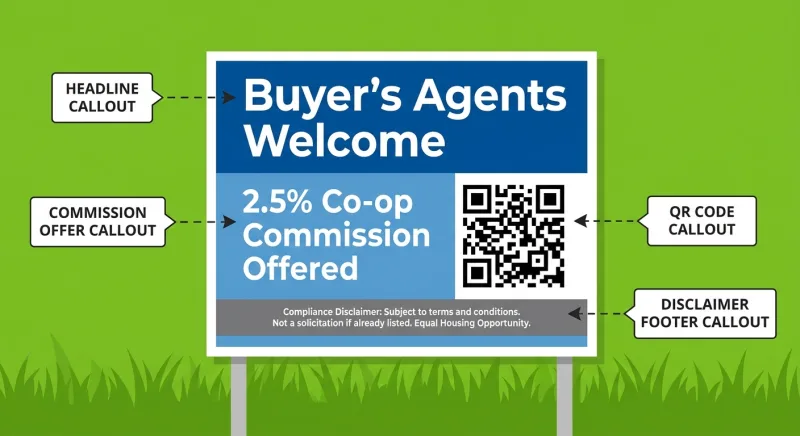
Put the co-op offer on a yard-sign rider — a small add-on panel below your main sign. A yard sign sits on your private property, outside the MLS, so a stated buyer-agent commission is completely legal in Tennessee.
A rider that reads clean and stays honest:
BUYER'S AGENTS WELCOME 2.5% Co-Op Commission Offered Details & terms: [QR code] · [phone]
That rate is an example — you set your own. The QR code routes agents and buyers to your single-property page, where full terms and the disclaimer live. Add a small footer: "Commission subject to written agreement at closing."
One caveat: a yard sign only reaches people who physically drive past. Pair it with a flat-fee MLS listing so the property syndicates everywhere while the sign carries the commission message the MLS no longer can.
Flyer & QR-Code Templates With Built-In Disclaimers
A printed flyer can state your buyer-agent commission because it's distributed off-MLS. Include the rate, a QR code to your single-property page, and a one-line disclaimer that the offer is subject to a written agreement.
A compliant flyer carries:
- A headline agents notice fast: "2.5% Co-Op to Buyer's Agents."
- Property basics — beds, baths, square footage, price.
- A QR code linking to the single-property page.
- Direct contact for the seller.
- A footer disclaimer: "Buyer-agent compensation is offered outside the MLS and confirmed in the purchase and sale agreement. This flyer is not an offer of representation."
Where sellers trip up: they print one master flyer, then attach that exact file to their MLS listing to "save time." That drops a prohibited commission mention straight into Realtracs. Keep two versions — one with the co-op for off-MLS handouts, one clean for anything that touches the MLS.
Building a Single-Property Landing Page for Buyer Agent Commission
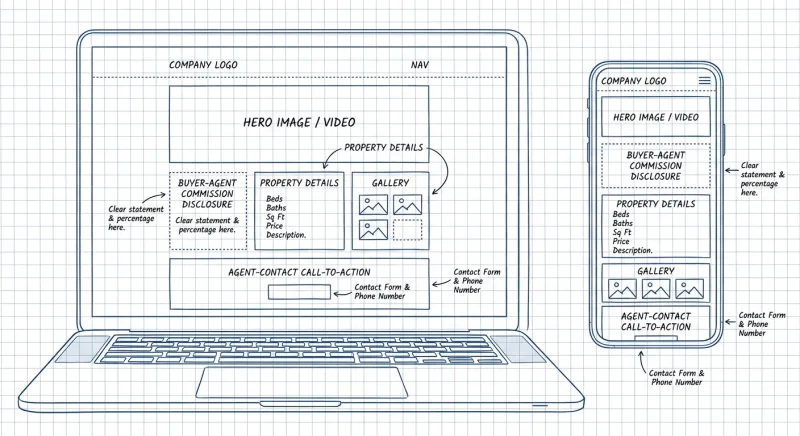
A single-property website is a standalone page for one home that publicly states your buyer-agent commission, hosts photos and details, and gives agents a direct contact path. Because it lives on your own domain — not Realtracs — the disclosure is fully legal.
Build it top to bottom:
The co-op disclosure goes high, stated plainly: the commission offered, plus a note that terms are finalized in the purchase contract. Don't bury it — that's why the agent scanned the code.
Below that, the property itself — a full photo gallery, address, price, square footage, and the details an agent needs to decide on a showing.
Then a direct-to-agent CTA: a form or phone line for showing access and commission terms. This is where the RF141-holding agent starts the conversation.
A short disclaimer at the bottom mirrors the flyer. Build it on Carrd, WordPress, or any single-property tool. Keeping the commission language off Realtracs and on your own URL is the part that matters.
Sequencing who learns the commission, and when
Off-MLS advertising isn't one broadcast — it's a ladder with a different compliance profile at each rung.
Tier 1 — public broadcast (yard sign, flyer). Your widest net, lowest control. Keep the number clean and the disclaimer present.
Tier 2 — gated broadcast (single-property site). The agent has to scan, click, and land before terms appear. That gate timestamps when an agent viewed your offer, so you're not locked into a stale number printed weeks ago.
Tier 3 — direct disclosure (agent calls you). Now you're one-to-one. Confirm the co-op and learn whether the agent has a signed RF141 with their buyer. A number that lives only on a public sign gives you zero record of who saw it. One behind a gated page gives you an audit trail — far stronger if a commission dispute surfaces at closing.
The Documentation Chain: RF141 → RF401
Buyer-agent commission gets documented in the purchase and sale agreement — Tennessee REALTORS® Form RF401 — once a buyer's agent responds to your off-MLS offer. The advertised rate becomes a written, enforceable term, not a verbal promise.
A buyer's agent sees your co-op on the sign, flyer, or page. That agent already holds a signed RF141, so their compensation expectation is set before the first showing. Your advertisement is an invitation to discuss — a conversation-starter with zero binding force, which protects you. You're not locked into a number until it's in the contract.
When the buyer writes an offer, the agent uses RF401 to memorialize the deal — including how the commission is paid. Related forms such as RF201 may apply; your closing professional will confirm. Your marketing advertises, your contract obligates.
Reminder: this is educational, not legal advice. Have a Tennessee attorney or your broker review contract language before you sign.
The Double-Bucket Rule: Commission vs. Concessions and IPC Limits
Buyer-agent commission and seller concessions are two separate buckets. Write the commission as a seller-paid commission, not a concession, and it generally won't count against the buyer's Interested Party Contribution (IPC) cap on closing-cost help.
Lenders limit how much a seller can contribute toward a buyer's closing costs. On a conventional loan, Fannie Mae's Selling Guide caps interested-party contributions at, for example, 3% for LTV ratios above 90% on primary residences. A commission paid to a licensed broker is not an IPC. A concession toward closing costs or a rate buydown is.
| Bucket | What it covers | Counts against IPC cap? |
|---|---|---|
| Bucket 1 — BAC | Commission to the buyer's brokerage | No |
| Bucket 2 — Concession | Closing costs, prepaids, discount points | Yes (limited by loan type/LTV) |
The failure mode: the settlement statement characterizes your co-op as a concession rather than a seller-paid commission. If the buyer is also asking for closing-cost help, mislabeling the co-op can push the combined figure over the IPC ceiling — and the underwriter forces a re-cut days before closing.
Tell your closing attorney early to keep two separate lines on the settlement statement: a buyer-agent commission line and a concession/credit line. IPC rules vary across Fannie Mae, Freddie Mac, FHA, and VA loans and they change — have the buyer's lender confirm treatment in writing before closing.
A Few Edge Cases That Break the Simple Advice
The unrepresented buyer. No agent means no co-op to pay. Offering to "credit them the commission" isn't a commission — it's a price reduction or concession landing in bucket two. Say it plainly: no agent, no agent commission; discuss price directly.
The agent who wants their full RF141 fee. Your sign says 2.5%; their agreement with the buyer says 3%. That gap is the buyer's or agent's problem to resolve. The RF401 — not the buyer agreement you never signed — governs what you pay.
New construction. Same off-MLS rules apply, but builder-paid compensation can interact with appraisal and IPC scrutiny differently than resale. Confirm with the lender before you print anything.
Middle Tennessee Commission Math
| Submarket | Example price | 2.0% co-op | 2.5% co-op | 3.0% co-op |
|---|---|---|---|---|
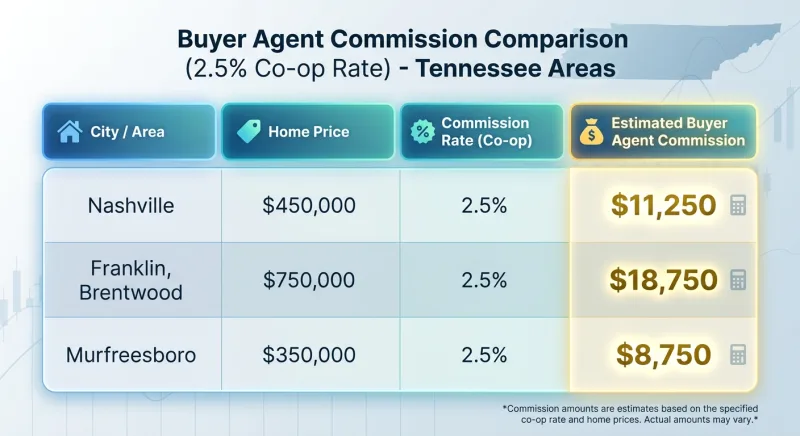
| Nashville | $450,000 | $9,000 | $11,250 | $13,500 |
| Murfreesboro | $425,000 | $8,500 | $10,625 | $12,750 |
| Franklin | $700,000 | $14,000 | $17,500 | $21,000 |
| Brentwood | $750,000 | $15,000 | $18,750 | $22,500 |
In higher-tier markets like Franklin and Brentwood, a half-point difference is thousands of dollars — enough to matter to the agent deciding whether to prioritize your showing, and to your bottom line. Price it competitively enough to attract agents without overpaying. Check current Greater Nashville REALTORS® / Realtracs data for your submarket before setting a rate.
Reach Reality: Pairing Off-MLS With a Flat-Fee Listing
When compensation lived in an MLS field, every regional agent saw it passively the instant they pulled your listing. Off-MLS, they only see it if they encounter your specific channel. That's fewer eyes. The MLS was doing two jobs: exposure (getting your home in front of buyers) and compensation signaling (telling agents what they'd earn). The settlement only killed the second job. Split them.
| Channel | Agent reach | Can it carry BAC? |
|---|---|---|
| MLS compensation field | Region-wide, passive | No (banned Aug 17, 2024) |
| Flat-fee MLS syndication | Zillow/Realtor.com/Redfin buyers | No — exposure only |
| Yard sign + rider | Drive-by + local | Yes |
| Flyer + QR | In-person + scan | Yes |
| Single-property page | Anyone you route there | Yes (best placement) |
A flat-fee MLS listing puts your home on Realtracs — syndicating to Zillow, Realtor.com, and Redfin — with no commission language (it can't). Your sign, flyer, and single-property page carry the co-op the MLS no longer will, gated and timestamped. Maximum property exposure through the MLS. Full commission control through your off-MLS assets. Neither steps on the other's rules.
That's the setup we help Middle Tennessee sellers build. If you're in Nashville, Franklin, Brentwood, Murfreesboro, Spring Hill, or Columbia, that combination is the practical next step.
Frequently Asked Questions
Is it legal to put buyer agent commission on a yard sign in Tennessee?
Yes. A yard sign sits on your private property, outside the MLS. The NAR settlement (effective August 17, 2024) only bans compensation offers inside the MLS, so a stated buyer-agent commission on a sign or rider is legal in Tennessee.
How do I handle post-NAR-settlement buyer commission as a Tennessee FSBO seller?
Advertise it off-MLS — yard signs, flyers, and a single-property website — then document the offer in the purchase contract (Form RF401) once an agent's buyer submits an offer. The buyer's agent also needs a signed written representation agreement (RF141) before showings.
Do I need a private landing page for buyer agent commission?
You don't need one, but it's the strongest off-MLS tool. A single-property landing page on your own domain legally states your commission, hosts full property details, and gives buyer's agents a direct contact path — and it's where your sign and flyer QR codes send everyone. Keep the offer off any Realtracs-syndicated field.
What do the Realtracs commission advertising rules prohibit?
Realtracs prohibits buyer-agent compensation in public data fields, broker/agent remarks, photos, and uploaded PDFs — anywhere inside the MLS. The same offer is allowed off-platform. Confirm the current Realtracs Rules & Regulations handbook, since policy has changed since the settlement.
Does buyer-agent commission reduce how much I can help with closing costs?
It can, if written as a concession. Keep it in a separate bucket as seller-paid commission and it generally stays outside the buyer's IPC cap (for example, 3% for conventional loans with LTV above 90% per Fannie Mae). Confirm treatment with the buyer's lender.
How much is a 2.5% buyer-agent commission on a Middle Tennessee home?
At 2.5%, a ~$450,000 Nashville home means about $11,250; a ~$750,000 Brentwood home means roughly $18,750. The rate you advertise is entirely your choice.
The settlement didn't take away your ability to attract buyer's agents. It moved where you advertise the commission. Off the MLS is legal. Inside Realtracs isn't.
Start with the yard-sign rider and a single-property page. Set your rate, state it plainly, add the disclaimer. When an agent responds, confirm their RF141, document the commission in the RF401 in its own bucket, and run the structure past your lender before closing.
This is educational information, not legal, tax, or lending advice — consult a licensed Tennessee real estate attorney, broker, and your lender, and verify current Realtracs rules before you rely on them.
Last reviewed: July 2026.