

Local Attorney-Backed Flat-Fee MLS vs Out-of-State Tech Platforms in Tennessee: Which Handles Closing Better?
Both models do the same job for about ten days. They get your home on the MLS, syndicate it to Zillow and Realtor.com, and hand you a dashboard. That part is nearly identical.
Then an offer comes in. That's where the two roads split hard.
Here's what nobody tells you when comparing an attorney-backed flat-fee MLS vs a tech platform in Tennessee: a mispriced listing costs you a little; a mishandled closing — bad earnest-money escrow, the wrong contract form, a title snag no one catches — can cost you the whole sale. Tennessee runs its closings through title companies and closing attorneys, on TREC-approved paperwork, under state trust-account rules. National platforms like Houzeo, ListWithFreedom, and Homecoin are built for all fifty states, so they lean on automated boilerplate and leave closing mechanics to you.
The listing was the easy part. The closing table is where money gets lost.
Quick Verdict: Which Model Wins in Tennessee?
The short answer: If you want raw MLS exposure and nothing else — and you already know how a Tennessee closing works — an out-of-state tech platform is a fine, cheaper tool. If you want someone who understands TREC forms, earnest-money escrow rules, and how closings run county-to-county here, a local attorney-backed flat-fee MLS handles the part that carries real risk.
Choose a local attorney-backed flat-fee MLS if you:
- Are a first-time or infrequent seller unsure who prepares the contract or holds earnest money
- Want live, same-region help when a closing-day problem surfaces
- Need your earnest money in a compliant escrow account
An out-of-state tech platform is the right call if you:
- Are an experienced investor with a closing attorney already on retainer
- Are ultra price-sensitive and comfortable managing the transaction yourself
- Just need the listing syndicated and nothing more
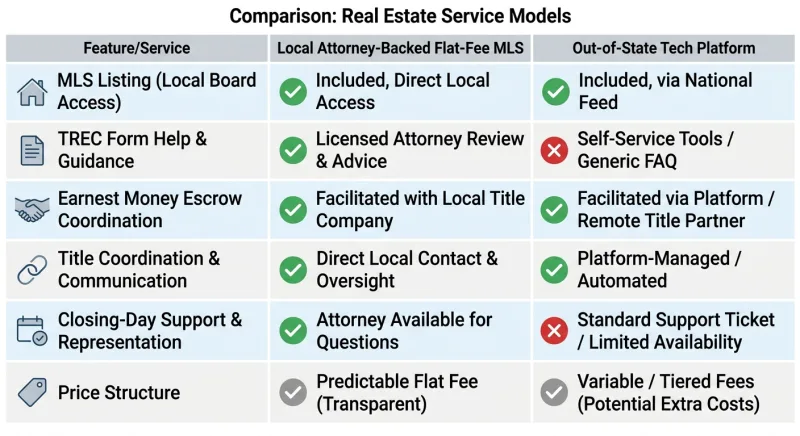
Side-by-Side Comparison
| Feature | Local Attorney-Backed Flat-Fee MLS | Out-of-State Tech Platform (Houzeo, ListWithFreedom, Homecoin) |
|---|---|---|
| MLS syndication | ✅ Local Tennessee MLS + major portals | ✅ Local MLS + major portals |
| Who prepares TREC forms (RF401, RF707) | ✅ Local guidance on Tennessee REALTORS® forms | ⚠️ Self-serve templates/eSign; seller completes forms alone (per platforms' how-it-works pages, as of [OWNER: verify month/year]) |
| Earnest-money handling | ✅ Coordinated into a licensed escrow account per Tenn. Comp. R. & Regs. 1260-02-.09 | ❌ Platform does not hold funds; seller must find a third-party escrow holder |
| Title/escrow coordination | ✅ Works directly with TN title companies & closing attorneys | ❌ Left to the seller |
| Closing-day support | ✅ Live, in-state problem-solving | ⚠️ Ticket/email support; not TN-transaction specific |
| Tennessee legal compliance | ✅ Built around TREC rules & TN closing custom | ⚠️ National boilerplate; not TN-tailored |
| Price range | [OWNER PLACEHOLDER: real TN price range as of month/year] | Low flat fee, tiered add-ons (per each platform's pricing page, as of [OWNER: verify month/year]) |
The low sticker price covers the listing, not the closing. The riskiest work is the part they hand back to you.
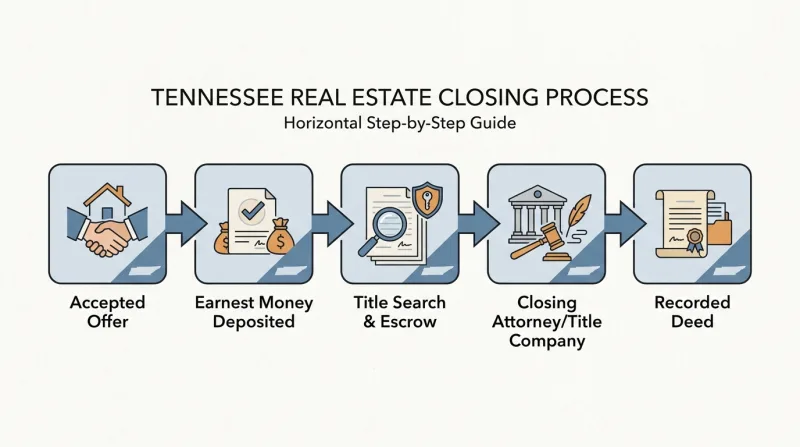
How Tennessee Closings Actually Work
Tennessee is a title-and-attorney-driven closing state. The law doesn't require an attorney, but the closing itself almost always runs through a title company or closing attorney who prepares the deed, clears title, and disburses funds.
Typical path once an offer is accepted:
- Accepted offer — buyer and seller sign the purchase and sale agreement (typically the RF401 published by Tennessee REALTORS®).
- Earnest money deposited — into a neutral escrow account.
- Title search & escrow — the title company or closing attorney searches the chain of title, resolves liens, and orders title insurance.
- Closing — closing attorney or title company prepares the deed and settlement statement; funds disburse.
- Recorded deed — filed with the county Register of Deeds.
A national platform can put your listing online, but it isn't preparing your deed, searching your title, or scheduling your closing. Sellers assume the flat-fee platform "handles closing" because it handled the listing. It doesn't. That gap is where delays start.
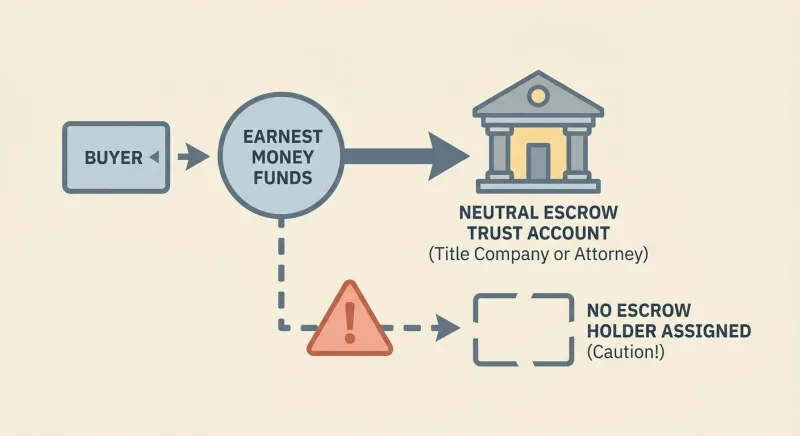
Who Holds the Earnest Money in a Tennessee FSBO Sale?
Earnest money must sit in a neutral escrow account — a licensed broker's trust account or a closing attorney's/title company's escrow account — never directly with the seller. Under Tenn. Comp. R. & Regs. 1260-02-.09, funds handled by a licensed broker must be held in a designated trust account, separate from operating money.
A national syndicator isn't acting as your broker — it's a listing service, outside the trust-account chain entirely. That leaves an unrepresented seller responsible for naming a compliant escrow holder before the buyer's deposit changes hands. If the deposit lands in the wrong place, you have no clean mechanism to release or refund it when a deal falls apart.
The wire-fraud edge case nobody flags: when no escrow holder is assigned early, wire instructions get improvised over email between two unrepresented parties. That's exactly the gap fraudsters exploit — a spoofed "updated wire instructions" email between offer and deposit. A closing attorney named in the RF401 closes that window before it opens. Platforms' terms typically disclaim responsibility for funds they never touch, so the liability for a mishandled deposit lands on you.
TREC Contract Forms: Who Fills Out RF401 and RF707?
In most Tennessee transactions the contract is the RF401 Purchase & Sale Agreement; changes are documented on the RF707 Amendment — both published by Tennessee REALTORS®. On a tech platform, you complete these yourself. With a local attorney-backed model, you get guidance on which form applies and how it's completed.
Amendments are sequential and cumulative, which is where it gets tricky. Say a buyer requests a $4,000 repair credit and a five-day closing extension in one negotiation. If those get papered as two separate amendments with overlapping effective dates, or the extension doesn't reference the original inspection contingency deadline, you've created an ambiguity that title flags at closing. An automated template generates the form; it doesn't reconcile deadlines against the original RF401.
National platforms often provide generic template language that isn't the Tennessee-specific form buyers' agents expect. When a buyer's agent sends you an RF401 and you're holding a generic out-of-state PDF, you're negotiating in two different languages. A mismatched contract slows title work and can spook a buyer's lender.
Title Defects: The Tennessee-Specific Clearing Problem
Tennessee is a race-notice recording state, and title gets cleared through the county register of deeds where the property sits. Common defects that surface during the search:
- Unreleased deeds of trust — a prior mortgage paid off but never formally released; very common on homes that changed hands multiple times.
- Heir property / chain gaps — especially in rural counties, where an estate transferred informally.
- Contractor's or mechanic's liens — Tennessee gives certain unpaid contractors lien rights; a recent renovation can hide one.
When title surfaces an unreleased deed of trust, someone has to chase the prior lender's payoff department, obtain and record the release, and get the title company comfortable enough to insure. On the local attorney-backed path, the closing attorney runs that cure — routine work. On the tech-platform path, you're the project manager for a title cure you've never done, with a closing clock running and a buyer's rate lock expiring.
When an Out-of-State Tech Platform Is the Right Call
If you're an experienced investor who's closed a dozen Tennessee deals and already has a closing attorney on retainer, you need cheap MLS access, not hand-holding. Houzeo, ListWithFreedom, or Homecoin deliver exactly that. Same goes for the confident, self-managing seller who's read the RF401 front to back, knows their title company, and has escrow already lined up.
The honest test isn't "which is better" — it's "how much of the closing am I prepared to run myself?" If the answer is all of it, competently, the tech platform wins on price. If there's any part you're unsure about, the local model earns its fee at the closing table.
Cost Comparison: What You Really Pay Through Closing
Sticker price is the wrong number to shop on. Three lines never appear on the platform's checkout page:
Line 1 — The listing fee. What you pay to get on the MLS. National platforms usually win here.
Line 2 — Gap-filling costs. Services the platform doesn't include that you now pay for separately — sourcing an escrow holder, à-la-carte contract help, or hiring a Nashville flat fee real estate attorney mid-deal. Hourly fees add up fast.
Line 3 — The blow-up cost. Low-probability, high-severity: a mishandled deposit, a contract error that voids the sale, a closing-day delay that loses you the buyer. This line is $0 most of the time. When it isn't, it dwarfs everything above it.
| Cost element | Local Attorney-Backed | Tech Platform |
|---|---|---|
| MLS listing fee | [OWNER PLACEHOLDER: TN range, month/year] | Low flat fee (per platform pricing pages, as of [OWNER: verify]) |
| Contract/form help | Typically included | Add-on or self-serve |
| Escrow/title coordination | Coordinated | Self-arranged |
| Closing attorney/title fees | Standard TN closing costs apply | Standard TN closing costs apply |
Closing attorney and title fees apply to any Tennessee sale — both models pay them. The difference is who coordinates the work. A flat fee MLS with title escrow Tennessee built into the service can cost more upfront and less at the finish line because Lines 2 and 3 are already handled.
Local Coordination Isn't a Slogan — It's Geography
Closing custom varies by county. Who prepares the deed, whether a closing attorney or title company runs settlement, which firms local buyers' agents prefer — none of it is uniform, and a syndicator in another time zone has no line into it.
- Nashville & Franklin: fast-moving, heavily agented buyer pool; RF401 fluency and title-company coordination carry real weight.
- Memphis: closings frequently run through established title companies; coordinating the search early prevents last-minute surprises.
- Knoxville: its own preferred closing attorneys and Register of Deeds recording rhythms.
- Chattanooga: sellers on the Tennessee–Georgia border need extra care that the right state's process governs.
On closing day, the difference is measured in phone calls that get answered. The failure mode is a last-minute snag — a settlement figure that doesn't match the RF707 credit, a payoff that arrived $200 short, a signer who needs a mail-away notarization. Each is solvable in twenty minutes if someone with standing picks up the phone and coordinates the fix between buyer, title, and lender.
[OWNER PLACEHOLDER: brief real, non-fabricated example of local closing coordination across one of the four metros]
A Decision Framework: Match the Model to Your Deal
| Risk factor | Low-risk (tech may be fine) | High-risk (local attorney-backed pays off) |
|---|---|---|
| Title history | Bought recently; clean, insured title | Inherited, owner-financed, or renovated property |
| Buyer type | Cash or pre-approved conventional | FHA/VA, low down payment, or contingent-sale buyer |
| Your experience | You've closed FSBO deals before | First unrepresented sale |
| Escrow readiness | Closing attorney already retained | No escrow holder identified yet |
| County | Simple metro closing | Multi-county, rural register, or estate involvement |
Checking mostly the left column? A national syndicator's cheaper listing fee is genuinely good enough. Check two or more on the right, and the math flips. The few hundred dollars saved on the listing fee is a rounding error against one blown closing date or one uncured lien.
That's the real distinction underneath the whole attorney-backed flat fee MLS vs tech platform Tennessee question. Both get you on the MLS. Only one is still in the room when it counts.
Frequently Asked Questions
Do you need an attorney to close a real estate sale in Tennessee?
No — Tennessee doesn't legally require an attorney to close a residential sale, but attorney or title-company involvement is customary statewide. Most closings run through a closing attorney or title company that prepares the deed and coordinates funds. That "not required but customary" distinction is why local closing competence matters more here than the raw MLS listing.
Who holds the earnest money in a Tennessee FSBO transaction?
A neutral party authorized to hold trust funds — typically a licensed broker's or attorney's escrow account, governed by Tenn. Comp. R. & Regs. 1260-02-.09. Out-of-state tech platforms don't hold earnest money, so an unrepresented seller must arrange a third-party escrow holder (usually the closing attorney or title company) independently.
Is an attorney-backed flat-fee MLS worth it in Tennessee?
It's worth it if you value guided TREC paperwork, coordinated title/escrow, and live closing-day support over the lowest possible sticker price — which describes most first-time and infrequent sellers. If you're an experienced investor with a closing attorney already retained, a cheaper national platform may serve you just as well.
Can out-of-state tech platforms handle a Tennessee closing?
They handle the MLS listing, not the closing. Platforms like Houzeo, ListWithFreedom, and Homecoin act primarily as flat-fee listing services (per their own how-it-works pages, as of [OWNER: verify month/year]) — they don't hold escrow or provide hands-on local closing coordination. That contract-to-close gap is where TN sellers get stuck.
Which TREC forms do I need for a Tennessee home sale?
Most sales use the RF401 Purchase & Sale Agreement, with changes documented on the RF707 Amendment — both published by Tennessee REALTORS®. National automated templates don't map cleanly to these Tennessee-specific forms, which is where unrepresented sellers most often run into trouble.
How much does a flat-fee MLS with title and escrow coordination cost in Tennessee?
Pricing varies by provider and service level. [OWNER PLACEHOLDER: insert real price range and included title/escrow coordination details, as of month/year.] Always compare total cost through a completed closing, not just the listing fee, since escrow setup and paperwork fixes add up on the cheaper models.
Prices, form numbers, and rule citations should be verified and dated "as of [Month 2026]" before publishing. Every placeholder tag must be resolved with a verified primary source or genuine first-party detail before publication.