
Last updated: 2026. This guide is educational and not legal advice. Before you sign or counter anything, consult a Tennessee real estate attorney or your closing attorney.
A buyer's agent emails you a PDF. It's a Tennessee REALTORS® form, there's a line about "2.5%," and the message reads something like, "Here's the compensation my buyer's agreement requires — can the seller cover it?" You're selling for sale by owner, you never hired this agent, and suddenly you feel on the hook for $11,250.
You're not. Not automatically, anyway.
That form is the RF141 Exclusive Buyer Representation Agreement, and here's the part nobody explains clearly: it's a contract between the buyer and their broker. You're not a party to it. Whether you contribute a dime toward that fee is a decision you make during the purchase negotiation — not something the RF141 forces on you.
On the flat-fee listings we help set up across Middle and East Tennessee, most sellers overpay on buyer-agent concessions for one simple reason: they never counter. They treat the number on the RF141 as a bill. It isn't. This guide walks the rf141 buyer agent commission negotiation in Tennessee line by line — with real dollar math, the correct form sequence, and how to advertise any concession legally post-NAR.
What Is the RF141 Exclusive Buyer Representation Agreement?
The RF141 is Tennessee REALTORS®' standard contract that hires a buyer's agent and spells out what that agent gets paid — signed by the buyer and the buyer's broker, not the seller. It became the front-and-center document for buyers after the NAR settlement required written buyer-broker agreements before an agent shows homes.
Following the NAR settlement, whose practice changes took effect August 17, 2024 [Burnett/Sitzer, W.D. Missouri], buyers can no longer assume the seller's side will cover their agent. So the agent and buyer agree upfront, in writing, on a fee — often a flat dollar amount or a percentage like 2.5% or 3%. That's what the RF141 locks in.
The form, like all RF-series documents, is copyrighted by Tennessee REALTORS®. We won't reproduce it here — we'll describe how its paragraphs work.
In plain English: the RF141 is the buyer's problem to fund. The seller's job is to decide whether to help — and by how much.
RF141 vs. the forms it's often confused with
- Form RF161 (Single Showing Agreement) — a one-time, one-property version for a buyer who hasn't signed a full RF141.
- Form RF702 (Compensation Agreement) — a separate compensation arrangement some brokers use.
Don't let an agent tell you the RF141 "obligates the seller." It obligates the buyer.
Does a Tennessee FSBO Seller Have to Pay the Commission in a Buyer's RF141?
Short answer: No. A Tennessee FSBO or flat-fee seller has zero obligation to fund the buyer-agent fee listed on an RF141. The RF141 is a private contract binding only the buyer and their broker — you never signed it, so it can't make you pay anything. Per the Tennessee REALTORS® Exclusive Buyer Representation Agreement (Form RF141), the buyer agrees to pay their agent; any seller contribution is a separate, voluntary concession negotiated in the purchase agreement.
So when the agent's number is 2.5%, that's what the buyer owes their agent. Full stop.
Here's where sellers leave money on the table. They see "2.5%," assume it's the going rate, and roll it into the deal. But you can offer 1.5%. You can offer a flat $5,000. You can offer nothing and let the buyer fund their own agent.
The Paragraph E Shortfall Clause — Where the Real Math Lives
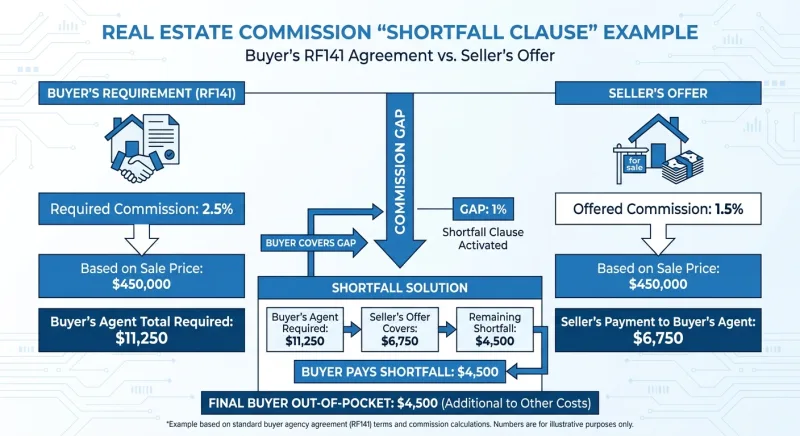
If the seller offers less than the fee the buyer's RF141 requires, the buyer is contractually bound to cover the difference out of pocket. That's the shortfall clause — the compensation/shortfall provision (Paragraph E on the current RF141). Confirm the paragraph and line numbers on your version, since Tennessee REALTORS® re-numbers forms on revision.
Most guides correctly tell you the RF141 is a private contract and you aren't a party to it — then stop there. The interesting part is what happens when your offer and the buyer's agreement don't match. The agent gets made whole either way; the question is just who funds the rest.
The dollar math (illustrative example, ~$450,000 Nashville-area home)
| Amount | |
|---|---|
| Sale price | $450,000 |
| Buyer-agent fee in the RF141 | 2.5% = $11,250 |
| What you choose to offer | 1.5% = $6,750 |
| The gap the buyer must cover | 1% = $4,500 |
That $4,500 doesn't vanish and doesn't bounce back to you. Under the shortfall provision, the buyer pays it — because the buyer signed a 2.5% agreement with their own broker. You didn't.
The Double Bucket Rule
Keep two buckets separate in your head, because conflating them costs real money.
Bucket 1 — your buyer-agent concession. Whatever you voluntarily offer toward the buyer's agent fee. Zero is a legitimate answer. So is 1%, 2%, or a flat figure. It's negotiable like anything else in the deal.
Bucket 2 — the loan's seller-concession cap. Every loan program limits total seller-paid costs — closing costs, prepaids, points, and buyer-agent help now compete for that same ceiling. Conventional, FHA, VA, and USDA each have different limits.
A buyer's agent will sometimes imply your concession is "capped" by loan rules or that the loan requires a certain amount. Neither is true. Bucket 1 is your choice; Bucket 2 is a limit the lender enforces. Ask which loan type the buyer is using before you name a figure — the cap tells you the real ceiling of the conversation.
This guide is educational and not legal advice. Tennessee REALTORS® holds the copyright on these forms, and the exact wording matters — consult a Tennessee real estate attorney or your closing attorney before you sign anything.
How the Money Actually Moves: The RF141 → RF401 → RF620 Form Sequence
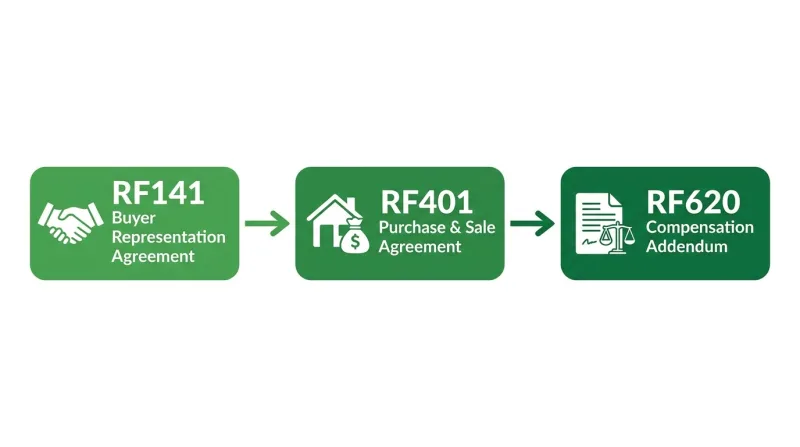
An off-MLS compensation offer doesn't magically appear on the closing statement. It travels through three Tennessee REALTORS® forms, each doing exactly one job.
| Form | Who signs it | What it does |
|---|---|---|
| RF141 (Exclusive Buyer Representation Agreement) | Buyer ↔ their broker | Sets the fee the buyer owes their agent. Seller is not a party. |
| RF401 (Purchase and Sale Agreement) | Buyer ↔ Seller | Where the buyer requests a seller concession — typically via Paragraph 17 Exhibits and Addenda. The only place you and the buyer actually negotiate. |
| RF620 (Compensation Addendum) | Buyer ↔ Seller (for closing attorney) | Confirms the exact seller-paid figure so the closing attorney disburses correctly. |
The RF141 defines the buyer's obligation → the RF401 is where you negotiate your concession → the RF620 pins the dollar amount for the closing attorney. The money moves through neutral escrow based on what's in the RF620 — not on what the RF141 says.
The two edge cases that break the chain
No RF620. If the concession lives only in a vague sentence in the RF401 and never gets confirmed on an RF620, the closing attorney may not know how to direct it. The attorney funds what the documents say. Get the number on the addendum.
Single-showing paperwork. If a buyer tours your home without a signed RF141, their agent may use an RF161 or RF702 to bind a fee to your specific property. You still don't have to agree — but recognize what you're looking at. The same principle applies: an agent's compensation paperwork is between them and their client until you put a number in the purchase agreement.
Step-by-Step: Negotiating the Buyer-Agent Commission Post-NAR
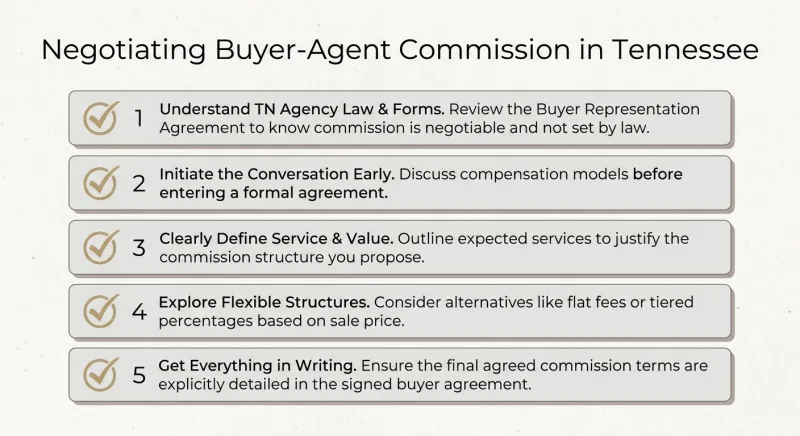
1. Read the RF141 for information, not instruction. Find the fee and the shortfall provision. Note the number — it's the buyer's starting ask, not your bill.
2. Anchor at zero, not at the buyer's number. The buyer's RF141 figure is their ceiling with their agent, not your starting point. Begin from "$0 offered" and move up only if it buys you something — a faster close, a cleaner inspection resolution, a higher sale price.
3. Check the buyer's loan cap first. No point offering 3% if the buyer's FHA cap won't absorb it. The cap sets the realistic range.
4. Trade concession for price, not goodwill. A $5,000 concession offered against a $5,000 price bump is neutral to you and lets the buyer finance the fee. That's often the cleanest resolution of a shortfall.
5. Counter in the RF401, not the RF141. Your concession goes into the Purchase and Sale Agreement — generally through Paragraph 17 Exhibits and Addenda. You never sign the RF141. If the buyer wants their full 2.5% and you offered 1.5%, the shortfall clause makes the buyer eat the 1%.
6. Lock the exact number in the RF620. The Compensation Addendum confirms the figure for the closing attorney so disbursement matches what you agreed — no surprises.
Sellers who understand the shortfall clause almost never pay the full "asking" commission, and the deals still close.
The VA loan wrinkle most sellers miss
Veterans used to be flatly barred from paying their own agent's commission. After the NAR settlement, the VA updated its policy to let VA buyers pay reasonable buyer-agent fees under defined conditions — which gives you more room to hold firm on a lower concession. But VA appraisal and fee rules are strict. If your buyer is using a VA loan, confirm the structure with the buyer's lender before you treat the shortfall as "solved."
One honest caveat: we can tell you how the forms work and where the leverage sits. We can't draft contract language for your specific deal — that's your Tennessee real estate attorney's job. Agency disclosure and compensation terms touch TREC rules and the Tennessee Broker Act (T.C.A. § 62-13).
How to Advertise a Buyer-Agent Concession Legally (Off-MLS Only)
Short answer: Off-MLS only. Since August 17, 2024, you cannot publish an offer of buyer-agent compensation inside the MLS — but you're free to advertise it everywhere else: yard signs, flyers, a single-property landing page, social posts, or directly in negotiation. This applies to RealTracs (Middle TN), MAAR (West TN), and NETAR (East TN), each of which enforces the no-in-MLS-compensation rule independently.
The settlement didn't ban offering a concession. It banned where you can broadcast it. Keep it out of the MLS; put it anywhere a buyer or their agent might see it off-platform.
What works on flat-fee listings: a one-line note on the property's own landing page ("seller will consider buyer-agent concessions — submit with offer"), plus a direct reply to agents who inquire.
Keep Control of the Whole Equation
The reason sellers lose the commission negotiation isn't the buyer's agent — it's starting from a listing structure that already handed away ~3% to a listing agent before the first offer arrives.
List flat-fee instead. You pay one flat price to get on RealTracs (or MAAR/NETAR), skip the traditional listing-side commission entirely, and keep full control over whether you offer any buyer-agent concession — and if so, how much. The RF141 shortfall clause does the heavy lifting on the buyer's side; your flat-fee listing does it on yours.
👉 See how it works in your market on our Nashville flat fee MLS listing page.
Frequently Asked Questions
Does a Tennessee FSBO seller have to pay the commission in a buyer's RF141?
No. The RF141 Exclusive Buyer Representation Agreement is a private contract between the buyer and their broker. The seller isn't a party and has zero obligation to fund it. Any seller contribution is a voluntary concession negotiated in the RF401 Purchase and Sale Agreement.
What happens if I offer less than the buyer-agent fee on the RF141?
The buyer covers the difference. Under the shortfall provision (Paragraph E on the current RF141), if the buyer's agreement says 2.5% and you offer 1.5%, the buyer pays the remaining 1% out of pocket. On a $450,000 home, that's $4,500 the buyer absorbs, not you.
How can Tennessee sellers advertise a buyer-agent commission after the NAR settlement?
Off-MLS only — yard signs, flyers, single-property landing pages, and direct agent outreach. You cannot post an offer of compensation inside RealTracs, MAAR, or NETAR per the NAR settlement changes effective August 17, 2024.
Which forms actually move the money at closing?
Three in sequence: the RF141 sets the buyer's obligation, the RF401 Purchase and Sale Agreement (Paragraph 17 Exhibits and Addenda) is where you agree to any concession, and the RF620 Compensation Addendum tells the closing attorney the exact amount to disburse through escrow.
Do I ever sign the buyer's RF141?
No. You negotiate your concession in the RF401 and confirm it in the RF620. The RF141 stays between the buyer and their agent.
Can VA buyers pay their own agent now?
Yes. Following a VA policy update, VA buyers may pay reasonable buyer-agent fees previously treated as non-allowable. Confirm current terms with the buyer's lender before relying on this in negotiation.
This guide isn't legal advice, right?
Correct — this is educational only. Confirm all form wording, paragraph numbers, and settlement dates against the live Tennessee REALTORS® form library, and consult a Tennessee real estate attorney before relying on any of it.