
How to Sell FSBO in Tennessee: The Complete 2026 Pillar Guide
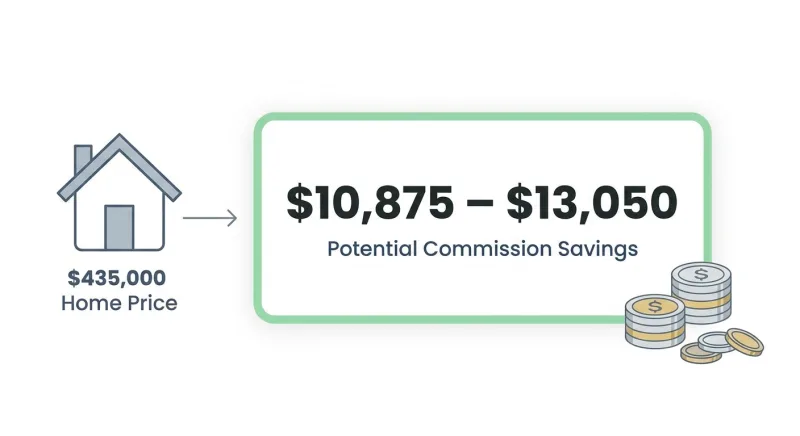
Selling FSBO in Tennessee means listing and closing your home yourself, without a listing agent. On a roughly $435,000 home, that can keep $10,875 to $13,050 in your pocket that would otherwise go to a listing commission. This guide walks all six stages, start to finish.
You price it, prep it, get it on Realtracs, handle showings and offers, settle buyer-agent commission under the new 2026 rules, deliver the right disclosures, and close through a title company. None of it requires a real estate license — Tennessee lets you sell your own property — and none of it requires a mandatory attorney.
But be honest about what you're taking on. FSBO saves the listing fee; it also puts pricing, negotiation, disclosures, and closing logistics squarely on your shoulders.
How do you sell FSBO in Tennessee?
To sell for sale by owner in Tennessee, you price the home with real sold comps, prep and photograph it, get it onto Realtracs through a limited-service flat-fee broker, handle your own showings and offers, complete the required Tennessee disclosures, and close at a title company. Six stages.
As of early 2026, the median Tennessee home price sits around $435,000. A standard listing-side commission of 2.5%–3% runs $10,875 to $13,050 — the number that pulls most sellers toward FSBO.
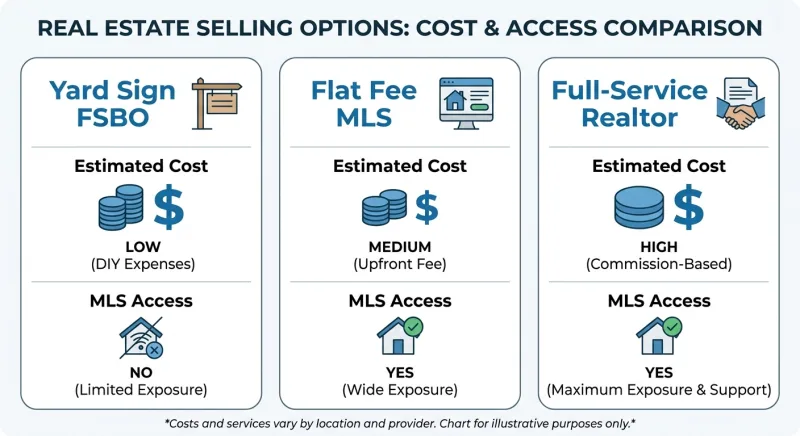
But FSBO isn't one thing. There's pure yard-sign FSBO — free, low exposure — and flat-fee MLS, where you pay a one-time fee to get on Realtracs and keep control.
| Yard-Sign FSBO | Flat-Fee MLS | Full-Service Listing | |
|---|---|---|---|
| Upfront cost | ~$0–$100 | One-time flat fee (a few hundred dollars) | ~$10,875–$13,050 (2.5%–3%) |
| On Realtracs MLS? | No | Yes (via licensed broker) | Yes |
| Syndicates to Zillow / Realtor.com | No | Yes | Yes |
| Buyer exposure | Low | High | High |
| Who handles showings | You | You | Agent |
| Who handles negotiation | You | You | Agent |
The single biggest driver of sale price is MLS exposure, and you can't get on the MLS as an unrepresented seller. Flat-fee MLS buys you that exposure without the percentage commission. For provider options, see our Flat Fee MLS Tennessee guide.
Stage 1 — How do I price my house FSBO in Tennessee?
Price your FSBO home by building a comparative market analysis: pull three to five recently sold homes near you — same size, age, and condition — adjust for differences, and land on a range. Sold comps matter far more than active listings or Zillow estimates.
Here's what to pull for each comp:
- Sold price (not list price) within the last 3–6 months
- Square footage, bed/bath count, and lot size
- Condition and updates (new roof, renovated kitchen)
- Distance — ideally within a mile, same school zone
Then adjust. Finished basement the comp didn't have? Add value. The comp had a two-car garage and yours is a carport? Subtract. This is the same math a licensed broker runs — the difference is they pull verified sold data straight from Realtracs.
The most common mistake is overpricing off emotion, then chasing the market down with cuts. A stale listing reads as "something's wrong with it." Price it right the first week when the listing is freshest.
If your buyer is financing, their lender orders an appraisal. If it comes in under contract price, the deal renegotiates or dies. Pricing to real comps protects you here too.
Stage 2 — Prepping and photographing your home
Prep your home by decluttering, handling obvious repairs, deep-cleaning, and investing in professional photography before a single buyer sees it online. Listing photos are the first showing.
Work this pre-listing checklist in order:
- Declutter and depersonalize — clear counters, closets, and family photos so buyers picture themselves there.
- Handle the easy repairs — leaky faucet, cracked switch plate, scuffed paint. Small stuff reads as neglect.
- Deep clean — floors, windows, grout, baseboards. Clean photographs clean.
- Stage the key rooms — living room, primary bedroom, kitchen. You need uncluttered, well-lit space.
- Boost curb appeal — mow, edge, mulch, a fresh doormat. The exterior photo is your thumbnail.
- Then shoot — hire a pro or, at minimum, use a wide lens in bright daylight.
Stage 3 — How to list on Realtracs without a realtor
You cannot list directly on Realtracs as a FSBO seller — MLS access is gated to licensed members. Realtracs is the MLS that matters in Tennessee, and the only way onto it without hiring a full-service agent is through a limited-service flat-fee broker.
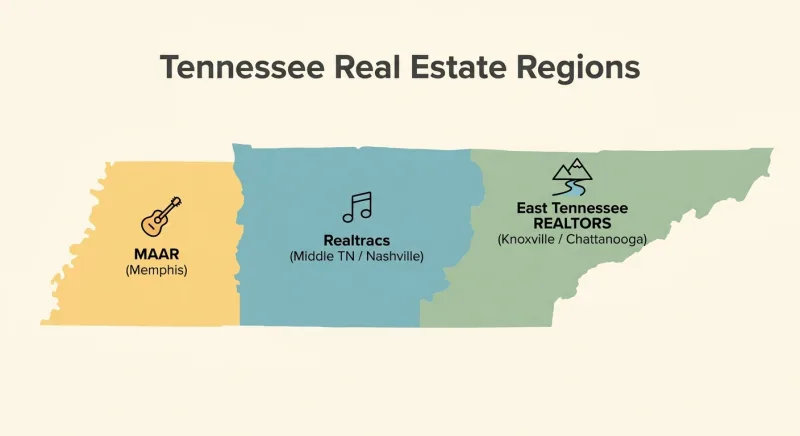
The state runs on three regional boards:
- Realtracs — Nashville and most of Middle Tennessee (Davidson, Williamson, Rutherford, and surrounding counties), covering Franklin, Murfreesboro, Brentwood, and Clarksville.
- East Tennessee REALTORS — Knoxville, Chattanooga, and the eastern region.
- MAAR (Memphis Area Association of REALTORS) — Memphis and West Tennessee.
These systems only accept listings from licensed, dues-paying members. As an unrepresented homeowner, you have no login and no way to input your own listing. A limited-service flat-fee broker is a licensed Realtracs member — you pay a flat fee, provide your details and photos, and the broker enters your home into Realtracs. From there, Realtracs syndicates your listing to Zillow, Realtor.com, Trulia, and broker sites buyers search. You keep showings, negotiation, and decisions.
How Tennessee's MLS entry rules actually work
A flat-fee listing puts you into Realtracs, but the broker owns the compliance. Realtracs enforces input rules on every field — photo count, status changes, and how fast a status must update after an accepted offer. Ask before you pay: who updates my status, and how fast?
Exclusive Agency vs. Exclusive Right to Sell. Most Tennessee flat-fee listings go in as Exclusive Agency: the broker lists you on Realtracs, but you keep the right to sell to an unrepresented buyer yourself and pay zero buyer-side commission on that deal. An Exclusive Right to Sell owes commission no matter who brings the buyer. Read which one your contract names — it decides whether you ever owe commission on a buyer you sourced yourself.
The syndication lag. Your listing doesn't hit Zillow and Realtor.com the instant it goes live on Realtracs — those sites pull feeds on a cycle, often hours to a full day behind. If you want a Thursday-night launch to catch weekend shoppers, enter the listing Wednesday.
Stage 4 — The 2026 commission rewrite, and how buyer concessions actually work
After the NAR settlement took effect in August 2024, buyer-agent compensation is no longer advertised on the MLS. A huge share of FSBO content still tells you to "offer 3% to the buyer's agent on the MLS." That field is gone.
Buyer-agent pay is now negotiated off-MLS, handled as a concession written into the purchase agreement at the offer stage. You're no longer pre-committing a percentage to the whole market sight unseen. And if a buyer comes without an agent, there's no buyer-side commission at all. On a $435,000 home, a 2.5% concession runs $10,875; 3.0% runs $13,050.
Concession vs. commission: not the same dollar
A buyer concession is a credit from your net proceeds toward the buyer's side. That's different from the old world where you paid the buyer's brokerage directly. A concession can also brush up against lender limits — on many conventional loans, seller-paid concessions are capped as a percentage of sale price depending on down payment. A too-generous concession doesn't just cost you money; it can collapse the financing.
The appraisal-gap trap
Here's the chain reaction. The buyer's agent says, "Let's go to $448,000 and you credit us $13,000 back." Sounds neutral — you net the same. But the house has to appraise at $448,000. If it appraises at $435,000, the lender funds off the lower number, and you're negotiating a $13,000 gap mid-contract. Build an appraisal contingency position into your counter before agreeing to a grossed-up price.
When paying a co-op actually makes you more money
Buyer agents still steer tours, and a listing offering 2–2.5% gets shown more than one offering nothing. The framework isn't "never pay." It's: price the concession as a marketing expense and measure it against showing volume. If your first ten days produce weak traffic, a mid-listing concession offer is often cheaper than a $15,000 price cut.
Stage 5 — Disclosure edge cases that create post-closing liability
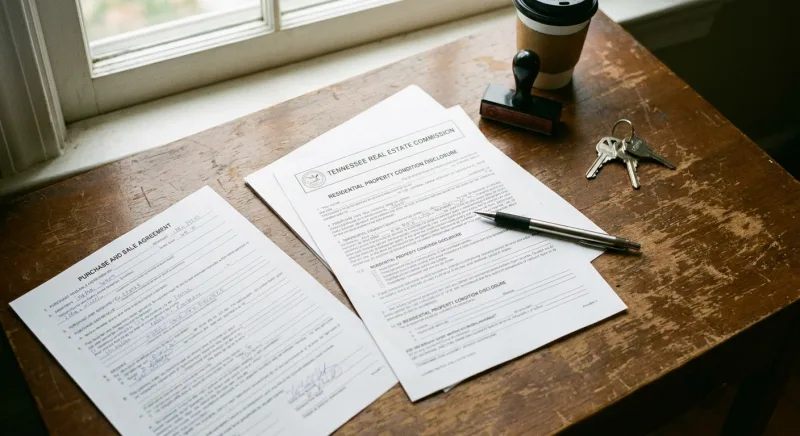
Under Tennessee Code Annotated § 66-5-201, most sellers must provide the Residential Property Condition Disclosure (form RF 201). Federal law also requires a Lead-Based Paint Disclosure for homes built before 1978. A seller may instead use the § 66-5-202 disclaimer ("as-is") in limited circumstances.
The "as-is" misunderstanding. Selling "as-is" under § 66-5-202 does not erase your duty to disclose known defects. As-is governs who pays for repairs — not whether you can stay silent about the foundation crack you've been caulking for three years. Disclose the known defect and sell as-is — that combination actually protects you.
FSBO status is not an exemption. An unrepresented seller of a used single-family home owes the same § 66-5-201 disclosure as any agent-listed property.
Lead paint: the timing rule that voids a clean contract. For homes built before 1978, the federal Lead-Based Paint Disclosure (42 U.S.C. § 4852d) must give the buyer a 10-day window to conduct a lead inspection unless they waive it in writing — and this attaches before the buyer is obligated. Deliver the disclosure after the purchase agreement is signed and you've handed the buyer grounds to walk, plus federal penalty exposure that dwarfs any commission you saved.
Stage 6 — Closing day for the unrepresented seller
Tennessee runs title-company closings — there's no mandatory-attorney rule for a residential sale.
Who picks the closing agent. The closing agent is negotiable in the purchase agreement. Without a listing agent, the title company becomes your de facto transaction coordinator — they order the title search, clear liens, prep the deed, and build the settlement statement. Call your mortgage servicer for a written payoff the day you go under contract.
Transfer-tax math. In Tennessee the transfer tax is customarily the seller's expense at $0.37 per $100. On a $435,000 sale: $435,000 ÷ $100 = 4,350 × $0.37 = $1,609.50.
Build your own net sheet before closing:
| Line | Who typically pays | On $435,000 |
|---|---|---|
| State transfer tax ($0.37/$100) | Seller | ~$1,610 |
| Title/closing fee | Negotiable | varies |
| Mortgage payoff + per-diem interest | Seller | per statement |
| Buyer concession (if agreed) | Seller | e.g., $10,875 (2.5%) |
| Prorated property taxes | Seller (through closing date) | varies by county |
| Recording of deed/release | Varies | county fee |
The number most FSBO sellers forget is per-diem interest on the mortgage payoff. Your payoff quote is good only through a stated date; close a day late and the shortfall comes out of your proceeds. Get a "good-through" date that covers your target closing plus a cushion.
Matching your situation to the right path
- Hot ZIP, you already have a buyer (family, neighbor, cash investor): pure FSBO with an Exclusive Agency flat-fee listing as backup insurance.
- Standard resale, broad buyer pool needed: flat-fee Realtracs entry plus a 2–2.5% buyer concession offered up front.
- Complex property (pre-1978 lead, septic, easement, estate transfer): flat-fee listing plus a flat-fee or hourly closing attorney to review the contract and disclosures.
- Luxury or unusual home with thin comps: get a paid appraisal before listing, then enter Realtracs with defensible numbers.
FSBO in Tennessee isn't one decision — it's a series of them: MLS structure, concession strategy, disclosure handling, closing control. Get those four right and the savings on a $435,000 home run well past $10,000.
Ready to see exactly what a limited-service Realtracs listing costs in your city? [Compare flat-fee MLS options for Tennessee →]
Frequently Asked Questions
Is it legal to sell your own house in Tennessee without a realtor?
Yes. Tennessee does not require a real estate license to sell property you own, and no state law forces you to hire an agent. You'll still need to complete the required disclosures and a legally sound purchase agreement, but the sale itself is entirely legal to handle yourself.
How much does it cost to list on Realtracs with a flat-fee broker?
FSBO sellers can't join Realtracs directly — membership requires a licensed broker. A limited-service flat-fee broker gets your listing onto Realtracs for a one-time fee that typically runs a few hundred dollars, instead of the roughly 2.5–3% listing commission a full-service agent charges.
Do I need a lawyer to sell a house FSBO in Tennessee?
No. Tennessee is a "title company" state — closings are routinely handled by licensed title/closing companies rather than a mandatory attorney. Many FSBO sellers still pay a lawyer to review the purchase agreement, but it's optional, not required by law.
What disclosures are required when selling FSBO in Tennessee?
Under Tennessee Code Annotated § 66-5-201, most sellers must provide the Residential Property Condition Disclosure (form RF 201). Federal law also requires a Lead-Based Paint Disclosure for homes built before 1978. A seller may instead use the § 66-5-202 disclaimer ("as-is") in limited circumstances.
How much can I actually save selling FSBO in Tennessee?
On a home near the 2026 Tennessee median of about $435,000, the listing-side commission alone (2.5–3%) runs roughly $10,875 to $13,050. That's the money that stays in your pocket when you skip a full-service listing agent — though you may still offer a buyer-agent concession.
Do FSBO sellers have to pay the buyer's agent commission?
No, it's not mandatory. Following the NAR settlement (effective August 2024), buyer-agent compensation is no longer advertised on the MLS and is negotiated off-MLS through concessions written into the purchase agreement. You decide whether — and how much — to offer.
The bottom line
Selling FSBO in Tennessee comes down to six things: pricing from real comps, prepping and photographing the home, getting it onto the MLS, managing showings and offers, settling buyer-agent compensation, and closing with accurate disclosures. None of it requires a license. All of it rewards preparation.
The single biggest lever is exposure. Realtracs is the MLS that matters in Tennessee, and you can't list on it as an unrepresented seller. A limited-service flat-fee broker is the practical bridge: direct Realtracs entry plus syndication to Zillow, Realtor.com, and Trulia for a flat fee, while you keep the roughly $10,875–$13,050 listing commission you'd otherwise hand over on a $435,000 sale.
Verify every legal and tax detail against the current Tennessee Code and your title company before you sign anything — statutes and forms change.
If you're in Nashville, Franklin, Murfreesboro, Knoxville, Memphis, Chattanooga, Clarksville, or Brentwood, your next step is the flat-fee MLS page for your city — that's where FSBO stops being a yard sign and starts being a real listing.