

How to Write a Binding FSBO Counter-Offer in Tennessee Without the Realtor-Only RF651 Form
You've got an offer on your Tennessee house. You want to counter. Then you find out the standard tool everyone points to — Form RF651 — is off-limits.
Here's the good news. You can write a fully binding FSBO counter-offer in Tennessee without RF651, and you don't need to be a licensed agent to do it right. RF651 belongs to Tennessee REALTORS® and is reserved for members. But that form is not what makes a counter enforceable. Tennessee law is.
What actually makes your counter binding is a written agreement, signed by the party to be charged, under the Statute of Frauds (T.C.A. § 29-2-101). Get those pieces right and your DIY document holds up the same as any agent's.
This guide is educational, not legal advice — have a Tennessee closing attorney review your final terms before you sign.
Is a Counter-Offer Legally Binding in Tennessee Without RF651?
Yes. A written counter-offer signed by both seller and buyer is legally binding in Tennessee without Form RF651, because T.C.A. § 29-2-101 requires only a written agreement signed by the party to be charged — not any specific realtor form.
RF651 is a convenience, not a legal requirement. What actually makes your counter binding is Tennessee contract law, and that law doesn't care whose logo sits at the top of the page. You need three things: the right elements, real signatures, and delivery before the deadline.
Why FSBO Sellers Can't Legally Use RF651
Form RF651 is copyrighted, proprietary content owned by Tennessee REALTORS® and licensed to dues-paying members only. It isn't a government form or a TREC (Tennessee Real Estate Commission) document — it's a private trade association's intellectual property, the same as companion Form RF401. Pulling a scraped copy off a form-mill site puts you in shaky copyright territory.
None of that affects the enforceability of your deal. RF651 is just a pre-formatted way to do something Tennessee law already lets you do with a plain, well-drafted document. When a buyer's agent says "we have to use RF651," they usually mean their brokerage requires it — a rule about their side, not yours.
The Tennessee Law That Makes Your DIY Counter Binding
Under Tennessee law, a counter-offer becomes binding when it satisfies T.C.A. § 29-2-101: it must be in writing and signed by the party to be charged — meaning both buyer and seller sign the final agreed terms.
Three legal ideas do the heavy lifting.
The Statute of Frauds. Any contract for the sale of land must be in writing and signed to be enforceable. A handshake doesn't count. A texted "I accept" is legally murky. A signed written counter is clean.
The Mirror Image Rule. When you counter, you simultaneously reject the buyer's original offer and make a brand-new offer. Any change in terms kills the old offer. Once you counter, the buyer's original offer is dead — they can accept your counter, reject it, or counter back, but you can't "change your mind" and snap up their first offer unless they re-extend it.
Meeting of the Minds. A binding contract needs both parties agreeing to the same essential terms: price, property, parties, closing date, contingencies. When your written counter spells those out and both sides sign, you have mutual assent.
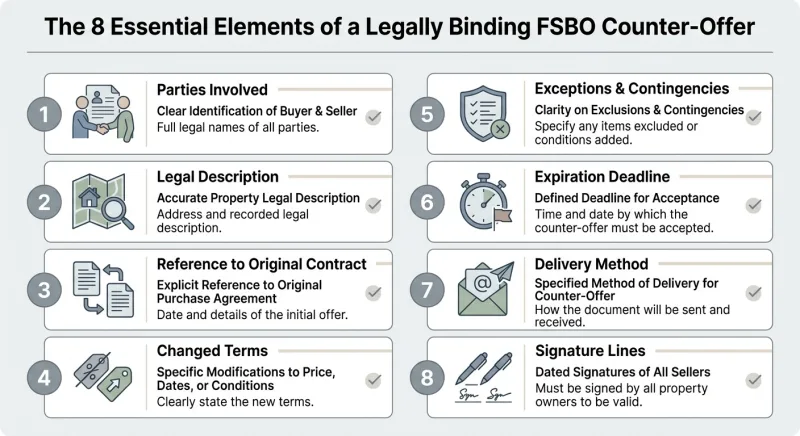
The 8 Essential Elements Every Compliant Counter Needs
- Reference to the original offer. Identify the Purchase and Sale Agreement by date and parties' names.
- Legal description of the property. Full street address plus the legal description from the deed. A bare street address is weak.
- Names of both parties. Full legal names of every seller and buyer. Every owner must be named and sign.
- The specific changed terms. State exactly what you're changing. Everything not changed stays as written.
- A rejection-and-replacement statement. One line confirming this counter rejects the prior offer and substitutes these terms.
- An acceptance deadline. State the exact date and time the buyer's signed acceptance must be received.
- A delivery-of-acceptance clause. Specify how acceptance must be delivered and to whom. Acceptance isn't effective until delivered back to you before the deadline.
- Signature and date lines for all parties. The document isn't binding until signed by the party to be charged.
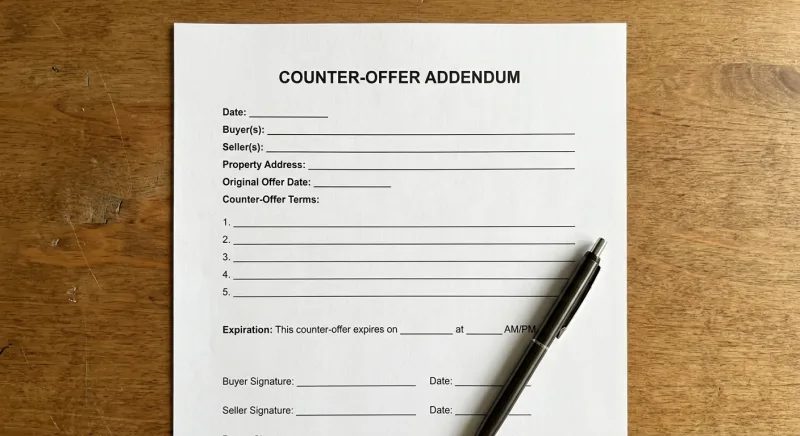
Free Copy-and-Paste TN FSBO Counter-Offer Template (RF651 Alternative)
Have a Tennessee closing attorney review it before you sign.
COUNTER-OFFER TO PURCHASE AND SALE AGREEMENT
Date: ______________
This Counter-Offer responds to the Purchase and Sale Agreement dated ____________, for the property at __________________________ [full street address], legally described as ____________________________________ [legal description / lot, block, subdivision, or parcel ID from the deed], in ____________ County, Tennessee.
Seller(s): ______________________________ Buyer(s): ______________________________
1. Rejection and Replacement. Seller rejects Buyer's offer dated ____________ and makes this Counter-Offer in its place. All terms of the original Purchase and Sale Agreement remain in effect except as modified below.
2. Modified Terms:
- Purchase Price: $______________
- Earnest Money Deposit: $______________, held by ______________________
- Closing Date: ______________
- Repairs / Inspection: ______________________________
- Other Changes: ______________________________
3. Acceptance Deadline. This Counter-Offer expires unless Buyer's signed written acceptance is delivered to Seller by ______ [time], Central Time, on ____________ [date]. Delivery may be made by ______________ [email / e-signature platform / hand delivery].
4. Full Agreement. Upon Buyer's signed acceptance and delivery within the deadline, the original Purchase and Sale Agreement, as modified by this Counter-Offer, becomes the binding agreement between the parties.
Seller Signature: ____________________ Date: ________ Buyer Signature: ____________________ Date: ________
This template is educational and general. It is not legal advice and does not create an attorney-client relationship.
Tennessee sellers must also provide the buyer a Property Condition Disclosure under T.C.A. § 66-5-201 — a separate obligation from your counter.
Draft vs. Decide: The Framework That Keeps Your Counter Binding
Writing a binding counter and deciding what it does are two different acts. FSBO sellers get in trouble by blurring them.
Draft is mechanical — putting terms on paper in language that satisfies the Statute of Frauds. You don't need to be a licensed agent to do it right.
Decide is strategic. Under the Mirror Image Rule, a counter isn't a friendly negotiation note — it's a legal rejection of the buyer's offer. The moment you counter, their first offer is dead. If you counter a $410K offer at $420K and the buyer walks, you cannot circle back and accept the original $410K. It no longer exists.
Before you send anything, run the Decide check:
- Is this term worth killing a live offer for?
- What's my fallback if they walk?
Then do the Draft work. Write so terms are self-executing: "Purchase price: $415,000" needs no interpretation. "Buyer to handle reasonable repairs" creates an interpretation problem — and interpretation problems are where deals die.
The Double-Bind Danger: Countering Two Buyers at Once
If you send binding counters to two buyers and both deliver acceptance before either expires, you may have formed two enforceable contracts to sell one house.
Two safe approaches:
Sequential counters. Counter Buyer One with a short deadline. Don't counter Buyer Two until One's deadline passes.
Reserved-right language. Send both, but include: "This counter-offer may be withdrawn by Seller at any time prior to Seller's receipt of Buyer's signed acceptance, notwithstanding the deadline stated below." The moment one buyer delivers a signed acceptance, immediately withdraw the other in writing.
Repair-Liability Caps: The Term FSBO Sellers Forget to Draft
Most FSBO counters hit trouble during the inspection contingency because the seller left repair exposure open-ended. Your counter is where you install a ceiling.
| Structure | How it works | Seller risk |
|---|---|---|
| As-is, inspection for information only | Buyer may inspect and terminate, but cannot demand repairs or credits | Lowest |
| Hard-dollar repair cap | Seller obligated up to a stated max; buyer covers overage or terminates | Capped, predictable |
| Open repair negotiation | Buyer requests, parties re-negotiate | Highest |
Write it so the number does the work: "Seller's total obligation for inspection-related repairs shall not exceed $2,500. Repairs exceeding this amount are at Buyer's election and expense, or Buyer may terminate and receive return of the earnest money deposit."
A repair cap limits your repair liability. It does not limit your disclosure duty. Under T.C.A. § 66-5-201, misrepresenting a known defect survives any "as-is" language.
Post-NAR 2026: Buyer-Agent Compensation Inside Your Counter
As of 2026, buyer-broker compensation is negotiated separately and is not advertised through MLS cooperation. As a FSBO seller, you owe the buyer's agent nothing unless you affirmatively agree.
Buyers will often ask you to contribute through a seller concession:
"Seller agrees to a buyer concession of up to $______, applicable at Buyer's election toward closing costs and/or buyer-broker compensation, not to exceed lender-permitted limits."
That last clause matters. Seller-paid concessions are capped by loan type — conventional, FHA, and VA each limit allowable contributions. Never promise to "pay the buyer's agent commission" open-ended.
Which Container Fits Your Deal?
| Feature | Plain Counter Letter | RF651 Counter Offer | Addendum-Style Rewrite |
|---|---|---|---|
| Legally binding in TN when signed? | Yes (T.C.A. § 29-2-101) | Yes | Yes |
| Available to FSBO sellers? | Yes | No — members only | Yes |
| Best for 1–3 simple changes | Excellent | Good | Overkill |
| Best for complex multi-term deals | Weak | Good | Excellent |
| Attorney review recommended | Yes | Yes | Yes |
For a two-term change, a plain letter is faster and just as binding. For repair caps, financing contingencies, and shifted earnest money together, an addendum-style rewrite that amends the existing RF401 is cleaner. RF651 is off the table for FSBO sellers because it's licensed, member-only content — not because a DIY counter is less binding.
Build an Audit Trail Your Closing Attorney Will Thank You For
Because delivery of acceptance triggers the contract, you need proof of delivery timing — email timestamps, text confirmations, a short log: "Counter sent 3/14 4:12 p.m., buyer acceptance received 3/15 9:40 a.m." Keep every signed version. When terms change three times, the last document signed and delivered by both parties controls.
Frequently Asked Questions
Is a counter-offer legally binding in Tennessee without Form RF651?
Yes. Under T.C.A. § 29-2-101, a counter-offer is binding when it's in writing and signed by the party to be charged — no specific Tennessee REALTORS® form required.
Can a FSBO seller use Form RF651 to counter an offer in Tennessee?
No. RF651 is copyrighted by Tennessee REALTORS® and licensed only to members. You can build your own compliant counter referencing the original Purchase and Sale Agreement (Form RF401) instead.
How do I handle buyer's agent compensation on a FSBO counter after the 2026 NAR changes?
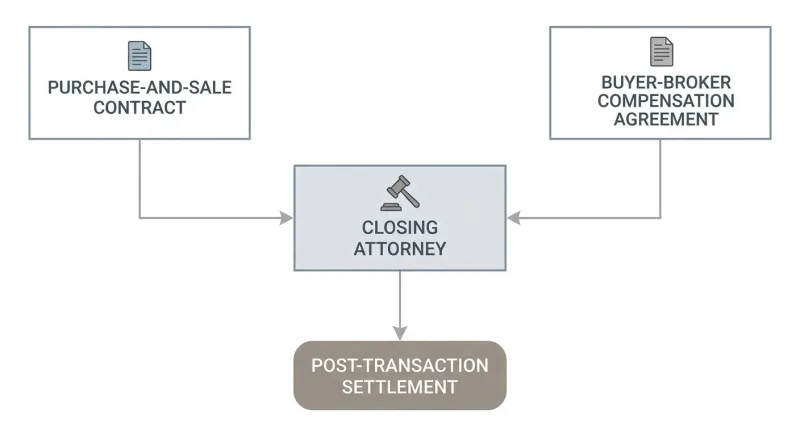
Buyer-broker compensation is negotiated separately, typically documented on a Compensation Agreement (Form RF702) between buyer and agent. On your counter, address any agreed contribution as a seller concession capped by Fannie Mae and HUD interested-party concession limits.
What makes a Tennessee FSBO counter-offer void or unenforceable?
It fails when it isn't signed by both parties, lacks a legal description, or when acceptance isn't delivered before the stated deadline. Countering two buyers simultaneously without careful language can also double-bind you into two contracts.
Does a counter-offer have to be notarized in Tennessee, and do I still owe a property disclosure?
No notary required — the Statute of Frauds requires a writing and signatures, not a notary. But you still owe a written Property Condition Disclosure under T.C.A. § 66-5-201 before the contract is binding.
Conclusion
RF651 was never the thing that made your deal enforceable. Tennessee law is. A written counter, signed by both parties, tied clearly to the original Purchase and Sale Agreement, with a legal description and a firm acceptance deadline — that's what holds up under T.C.A. § 29-2-101.
Two guardrails stay non-negotiable: deliver your property condition disclosure under T.C.A. § 66-5-201, and have a Tennessee closing attorney review your signed counter before money moves. You don't need to be a licensed agent to do this right. You need the correct law, a clean document, and one professional set of eyes on it.
This article is educational and is not legal advice. Statute references (T.C.A. § 29-2-101, T.C.A. § 66-5-201) and form names are provided for context and should be re-verified as laws and forms change.