

How to Sell FSBO in Tennessee in 2026: The Step-by-Step Timeline That Actually Holds Up
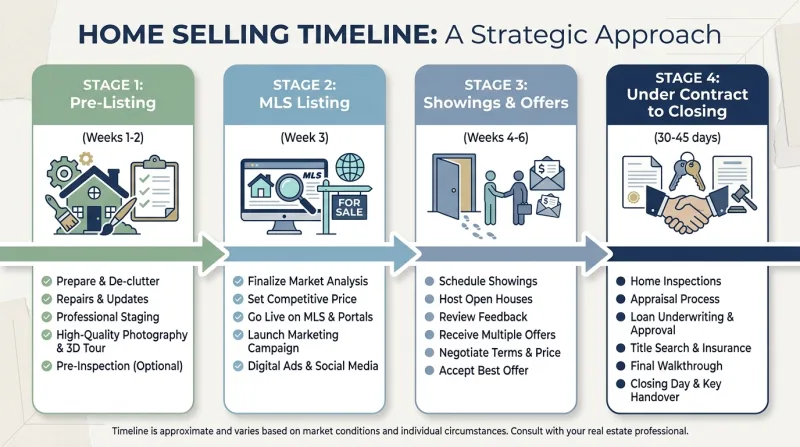
Selling FSBO in Tennessee step by step in 2026 takes about 30 to 90 days from listing to closing — roughly 1–2 weeks of prep and pricing, one week to get on the MLS, two to three weeks of showings and offers, then a 30–45 day escrow. Most Tennessee homes sit around 61 days on market before going under contract.
The part most sellers get wrong is the sequence — pricing before paperwork, listing before disclosures, accepting an offer before understanding the post-2024 commission rules. Miss the order and the timeline stretches. Worse, you create legal exposure you never saw coming.
Educational content, not legal or tax advice — consult a Tennessee attorney for your specific transaction.
Tennessee FSBO Timeline at a Glance: The 4 Stages
| Stage | Timeframe | Core Actions |
|---|---|---|
| 1. Prep, Pricing & Paperwork | Weeks 1–2 | Comp your price, gather docs, complete disclosures, prep the home |
| 2. Listing & Marketing | Week 3 | List on the MLS, syndicate to Zillow/Realtor.com, stage, photograph |
| 3. Showings, Offers & Under Contract | Weeks 4–6 | Host showings, field offers, negotiate, accept, open escrow |
| 4. Under Contract to Closing | 30–45 day escrow | Inspection, appraisal, title work, sign, record, fund |
Stage 1 (Weeks 1–2): Prep, Pricing & Paperwork
Price the home correctly first. Mispricing is the single biggest reason FSBO listings stall. Skip the Zestimate. Pull three to five recent sold comparables within a mile — similar square footage, beds, baths, and condition, sold in the last 90 days. Your county Register of Deeds and public sales records give you real closed numbers. Tennessee's median sale price sits around $435,000 as of early 2026, but your micro-market is what counts.
Assemble your paperwork so nothing stalls the close later:
- Mortgage payoff statement (request the per-diem figure)
- Property deed and current title information
- Recent property tax bill
- HOA documents and covenants, if applicable
- Survey and permit records (especially septic)
- Utility bills for the past year
- Warranties on roof, HVAC, appliances, and recent major repairs
Then prep the physical home. Declutter, deep-clean, handle obvious repairs, boost curb appeal. You need the home to photograph well and survive an inspection without ugly surprises.
Tennessee Disclosure Laws Every FSBO Seller Must Follow
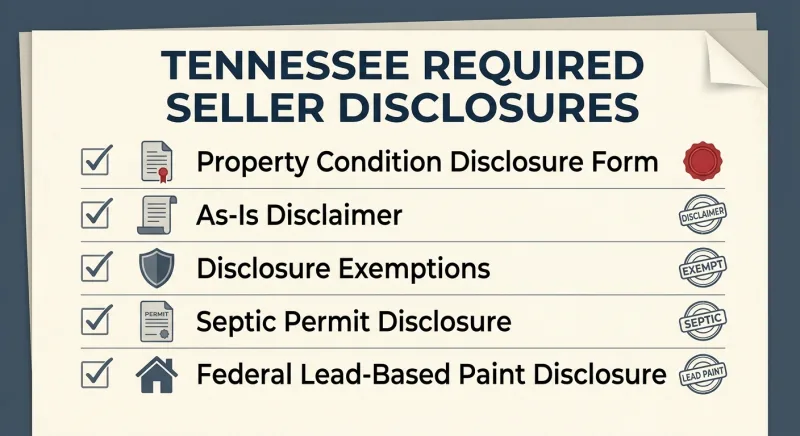
The Tennessee Residential Property Disclosure Act (T.C.A. § 66-5-201 et seq.) requires residential sellers to disclose the known condition of the home before a binding contract. FSBO doesn't exempt you.
- Standard disclosure form (§ 66-5-210): Written disclosure covering the roof, foundation, systems, water, sewer/septic, and known material defects. The TN REALTORS Residential Property Condition Disclosure form is customary, but the obligation is statutory.
- "As-is" disclaimer (§ 66-5-202): Tennessee lets you sell "as is" — but that waives disclosure of condition, not your duty to avoid fraud. You still can't conceal a known defect.
- Septic permit disclosure (§ 47-18-104(b)(42)): Disclosure of the subsurface sewage disposal permit status is required. Certain septic misrepresentations fall under the Consumer Protection Act, which carries sharper liability than a routine omission.
- Exemptions (§ 66-5-209): Court-ordered sales, transfers between co-owners, and some new construction are exempt. Most ordinary FSBO resales are not.
- Lead-Based Paint (42 U.S.C. § 4852d; 24 CFR Part 35): Homes built before 1978 require the EPA pamphlet, a signed disclosure, and a 10-day buyer inspection opportunity.
One important trap: you only disclose what you know. But once a buyer's inspector surfaces a defect, you know it. If that deal falls and you relist, that knowledge follows you onto the next disclosure form.
Educational, not legal advice. If you have a known material defect, unpermitted addition, or prior insurance claim, have a Tennessee real estate attorney review your disclosure before you sign.
Stage 2 (Week 3): Listing on the MLS & Marketing
The MLS is a broker-only database — access requires a licensed member. It feeds Zillow, Realtor.com, Redfin, and the syndication network where most buyers look. A yard sign and Facebook post won't reach them.
A flat fee MLS Tennessee listing places your FSBO on your local MLS and syndicates it to major portals for a one-time flat fee. You keep control of the sale, showings, and negotiation while avoiding the traditional listing-side commission.
Beyond the MLS: invest in professional-grade photos, write a factual benefit-led description, and stage lightly. Decide upfront how you'll schedule, screen, and secure your home during buyer visits.
The Pricing Mechanism Most FSBO Sellers Get Backward
Your listing gets its heaviest algorithmic push in the first 10 to 14 days. Price at the top of the range hoping to "leave room to negotiate," and you burn that window on zero showings — then the price cut lands after the freshness is gone.
Portals re-rank new listings higher, and buyer agents run saved searches that fire on new inventory in a price band. Overprice by 6–8% and you go invisible. Buyers don't search "$462,000" — they search "$400K–$450K" or "$450K–$500K." List at $462K and you miss both cohorts. Sometimes dropping $3,000 to slide under $450K exposes you to a wider pool than the $3,000 is worth.
Set decision thresholds before you list:
- Lots of views, few showing requests → photos or price look off. Adjust presentation or price.
- Showings, no offers → something in person kills it. Address condition or price.
- Neither views nor showings → you're priced out of the band. Correct fast, not in $2K increments.
Buyer's Agent Commissions After the 2024 NAR Settlement
Following the National Association of Realtors settlement (effective August 2024), buyer-agent compensation can no longer be posted on the MLS. Buyers now sign written buyer-broker agreements spelling out what their agent earns. You are not required to offer any buyer-agent commission to appear on the MLS.
Instead of pre-committing "2.5% to any buyer's agent," offer a seller concession negotiated per offer:
- Buyer has an agent and asks you to cover it → treat it as a line item and net it against price. A $445K offer where you cover 2.5% nets roughly the same as a $434K offer with no concession. Compare net, always.
- Buyer has no agent → don't volunteer a concession nobody asked for.
- Buyer wants closing-cost help and has an agent → a general concession capped at a dollar figure you control can cover both.
Compensation is now a negotiated term inside the offer, not a fixed advertised rate.
Verify current rules via the official NAR settlement FAQ before relying on them.
Stage 3 Curveballs: Appraisal Gaps and "Cash" Offers
When the appraisal comes in low
On a financed offer, if the appraisal lands below contract price you have four levers:
- Buyer covers the gap in cash.
- You reduce price to appraised value.
- You split the difference.
- The deal dies — or you rebut the appraisal.
An appraisal is a supportable opinion, not gospel. If the appraiser leaned on weak comps, you can file a Reconsideration of Value through the buyer's lender with better comps and factual corrections. A well-documented ROV with three superior comps changes the number often enough to be worth the effort.
Also note: in Tennessee contracts, the appraisal contingency and financing contingency are distinct. A buyer can waive appraisal (agreeing to pay any gap) while keeping financing protection. An offer that waives appraisal is materially stronger than a higher price with it intact.
When "cash" is worth less than it looks
Cash removes appraisal and lender risk — but a cash buyer prices that in. A cash offer at $425K with a 21-day close trades $20,000 for certainty against a financed $445K offer with 20% down. Two mortgage payments, taxes, and insurance during a slower close might run $4,000–$6,000 — that doesn't close a $20K gap.
Before you accept cash: ask for proof of funds dated within 30 days — a bank or brokerage statement, not a verification letter. And check the buyer field on the contract. If it reads "and/or assigns," you may be dealing with a wholesaler flipping the contract, not buying your house.
Stage 4 (30–45 Day Escrow): Closing in Tennessee
Tennessee closes primarily through title companies — a title/escrow officer orders the search, clears the payoff, prepares the settlement statement, and records the deed. An attorney is optional but wise on anything unusual. Because you have no listing agent reviewing your contract, an attorney reviewing the purchase agreement and deed is cheap insurance.
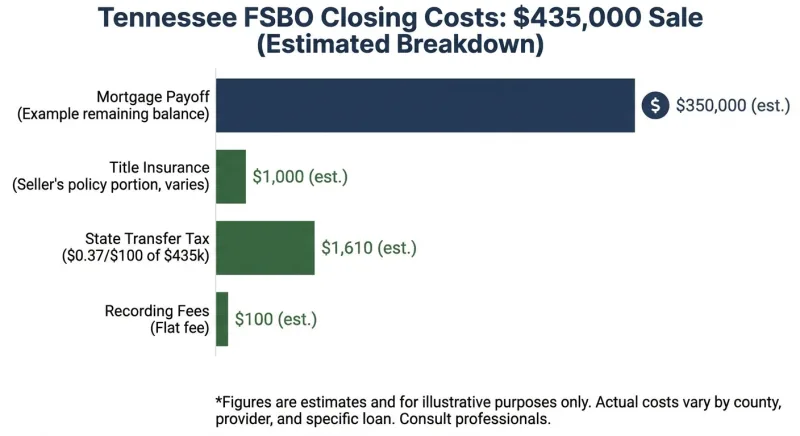
Title-insurance custom that quietly costs sellers. Who pays for the owner's title policy isn't set by law — it's regional custom and negotiable. In Middle Tennessee the seller customarily pays; in parts of East Tennessee it more often lands on the buyer. On a $435K sale the owner's policy is a four-figure line item. Ask your title company early who usually pays in your county, then treat it as a live contract term.
Watch these pre-closing landmines:
- Mortgage payoff timing. Confirm a per-diem figure good through the actual funding date. Payoffs expire; a stale number leaves you short at the table.
- Unreleased prior liens. A paid-off HELOC or contractor's lien never formally released on record will surface in the title search and stall closing. Pull your own preliminary title early.
- Solar leases, HOA transfer fees, and unpermitted work clear slower than you expect. Start them in week one of the contract.
The transfer tax, precisely. Tennessee's realty transfer tax is $0.37 per $100 of value. On a $435,000 sale: $435,000 ÷ 100 × $0.37 = $1,609.50.
Confirm current rates with the Tennessee Department of Revenue and your closing agent.
Where the Flat-Fee MLS Step Fits — and Where FSBO Stops Making Sense
There is exactly one task a non-licensed seller can't replicate: getting the listing inside the MLS so it syndicates to Zillow, Realtor.com, and the feeds every buyer's agent searches. That's the whole logic of flat fee MLS.
When FSBO holds up: clean title, a straightforward home in a liquid market, time to manage showings, and the discipline to price by comps and read the first-two-week feedback loop honestly.
When it stops making sense: you're carrying two mortgages under time pressure, the property has title or disclosure complications you can't confidently document, or you've had zero qualified showings after a correctly-priced 30 days. At that point the savings aren't savings — they're carrying cost.
Frequently Asked Questions
How long does it take to sell a house FSBO in Tennessee?
Plan on roughly 30 to 90 days from listing to closing. Tennessee homes sit on market a median of about 61 days before going under contract, followed by a typical 30-to-45-day escrow. Pricing right and syndicating to Zillow and Realtor.com keeps you on the fast end.
Do I legally have to give buyers a disclosure form when selling FSBO in Tennessee?
Yes. The Tennessee Residential Property Disclosure Act (T.C.A. § 66-5-201 et seq.) requires most sellers to deliver a written disclosure before accepting an offer, using the statutory form under § 66-5-210. Limited exemptions exist under § 66-5-209.
Can I list on the MLS without a realtor in Tennessee?
Not directly — the MLS is only open to licensed members. A flat fee MLS service lists your home on your local MLS and syndicates it to Zillow and Realtor.com for a one-time fee, so you keep FSBO control while gaining full buyer traffic.
Who pays the buyer's agent commission on an FSBO sale after the 2024 NAR settlement?
It's now negotiable, not automatic. Since August 2024, buyer-broker compensation can no longer be advertised on the MLS. You may offer a concession offline if it helps close the deal — but you're never obligated to.
Do I need a real estate attorney to close a FSBO sale in Tennessee?
No, but it's wise. Tennessee is largely a title-company closing state. Because FSBO means no listing agent reviewing your contract, having an attorney review the purchase agreement and deed is cheap insurance.
What does it cost to close an FSBO sale on a $435,000 Tennessee home?
Budget for the state realty transfer tax of $0.37 per $100 — about $1,609.50 on $435,000 — plus recording fees, your mortgage payoff, and (in Middle Tennessee) customarily seller-paid owner's title insurance. Skipping a listing agent typically saves roughly 2.5–3% of the sale price.
Conclusion
Selling FSBO in Tennessee is a sequence. Prep and price in weeks one and two. Get your disclosures right under T.C.A. § 66-5-201. Syndicate to buyers in week three. Field offers, go under contract, and let a title company carry you through a 30-to-45-day escrow.
What you can't DIY is the MLS — without it, your listing never reaches the Zillow and Realtor.com audience where serious buyers look. A flat fee MLS listing solves that one step: pay once, stay in control, keep the commission.
Confirm every statute, tax figure, and market number against primary sources — this guide is educational, not legal or tax advice.