
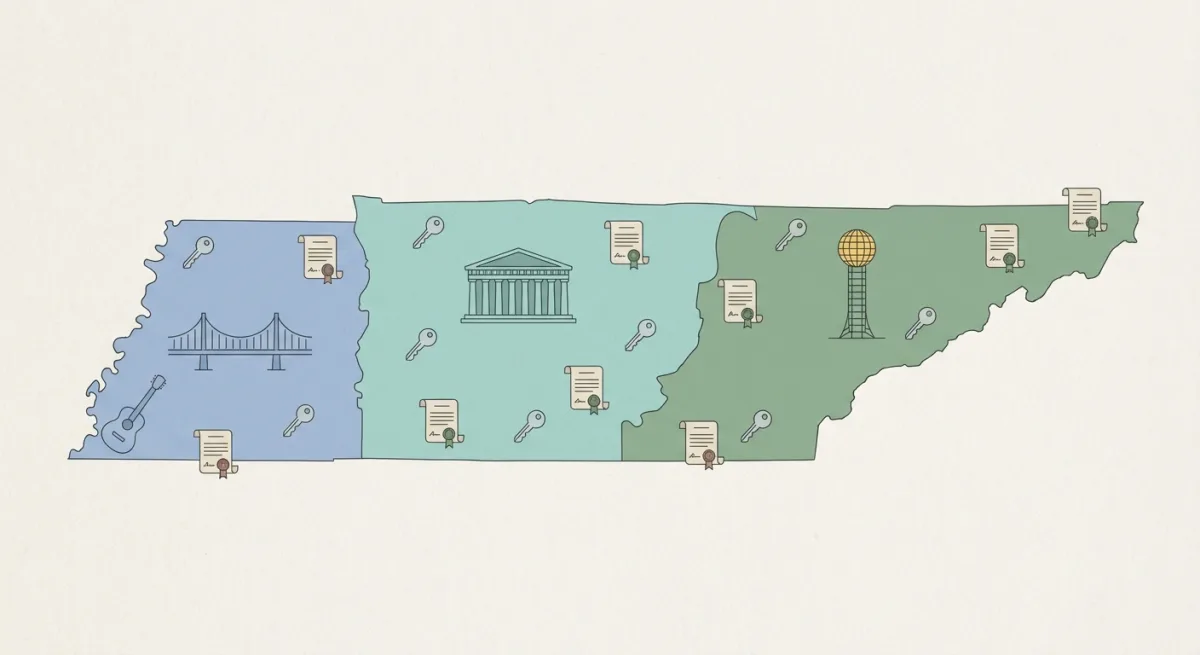
Here's the short version — no Tennessee statute dictates who pays for title insurance. It's a negotiated custom, and that custom changes as you drive across the state. Around Nashville, sellers usually buy the owner's policy for the buyer. Memphis follows a similar seller-pays tradition. Knoxville and much of East Tennessee lean toward a 50/50 split or buyer-paid. Everything on this page is general information, not legal or tax advice — confirm specifics with your closing attorney or title company.
If you're selling without a full-service agent, this matters more than you'd think. Closing-cost allocation is a set of line items you control directly in the contract — separate from any commission conversation. Match the local custom and your offer looks market-standard. Deviate without knowing it, and a buyer's agent will flag you as an outsider.
Tennessee's Three Grand Divisions & Why Customs Differ
Tennessee isn't one market. It's three. The state formally recognizes three Grand Divisions — Middle, East, and West — and that split shows up at the closing table more than most sellers expect.
Here's the distinction that trips up nearly every guide you'll read: statute tells you what you must pay. Custom tells you what you'll probably pay if nobody negotiates. Confusing them costs sellers money.
Why do customs differ by region? Two reasons.
First, who runs the closing. Middle and West Tennessee lean on title companies as settlement agents. East Tennessee has a stronger tradition of closing attorneys handling settlement. Different players, different default habits.
Second, local market gravity. In a metro where sellers have historically bought the owner's policy for the buyer, a listing that doesn't offer that looks off-market — even though the seller was never legally obligated to. Custom becomes a soft expectation, and soft expectations become negotiating baselines.
The standard Tennessee REALTORS purchase agreement leaves title-insurance allocation as a fillable field precisely because it's bargained, not mandated. Treat every custom below as a negotiable starting point.
The Two-Bucket Test: The Filter That Fixes Every "Who Pays" Question
Bucket 1 — Statutory Defaults. These have a named payer in Tennessee Code. There's really only one item here: the realty transfer tax and its cousin, the mortgage indebtedness tax.
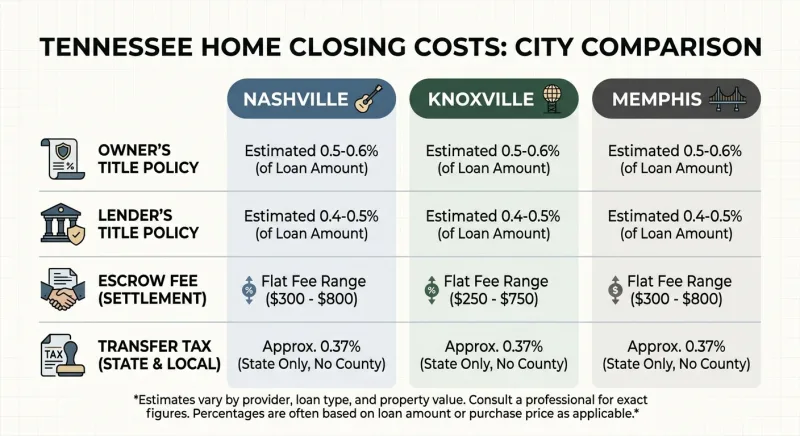
Under Tennessee Code Annotated § 67-4-409, the realty transfer tax is $0.37 per $100 of value — imposed as a privilege tax on the grantee (the buyer). Read that twice. The law names the buyer, not the seller. Yet you'll find Tennessee closing guides flatly stating the seller pays transfer tax "by default." That's the statutory default being reported wrong.
Worked transfer-tax math on a $400,000 sale:
$400,000 ÷ 100 = 4,000 → 4,000 × $0.37 = $1,480
The mortgage indebtedness tax under § 67-4-409(b) runs $0.115 per $100 of the debt, with the first $2,000 exempt, and it also falls on the borrowing buyer.
Worked mortgage-tax math on a $320,000 loan:
$320,000 − $2,000 = $318,000 → $318,000 ÷ 100 = 3,180 → 3,180 × $0.115 = $365.70
Two edge cases worth knowing. First, "value" is the greater of sales price or fair market value — so on a below-market family or estate sale, the Register of Deeds can tax the FMV. Second, the mortgage-tax exemption applies per recorded instrument, so a buyer recording both a first and second mortgage gets the $2,000 break on each. Cash buyers pay zero mortgage tax entirely.
Bucket 2 — Negotiated Customs. Everything else. Owner's title policy. Lender's title policy. Escrow/settlement fees. Deed preparation. No statutory payer — just regional habits, and habits are negotiable by definition.
The honest answer most guides won't give you: the reason customs feel like rules is that nobody at the table has a financial incentive to tell an unrepresented seller that a "standard" cost was always negotiable. Outside the transfer/mortgage tax formulas, almost nothing at a Tennessee closing is required of a specific party. Re-verify current figures with the Tennessee Department of Revenue before you rely on them.
Nashville vs. Knoxville vs. Memphis Closing Cost Customs Compared
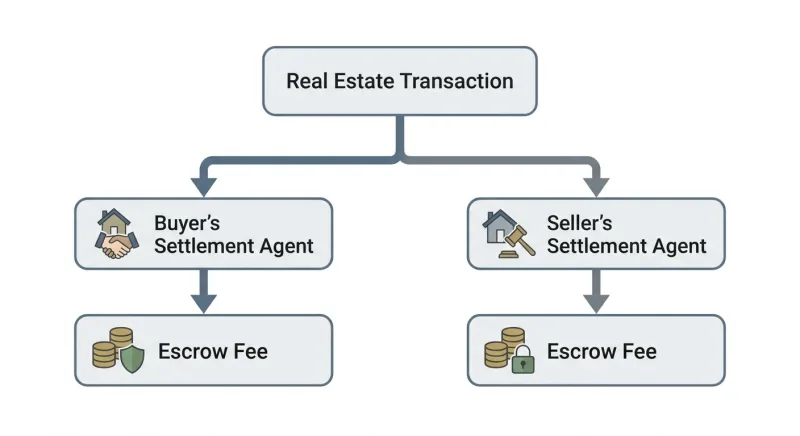
| Line Item | Nashville (Middle TN / Davidson) | Knoxville (East TN / Knox) | Memphis (West TN / Shelby) |
|---|---|---|---|
| Owner's title policy | Seller customarily pays | Often split 50/50 or buyer-paid | Seller customarily pays |
| Lender's title policy | Buyer pays | Buyer pays | Buyer pays |
| Escrow / settlement fee | Each side pays its own (~$400–$600) | Each side pays its own (~$400–$600) | Each side pays its own (~$400–$600) |
| Realty transfer tax | Buyer (statutory) | Buyer (statutory) | Buyer (statutory) |
| Mortgage / indebtedness tax | Buyer (statutory) | Buyer (statutory) | Buyer (statutory) |
| Closing conducted by | Title company | Attorney or title company | Title company |
The transfer and mortgage taxes are identical statewide — set by law, not custom. What shifts region to region is the title insurance allocation.
The title insurance split Middle Tennessee pattern is the cleanest: across Nashville, Franklin, Brentwood, and greater Davidson and Williamson counties, the prevailing practice is for the seller to purchase the owner's policy on the buyer's behalf. Knoxville does it differently — in Knox and Hamilton counties, it's common to see the owner's policy split or shifted to the buyer. Memphis closing cost customs mirror Nashville — Shelby County sellers commonly buy the owner's policy — though it's always contract-driven.
Why the Custom Differs: Follow the Premium
Customs don't materialize from thin air. A title company's revenue model centers on the title insurance premium; its settlement business is downstream of the policy sale. So the Nashville custom — seller buys the owner's policy — routes that premium through the same title company handling the deed and escrow. Efficient for the office, and it became the default because the offices that shape local purchase-agreement norms benefit from it.
An attorney-driven closing has different economics. The attorney bills for settlement work and the title opinion separately from the premium. That decoupling is why East Tennessee never locked into a rigid "seller-buys-owner's-policy" rule. Rule of thumb: when you want to know why a custom exists, ask who books the premium.
Custom also fractures at the office level within a division. In Knox and Hamilton counties, the same file gets handled two ways depending on which settlement agent the buyer's lender uses. A national title-company relationship pulls toward seller-paid owner's policy; a local attorney closing pulls back toward a split. So an East Tennessee offer assigning the owner's policy to the seller isn't "wrong" — it's a soft default you can counter.
Owner's vs. Lender's Title Insurance
Owner's title policy protects the buyer's ownership stake — covering defects that predate closing such as an old lien, a forged deed, or a missed heir. It's a one-time premium paid at closing that lasts as long as the buyer owns the home. In Tennessee as of 2026, expect roughly $1,000–$2,500 depending on price and underwriter.
Lender's title policy protects the mortgage lender up to the loan amount. If there's a loan, the lender requires it — and it's almost universally the buyer's cost across all three metros, because it's a condition of the buyer's financing.
The two are separate. A buyer with a mortgage pays for the lender's policy and — in Knoxville-style deals — may pick up part of the owner's policy. In Nashville and Memphis, the seller absorbing the owner's policy is what makes those markets feel "buyer-friendly" before price negotiation even starts.
Split Closings: Why Each Side Pays Its Own Escrow Fee
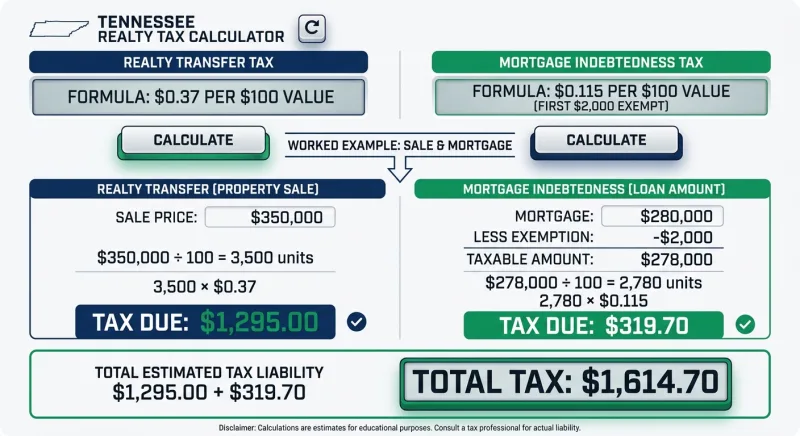
In Tennessee it's normal for the buyer and seller to use separate settlement agents — a split closing. The seller's title company or attorney handles the seller's side (payoff, deed prep, proceeds), and the buyer's settlement agent handles the buyer's side (loan docs, lender's policy, cash to close). Each side pays its own escrow fee — commonly $400–$600 per side as of 2026.
A split isn't automatic — it happens when the buyer's lender requires its own approved settlement agent. Here's the trap: in a non-split closing, one agent handles both sides and the fee is often negotiated as shared. In a split, that negotiation vanishes — a seller who assumed a shared $500 fee suddenly owns a full $500. You often find out the deal is splitting a week before closing, so rebuild your net sheet the moment you learn it.
For a flat-fee seller, you still choose your own settlement agent, pay only your own side, and can shop that fee. Ask for a quote before you sign.
Other Closing Costs: Recording, Deed Prep, and Proration
Recording fees are set by each county's Register of Deeds — Davidson, Knox, Shelby, and Hamilton each publish their own per-document and per-page schedules. Deed preparation covers drafting the new deed — usually a flat fee ($75–$200) and often a seller cost. Prorated property taxes are split by closing date; Tennessee taxes are paid in arrears, so the seller typically credits the buyer for the portion of the year the seller owned the home. Earnest money isn't an extra fee — it's a buyer deposit already applied toward cash to close.
How FSBO & Flat-Fee Sellers Use These Customs to Win Offers
Agent commission and closing costs are two separate conversations. When you list flat-fee, you've already removed the biggest variable cost. What's left is the closing-cost stack — negotiable in the contract you personally review and sign.
Match the market to look normal. In Memphis or Nashville, offering to buy the owner's policy is what buyers expect — leading with it removes a common objection. In Knoxville, don't volunteer to cover the full owner's policy when local custom splits it; you'd be giving away money the market doesn't require.
Concede on custom, negotiate on cash. Say a buyer submits at $400,000 with the owner's policy assigned to you and asks for $6,000 in credits. Around Nashville, that's market-standard. Don't reflexively strip the owner's policy — that reads as non-market and invites friction. Instead, keep the custom-aligned line and reprice or trim the credit. A $6,000 credit costs far more real dollars than a ~$1,600 owner's policy on a $400K sale, yet buyers weight them equally.
Hold the statutory lines. Transfer and mortgage taxes legally sit with the buyer under § 67-4-409. Don't absorb them by reflex — conceding transfer tax on a $400,000 sale is roughly $1,480.
Model your Seller's Net Sheet twice — once custom-aligned, once with every negotiable line stripped — so you know your true floor before any offer arrives. Flag the settlement fee "×2 if split" so a lender-driven split doesn't blow up your net.
Frequently Asked Questions
Who pays for title insurance in Tennessee?
No Tennessee statute dictates who pays title insurance — it's a negotiated custom written into your purchase contract. In practice, sellers in Middle and West Tennessee customarily buy the owner's policy for the buyer, while East Tennessee often splits it or leaves it to the buyer.
How much is the realty transfer tax in Tennessee?
Under Tennessee Code Annotated § 67-4-409, the realty transfer tax is $0.37 per $100 of value (the higher of sales price or fair market value), imposed on the buyer as a privilege tax. On a $400,000 sale, that's $1,480.
Who pays the mortgage tax in Tennessee?
The mortgage indebtedness tax is $0.115 per $100 of the amount financed, with the first $2,000 exempt, paid by the buyer at closing under T.C.A. § 67-4-409(b). Cash buyers skip it entirely.
What is a split closing in Tennessee?
A split closing means the buyer and seller each use a separate settlement agent, and each side pays its own escrow or settlement fee — typically $400–$600 per side as of 2026.
Do closing cost customs differ between Nashville, Knoxville, and Memphis?
Yes. Around Nashville (Davidson/Williamson) and Memphis (Shelby), the seller customarily buys the owner's policy for the buyer; Knoxville (Knox County) more often splits title costs 50/50 or leaves them to the buyer. These are negotiable defaults, not law.
Can a flat-fee or FSBO seller negotiate closing costs?
Absolutely — every one of these costs is a line item you control directly in the contract, separate from any agent commission. Matching local custom on the owner's policy while negotiating other fees is how limited-service sellers write competitive counter-offers.
The Bottom Line
Tennessee sets exactly two closing costs by law — the realty transfer tax at $0.37 per $100 and the mortgage indebtedness tax at $0.115 per $100, both falling on the buyer under T.C.A. § 67-4-409. Everything else, including who buys title insurance, is custom. Custom bends. Statute doesn't.
Around Nashville and Memphis, sellers usually cover the owner's policy; Knoxville tends to split or shift it. Knowing your region's default lets you write an offer that looks market-standard while trimming what actually leaves your pocket. Ask your title company or attorney for a Seller's Net Sheet early — before you sign anything — and re-confirm current tax figures with the Tennessee Department of Revenue and your county Register of Deeds.
This is general information for Tennessee sellers, not legal or tax advice. Statutory figures should be re-verified against current T.C.A. § 67-4-409 and your county Register of Deeds schedule, and every allocation confirmed with your closing attorney or title company before you sign.