
The Post-NAR Reality for Tennessee FSBO Sellers in 2026
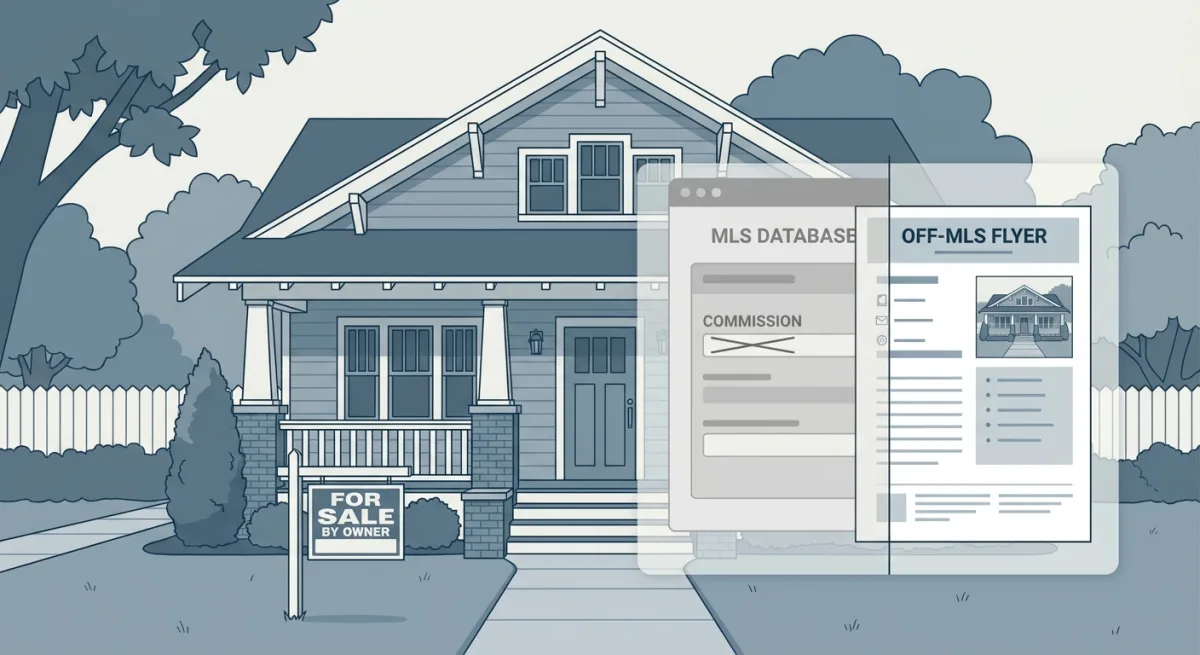
Yes — a Tennessee FSBO seller can still legally offer a buyer-agent commission after the NAR settlement. What changed is where you can say it. You can no longer post that offer inside RealTracs (the MLS). You can still offer it, negotiate it, and pay it — you just do that off the MLS.
You may have read that sellers can't pay buyer agents anymore. That's not true. The money still moves; only the advertising channel closed.
The National Association of REALTORS® settlement ended the old practice of publishing cooperating-broker compensation in the MLS. In Middle Tennessee, RealTracs implemented that change locally, pulling compensation out of every MLS field, remark, and uploaded document. The fee is legal. The listing just can't mention it.
That single distinction trips up more sellers than any other post-settlement rule.
We file these RealTracs listings for a flat fee every week, so this guide is a practitioner's walkthrough, not a headline recap. It covers the rules, the paperwork, the loan math, and copy-paste language you can use today.
General information only — not legal or lending advice. RealTracs, TREC, and lender rules change; confirm current requirements before you act.
Old vs. New: What Changed for Advertising a Buyer-Agent Commission
The confusion comes from mixing up two separate things: offering a commission and advertising it. Only one of those changed.
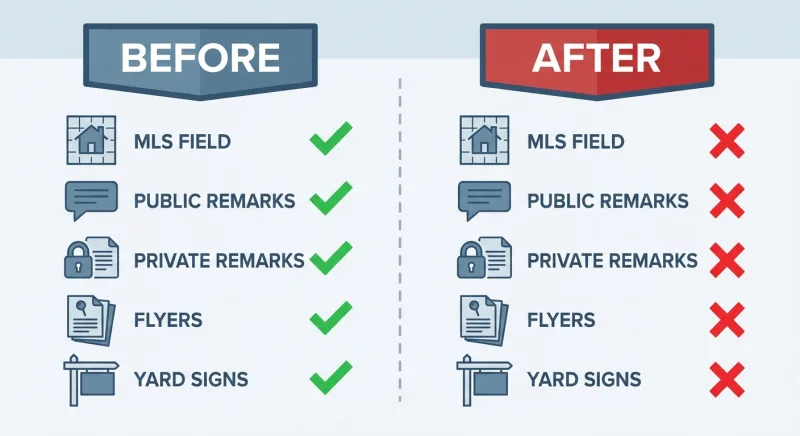
Under the old model, you'd list on RealTracs, type a compensation figure into a dedicated field, and every buyer's agent in Middle Tennessee could see it. That field is gone. So are commission mentions in remarks and uploaded documents.
Off the MLS? Very little changed. Your yard sign, flyer, FSBO website, and direct conversations with buyers' agents all still work the way they always did.
| Channel | Pre-2024 | 2026 |
|---|---|---|
| MLS compensation field | ✅ Allowed | ❌ Removed |
| MLS Public Remarks | ✅ Allowed | ❌ Banned |
| MLS Private Remarks | ✅ Allowed | ❌ Banned |
| Documents uploaded to MLS | ✅ Allowed | ❌ Banned |
| Yard sign / rider | ✅ Allowed | ✅ Allowed |
| Printed flyer (non-MLS) | ✅ Allowed | ✅ Allowed |
| Your own FSBO website | ✅ Allowed | ✅ Allowed |
| Direct offer to buyer's agent | ✅ Allowed | ✅ Allowed |
Everything inside RealTracs is off-limits for commission. Everything outside it is still fair game.
Why the Misconception Is the Whole Story
Nearly every thin post-settlement article tells Tennessee sellers the same half-truth: "buyer-agent commission is now 0%." Read literally, that convinces a nervous FSBO seller they're forbidden from paying a buyer's agent.
The advertising moved. The money didn't.
The NAR practice changes and RealTracs' implementation removed the ability to display cooperating-broker compensation inside the MLS. They did not repeal your right to offer it. You can pay a buyer's agent whatever you negotiate — you just can't broadcast that offer in a RealTracs field, in remarks, or in an uploaded document.
On paper vs. in practice: buyers now sign their own representation agreements and negotiate who pays. In practice, plenty of Tennessee buyers still can't bring extra cash to cover their agent on top of a down payment and closing costs. A seller who quietly offers to cover that fee — off the MLS — widens their buyer pool without touching a single RealTracs remark.
Can You Advertise Commission on RealTracs in 2026?
No. Advertising a buyer-agent commission anywhere in RealTracs is banned in 2026 — including Public Remarks, Private Remarks, and any documents you upload. There's no compensation field to fill in, and you can't work around it by hiding the offer in free-text notes.
Why so strict? The settlement's whole point was to decouple listing on the MLS from any promise of buyer-agent pay. Violations are handled under the RealTracs Infraction and Fines Schedule, which has been revised more than once since 2024 — confirm current tiers before you list. Automated compliance scans catch these fast, and one commission mention in your Public Remarks is an avoidable, self-inflicted fine.
Common mistakes:
- "I'll write '2.5% to buyer's agent' in the remarks." No. Remarks count as MLS advertising.
- "I'll upload a flyer with the offer as a PDF attachment." No. Uploaded documents are part of the MLS record.
- "I'll hint at it — 'agents welcome, ask about terms.'" Risky. If it points to compensation, treat it as banned.
Keep every dollar figure out of RealTracs entirely, and put your offer in the channels covered next.
Where You CAN Legally Advertise a Buyer-Agent Fee Off the MLS
The bright line is simple: the MLS database is off-limits; almost everything else is fair game — as long as your advertising is truthful under TREC advertising standards.
Compliant off-MLS channels:
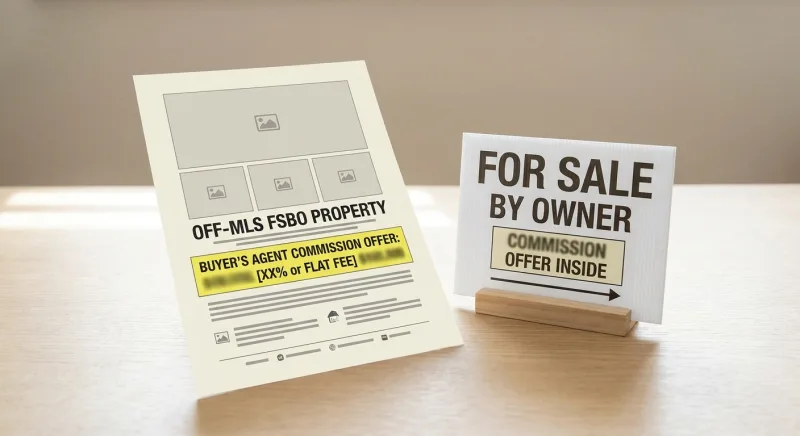
- Yard signs and riders — "Buyer-agent compensation available" is fine.
- Printed flyers handed out at showings (not uploaded to RealTracs).
- Your own non-MLS FSBO website or listing page.
- Social media posts you control.
- Direct communication with a buyer's agent — email, text, or phone.
- A direct buyer-broker compensation agreement, negotiated deal by deal.
One caveat: sites that pull from RealTracs can blur the line. If a portal auto-imports your MLS data, treat that fed content like the MLS — commission-free. Your standalone, self-published pages are the safe zone.
What this means for you: list clean on RealTracs (flat fee, zero commission language) and run your compensation offer through the channels above. Two separate lanes, one deal.
The Double Bucket Rule: Why a Seller-Paid Buyer Fee Won't Break the Loan
Here's the fear that kills more FSBO deals than anything else: a seller offers to cover the buyer's agent, the loan goes to underwriting, and everyone panics that the "concession" blew past a limit.
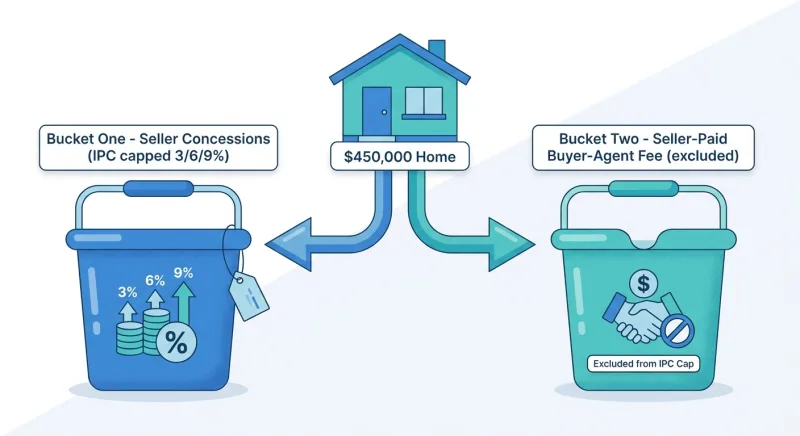
It usually didn't — because a seller-paid buyer-agent fee and a seller concession live in two different buckets.
Bucket One — Seller Concessions (the IPC bucket). Money toward the buyer's closing costs, prepaids, and rate buydowns. Per Fannie Mae Selling Guide B3-4.1-02, conventional owner-occupied IPC limits scale with LTV: 3% for loans over 90% LTV, 6% between 75.01–90%, and 9% at 75% LTV or less. FHA caps seller contributions at 6% under HUD Handbook 4000.1. VA has its own 4% concession framework under the VA Lender's Handbook.
Bucket Two — Compensation to the buyer's broker. After the NAR practice changes, the GSEs clarified that compensation a seller pays to the buyer's broker is generally treated as a sales expense, not an IPC — so it typically doesn't count against the caps above.
A $450,000 Nashville example
Buyer is financing with 5% down (conventional, ~95% LTV).
- IPC cap: 3% = about $13,500 toward closing costs.
- You agree to pay the buyer's agent 2.5% = $11,250.
If that $11,250 were forced into Bucket One, it would nearly exhaust the $13,500 ceiling, leaving almost nothing for closing-cost help. Because the fee lives in Bucket Two, the full $13,500 IPC allowance stays open for actual closing costs and you still cover the agent.
But policy moves. Guideline bulletins have been revised more than once since 2024, and individual lenders apply overlays. Confirm current treatment with the buyer's loan officer before you sign.
This is general information, not lending advice. Verify current Fannie Mae, Freddie Mac, FHA, VA, and individual lender rules before you act.
Documenting the Compensation So It Survives Closing
Advertising the offer is step one. Making it enforceable — and getting it through underwriting — is where FSBO deals quietly fall apart.
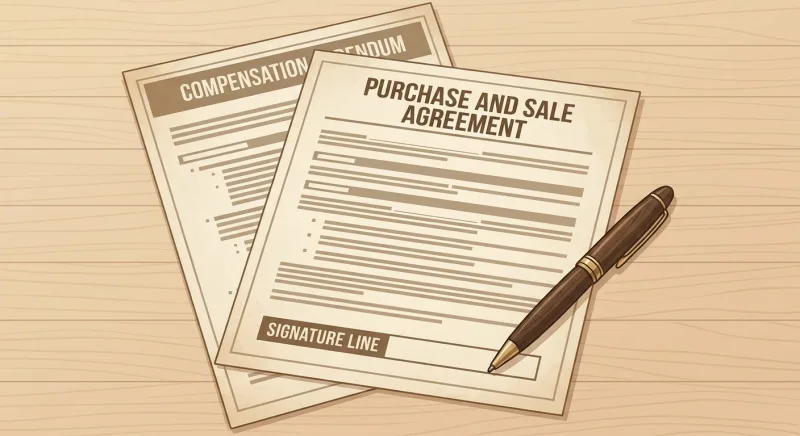
In Tennessee, the buyer-agent fee is documented in the purchase paperwork, most commonly the Tennessee REALTORS® Purchase and Sale Agreement (Form RF401), plus a compensation or concession addendum such as Form RF707. Tennessee law requires broker compensation arrangements to be in writing — see T.C.A. § 62-13-312 and § 62-13-404.
The offer on your flyer is marketing. The version on the signed contract is what actually pays.
Two additional items:
- Newer RF401 editions reference FinCEN's Residential Real Estate Rule reporting language (RF401 line 460). Standard financed sales are exempt, and a federal court vacated the rule in March 2026, but appeals continue — use the current form edition and monitor the situation.
- Match the closing disclosure. The fee needs to land as buyer-broker compensation, not a seller concession. If your title company miscategorizes it, you accidentally recreate the IPC problem you avoided. Ask the closer to confirm placement before signing.
General information, not legal advice. Use current form editions, verify statute citations, and have a Tennessee real estate attorney review your contract before signing.
Should You Offer a Buyer-Agent Fee at All?
Run it through four filters.
1. Inventory pressure in your submarket. In tight pockets (Franklin, Brentwood, East Nashville), buyer agents bring clients regardless — a fee buys little extra traffic. In slower markets, a competitive fee pulls showings.
2. Your net-proceeds math.
| Scenario | Sale price | Buyer-agent fee | Your net (before other costs) |
|---|---|---|---|
| No fee offered | $450,000 | $0 | $450,000 |
| 2.5% fee offered | $450,000 | $11,250 | $438,750 |
| Higher price to absorb fee | $461,250 | $11,250 | $450,000 |
Many sellers offering a fee simply price it in. Whether the market bears that higher number is a comps decision made before you list.
3. Buyer-agent behavior. Some agents still filter by whether a fee is offered. You can neutralize that by making a fee available off-MLS so represented buyers aren't quietly skipped.
4. Your appetite for negotiation. A stated fee simplifies the offer table. If you'd rather stay flexible, settle it deal-by-deal in the contract.
Edge Cases Most FSBO Guides Skip
The buyer has no agent. Don't offer a fee reflexively. State that a fee "is available" without naming a number, then negotiate at offer — that keeps the door open for represented buyers without giving away margin to unrepresented ones.
"What's the co-op?" On a flat-fee RealTracs listing, you are effectively the listing side with no commission to split. When a buyer agent asks out of old habit, redirect to a written compensation agreement or the seller-paid fee in the purchase contract.
The agent's buyer-rep agreement exceeds your offer. Buyers now sign representation agreements before touring — often committing to a set fee (say 3%). If you're offering 2%, that gap becomes the buyer's obligation or a negotiation point. Your offered fee is a ceiling on your exposure, not a promise to the agent's contract. Put the exact dollar figure in the purchase agreement so there's no ambiguity about who covers any shortfall.
Frequently Asked Questions
Can a Tennessee FSBO seller still offer a buyer-agent commission after the NAR settlement?
Yes. Post-NAR settlement rules changed where you can advertise compensation, not whether you can offer it. You can still legally offer and pay a buyer-agent fee — you just can't publish that offer inside RealTracs.
Can you advertise buyer-agent commission on RealTracs in 2026?
No. Under RealTracs' 2026 Rules and Regulations, any mention of cooperating-broker compensation is banned in Public Remarks, Private Remarks, and uploaded documents or flyers. Violations are enforced under the RealTracs Infraction and Fines Schedule.
Does a seller-paid buyer-agent fee count against loan limits in Tennessee?
No. Under current GSE guidance, a seller-paid buyer-agent fee sits in a separate bucket from seller concessions and is generally excluded from standard Interested Party Contribution (IPC) caps. Confirm treatment with your lender before closing.
How do you legally document a seller-paid buyer-agent fee in Tennessee?
In writing, through the Tennessee REALTORS® Purchase and Sale Agreement (Form RF401) and a compensation or concession addendum such as RF707. Tennessee law (T.C.A. § 62-13-312 and § 62-13-404) requires broker compensation arrangements to be in writing.
Where can I legally advertise a buyer-agent fee off the MLS?
On yard signs and riders, non-MLS flyers, your own website, social posts, and directly to buyers or their agents through a buyer-broker compensation agreement — all subject to truthful TREC advertising standards. The RealTracs database is the only place it's prohibited.
Do these rules apply outside Middle Tennessee?
The off-MLS principle is statewide, but your local MLS governs the specifics. RealTracs covers Middle Tennessee; KAAR covers Knoxville, MAAR covers Memphis, and Greater Chattanooga REALTORS® covers the Chattanooga metro.
Putting It Together
The headlines scared many Tennessee sellers into thinking they could no longer pay a buyer's agent. That was never true. What changed is narrow but strict: you can't advertise compensation anywhere inside RealTracs, and RealTracs enforces it under its Infraction and Fines Schedule.
Work the two lanes separately. Keep your RealTracs listing completely silent on commission. Make your offer loud everywhere the rules allow — yard sign, flyers, your own website, direct conversations with buyer agents. Put the number in writing where it counts, on Form RF401 and a proper addendum, structured so the fee lands in Bucket Two and doesn't collide with your buyer's IPC caps at underwriting.
One honest caveat: RealTracs policy and lender guidance have both shifted more than once since 2024. Confirm current field labels, TREC advertising standards, and your buyer's loan rules before you act. This is general information, not legal or lending advice.
When you're ready, ResultsMLS files your listing on RealTracs correctly the first time — with the concession field handled right — for a flat fee. You keep control of the sale.