
The Short Answer
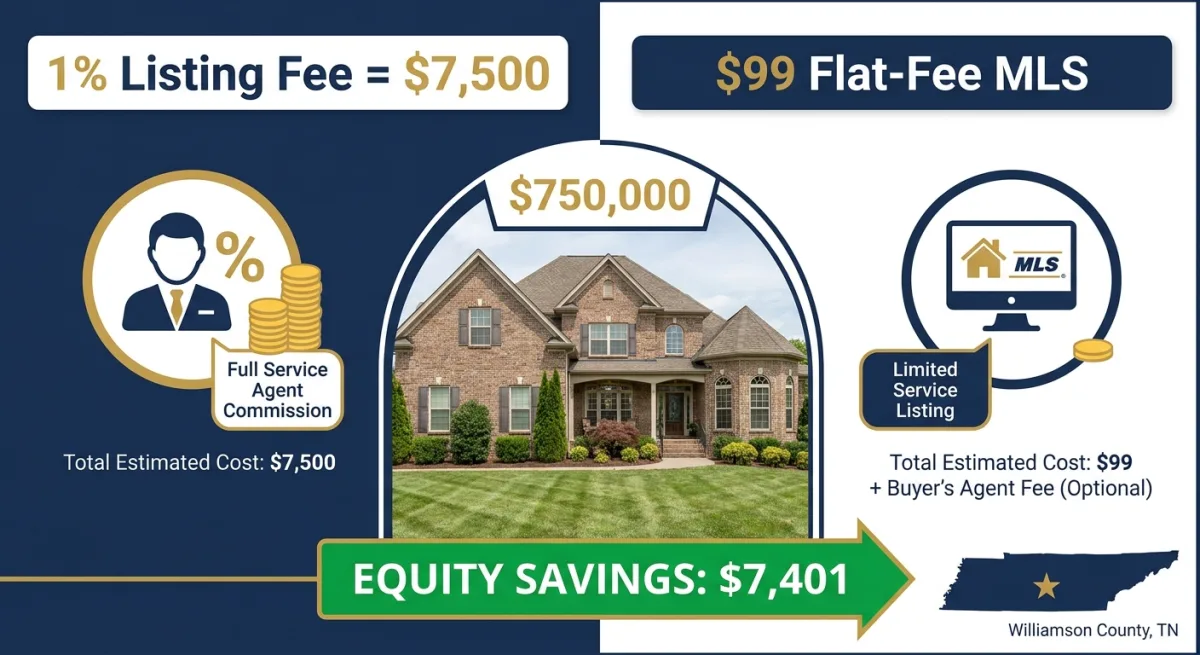
$7,500 versus $99. That's the listing-side gap on a $750,000 Brentwood home the second you sign a 1% listing agreement instead of a flat-fee MLS listing.
Here's the verdict up front: on price alone, the $99 flat-fee MLS wins by about $7,400 on the listing side. A 1% listing broker in Tennessee charges roughly $7,500 on that same home; a true flat-fee limited-service listing charges $99 upfront and nothing at closing. No amount of "full service" marketing changes that arithmetic.
But price isn't the whole story. At $750K, the 1% pitch sometimes earns its premium — just not for the reasons the brochure gives.
One thing to nail down first: the buyer-agent commission is a separate line item. Under the NAR settlement effective August 17, 2024, what you offer a buyer's agent is negotiated on its own — and it's the same decision whether you list at 1% or at $99. Keep those two numbers apart in your head. The listing fee is where the two models actually diverge.
What Each Model Actually Is
A 1% listing broker is a licensed Tennessee brokerage that lists your home on RealTracs for a commission of roughly 1% of the sale price, paid at closing out of your proceeds. Some are full-service (photos, pricing help, showing coordination, contract-to-close). Others trim service to hit the lower fee. Two things define the model: the fee is a percentage taken at closing, and that percentage scales with your price. On a $750,000 home, 1% is $7,500. On a $1.2M home, it's $12,000. The number climbs with your equity, not with the work.
A flat-fee MLS listing is a limited-service listing. You pay a flat upfront fee — $99 in a true no-closing-cost model — to a TREC-licensed broker of record who places your home on RealTracs. From there it syndicates to Zillow, Realtor.com, and Redfin through MLS Grid. You keep the parts a 1% broker would handle: setting your price, fielding showings (usually via the ShowingTime app), reviewing offers, and signing the TAR purchase and sale paperwork. No listing agent, no listing-side commission. The broker of record satisfies RealTracs' requirement that a licensed broker submit the listing; you run the rest.
The scope difference is the whole ballgame. One model rents you a fee that grows with your equity. The other charges a fixed price to put you on the same MLS.
The Real Math on a $750,000 Brentwood Home
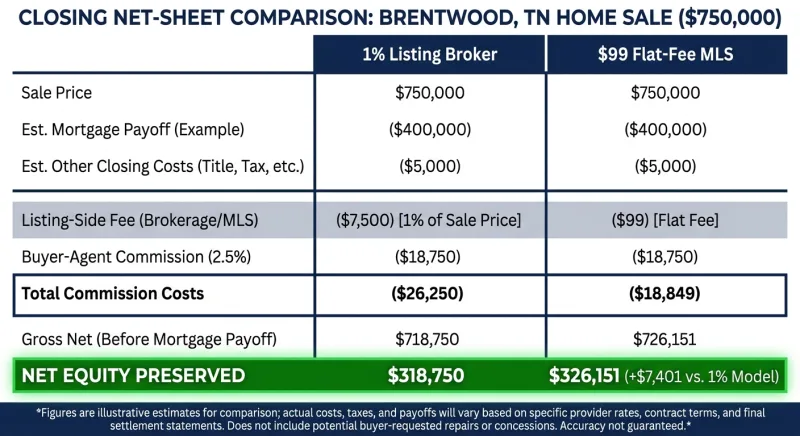
This is where sellers in 37027 stop skimming. Let's build the actual net sheet, with the buyer-agent commission set at 2.5% in both columns — because that number is identical no matter which listing model you choose.
| Line item | 1% Listing Broker | $99 Flat-Fee MLS |
|---|---|---|
| Sale price | $750,000 | $750,000 |
| Listing-side fee | $7,500 (1%) | $99 (flat, upfront) |
| Buyer-agent commission (2.5%) | $18,750 | $18,750 |
| Total commission/fee outlay | $26,250 | $18,849 |
| Equity preserved vs. the other model | — | +$7,401 |
Assumptions: illustrative $750,000 sale price for a Brentwood (37027) home; 1% listing fee = $7,500; flat-fee MLS = $99 upfront with $0 closing-table fee; buyer-agent commission set at 2.5% in both columns and shown identical because it is negotiated separately under post-Aug-2024 NAR rules. Excludes title, transfer tax, payoff, and other standard closing costs, which are the same under both models. Not a quote — your numbers depend on your negotiated terms.
The buyer-agent line — $18,750 — is the same in both columns. Strip it out and you're staring at the only number that actually changes: $7,500 vs. $99. $7,401 saved. On one line item.
Watch the Closing Statement: Where "Cheap" Gets Expensive
Not every "flat fee" listing is actually flat, and a 1% quote isn't always just 1%.
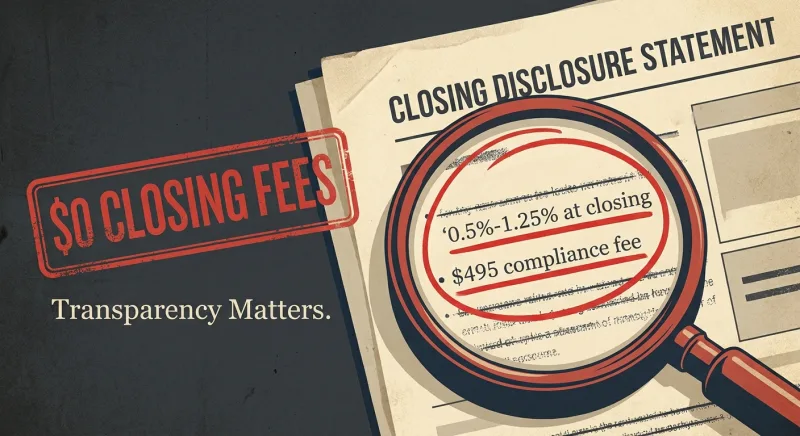
Some flat-fee services advertise a low upfront price, then attach a percentage at closing — commonly 0.5% to 1.25% — that erases most of your savings. On a $750,000 home, even a 0.5% closing-side cut is $3,750. That "$99 listing" just became $3,849 in real terms. Others tack on a compliance or transaction fee, often $395–$495, buried in the paperwork.
Before you sign anything, hunt for three things in the fee schedule:
- A percentage tied to sale price anywhere outside the buyer-agent line.
- A "compliance," "transaction," or "broker admin" fee listed separately from the upfront charge.
- The word "at closing" attached to any dollar figure or percent.
A true flat-fee model charges the fee once, upfront, with $0 at the closing table on the listing side. That's the version the $99 vs. $7,500 comparison assumes.
When your settlement statement arrives, scan the "Seller Charges" section for any percentage you didn't authorize in writing, any compliance/processing/transaction coordinator fee, and any referral fee payable to the listing broker. If your provider can't confirm a single flat line charged once, upfront, with zero seller-side broker deductions at the table — you've found a hybrid, not a flat fee.
The Buyer-Agent Commission Is the Same Decision Either Way
Under the NAR settlement effective August 17, 2024, offers of buyer-agent compensation can no longer be advertised on the MLS, and buyers now sign a buyer broker agreement before touring homes. Whether — and how much — you offer a buyer's agent is a negotiation handled through the offer and the TAR contract, not a fixed MLS field.
You can offer 2.5%, a flat amount, or nothing. The point: don't let a 1% broker fold "we'll handle the buyer-agent commission" into their pitch as if it's a service only they provide. That commission comes out of your proceeds in both models, at the number you agree to. It's your call either way.
The Slippage the 1% Fee Doesn't Show You
A 1% broker earns on volume and standardization — they need deals to close predictably. That creates a quiet incentive: price the home to move, not to max. A broker who nudges you to list at $735K instead of $750K to guarantee a fast contract has cost you $15,000 of ceiling — double the entire fee they charged. And 1% of $750K ($7,500) versus 1% of $735K ($7,350) is a $150 difference to them over a $15,000 difference to you. Their skin is thin at exactly the margin that matters most.
A true flat-fee model has a cleaner relationship to your money: it simply isn't in it. The fee is paid, the listing goes live on RealTracs, and every negotiated dollar flows straight to your equity.
The Honest Verdict: When Each One Actually Wins
Think of it as two sliders.
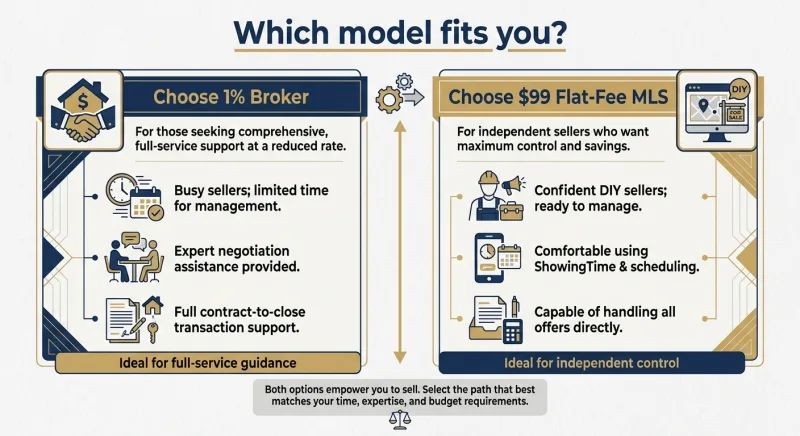
Slider one — your DIY capacity. Can you run showings through the ShowingTime app, respond to buyer-agent inquiries within hours, and read an offer confidently? High capacity slides you toward $99.
Slider two — deal complexity. A cash offer on a well-priced Brentwood home closing in 21 days is simple. A financed offer with repair negotiations, an appraisal gap, and a picky buyer's agent is complex.
- High capacity + simple deal: $99 flat-fee wins outright. Keep the $7,400.
- Low capacity + complex deal: 1% likely earns its premium.
- High capacity + complex deal: $99 with an à-la-carte transaction coordinator (~$400–$600) usually beats paying a full percent.
- Low capacity + simple deal: a 1% broker is most likely overpaying for a deal that would've closed itself.
Edge cases where the math bends
- Relocation seller under a hard deadline. A missed inspection deadline can cost you a second listing cycle and weeks of carrying two mortgages. The 1% broker's execution earns part of its premium — though a transaction coordinator recaptures most of the gap.
- Estate or trust sale. Multiple heirs and documentation-heavy TAR execution. If no heir is local and DIY-confident, full service reduces real risk.
- Over-improved or hard-to-comp home. You can buy a single paid CMA ($300–$500) and still list flat-fee. Buying the intelligence doesn't require buying the whole package.
- Multiple offers in a hot pocket. The flat-fee model shines — the market is doing price discovery for you. Paying $7,500 to help pick between competing offers on a home selling itself is the weakest possible spend.
At $750K, "only 1%" is still seven grand and change. The right question isn't "which is cheaper." It's "will I actually use $7,400 worth of service?"
Run Your Own Break-Even
Step 1. Set your listing-side delta: $7,500 minus $99 = $7,401 in play.
Step 2. Add à la carte costs you'd actually buy — transaction coordinator (~$400–$600) plus an optional CMA ($300–$500). Call it $1,000. Real flat-fee spend ~$1,099; true delta narrows to ~$6,400.
Step 3. For the 1% broker to break even at $6,400, they'd need to net you 0.85% more on sale price ($6,400 ÷ $750,000). Ask honestly: will this broker get you nine-tenths of a percent more than you'd get listing it yourself on RealTracs with a professional CMA in hand?
Step 4. Weight for your edge case. Relocation or estate seller? Tilt toward the broker. Confident 37027 seller in a low-inventory pocket? The math rarely justifies $6,400.
How to List Your Brentwood Home Flat-Fee on RealTracs
- Choose a TREC-licensed broker of record offering a limited-service flat-fee listing in Middle Tennessee.
- Submit your listing details and photos. Your address, description, price, and images go into RealTracs, which syndicates via MLS Grid to Zillow, Realtor.com, and Redfin.
- Set your showing method. Most flat-fee listings route showings through the ShowingTime app.
- Decide your buyer-agent offer and how you'll handle it in the TAR contract.
- Field and negotiate offers, then sign the TAR purchase and sale agreement. You handle inspection responses and coordinate with the title company through closing.
You're on the same MLS a 1% broker would use — you just kept the listing-side fee in your pocket.
Two questions to ask before you sign anything, 1% broker or flat-fee alike: "Show me every line you appear on in my closing statement," and "Is there any percentage-based or compliance fee at closing — yes or no?" A dodge on the second means it's a hybrid wearing a flat-fee costume.
Ready to keep your Brentwood equity? [List your 37027 home flat-fee on RealTracs →]
All dollar figures use a $750,000 sale price as a worked illustration for Brentwood (37027). Commission and fee amounts are examples, not quotes; all commissions are negotiable post-NAR settlement (effective August 17, 2024). Verify any specific company's current published pricing before deciding.
Frequently Asked Questions
Is a 1% listing fee cheaper than flat-fee MLS in Tennessee?
No. On a $750,000 Brentwood home, a 1% listing fee runs about $7,500 versus roughly $99 for a flat-fee MLS listing — that's about $7,401 more on the listing side alone (illustrative math; buyer-agent commission is separate and identical in both models).
Do you still pay buyer-agent commission with flat-fee MLS in Brentwood?
Yes, if you choose to offer one — and it's the same negotiated decision whether you use a 1% broker or a $99 flat-fee listing. Under the NAR settlement effective August 17, 2024, buyer-broker compensation can no longer be advertised in the MLS and is negotiated directly on the offer.
How much do you save selling a $750K Brentwood home with flat-fee MLS vs 1%?
Roughly $7,400 on the listing side (illustrative), since you pay a one-time flat fee instead of a percentage-based listing commission — but it assumes you're comfortable handling showings, offers, and TAR paperwork yourself.
Are there hidden closing fees with flat-fee MLS in Tennessee?
Sometimes. Some services advertise a low upfront fee but add a percentage at closing (often 0.5%–1.25%) or a compliance/transaction fee. Read the pricing page carefully and always confirm a service's fee structure against its own current, dated pricing page.
Can you list on RealTracs without a full-service agent?
Yes. A TREC-licensed broker of record can place your home on RealTracs through a limited-service flat-fee listing, which syndicates via MLS Grid to major portals. You keep control of showings and negotiations while the broker handles the MLS entry.
The Bottom Line
On a $750,000 home in Brentwood, the listing side is the only place these two models differ: about $7,500 for a 1% broker versus roughly $99 for a flat-fee MLS listing. The buyer-agent commission is the same negotiated line item either way, so it cancels out — leaving roughly $7,400 in equity between the two paths.
A 1% broker earns that premium when you want pricing help, contract-to-close coordination, and a pro handling negotiations. The $99 route wins when you're confident managing ShowingTime, fielding offers, and working through TAR paperwork yourself.
Run your own numbers against your own comfort level. If you'd rather keep that $7,400 and steer your own sale, a true $0-closing-fee flat-fee MLS listing puts your Brentwood equity where it belongs: in your pocket, not a commission line.