

Selling a House As-Is in Tennessee: The Complete FSBO Paperwork Checklist
The short version: In Tennessee, selling a house as-is does not waive your legal duty to disclose known defects. Selling a house as-is in Tennessee paperwork still requires a completed Tennessee Residential Property Condition Disclosure (Form RF201) or, in narrow cases, a disclaimer (Form RF204) — plus six non-waivable statutory disclosures under Tenn. Code Ann. § 66-5-201 et seq. As-is is a condition, not a disclosure loophole.
That single point is where most guides get it wrong. National FSBO blogs push you toward cash buyers and tell you "as-is" means "sell blind." Under TN law, it doesn't. It means you're offering no repairs — not that you can hide a leaking foundation or a failing septic system you already know about. Get that distinction wrong and you're inviting a post-closing lawsuit.
This checklist is built on Tennessee statute and the actual Tennessee REALTORS® RF-series form codes your title company and escrow officer expect — RF201, RF203, RF204, RF205, RF209, and RF401. Real form numbers, real § citations, updated for the July 2024 sinkhole change under Public Chapter 510. The paperwork is where FSBO deals live or die. Let's get yours right.
This guide is educational, not legal advice; Tennessee forms and statutes change — verify current text before closing.
What "As-Is" Actually Means Under Tennessee Law
Selling as-is doesn't mean selling blind.
In Tennessee, "as-is" is a condition of sale — you're telling buyers you won't fix anything. It is not a disclosure loophole. You still owe buyers the truth about defects you already know about. That distinction is where a lot of for sale by owner Tennessee deals go sideways after closing.
Here's the legal spine. The Tennessee Residential Property Disclosure Act (Tenn. Code Ann. § 66-5-201 et seq.) requires sellers of residential property to disclose the condition of the home before the contract is binding. Nothing in the statute carves out an exception for as-is sales.
Patent vs. latent defects
Tennessee law draws a line between two kinds of problems:
- Patent defects — visible issues a buyer could see on a normal walkthrough (a sagging porch, water stains, a cracked driveway). As-is genuinely covers these. The buyer took the home as they saw it.
- Latent defects — hidden problems a buyer can't reasonably discover (a leak behind a finished wall, a foundation repaired and painted over, a septic system that backs up every spring). As-is does not protect you here.
Your duty runs to known material defects — the things that would affect a reasonable buyer's decision or the price. Critically, the law asks you to disclose what you know. It does not require you to hire inspectors or hunt down defects you're unaware of.
So the honest rule: if you know about it, and it's material, you disclose it — no matter how loudly the listing says "as-is."
The as-is clause is a trap, not a shield
The national guides treat the as-is clause as your protection. It's closer to your biggest liability exposure. Sellers read "as-is" and stop disclosing because the contract says as-is. That's exactly backward. The more you sell as-is, the more important your written disclosure becomes — because when a buyer later finds a latent defect, your only defense is a paper trail proving you disclosed it.
The three-part test that decides liability
Sellers who get sued almost always fail one of these three:
- Actual knowledge — did you know the defect existed? (Not "should have known.")
- Materiality — would it affect a reasonable buyer's decision or the price?
- Concealment or misrepresentation — did you actively hide it, or answer falsely on the form?
Miss all three and you're clean. Hit all three and "as-is" won't save you — fraudulent concealment survives an as-is clause in Tennessee. You can sell a house with a failing foundation. You cannot sell it while checking "no known structural issues" when you paid a company to jack it two years ago.
Bottom line: the as-is line protects you from repairs, and the disclosure form protects you from lawsuits. You need both.
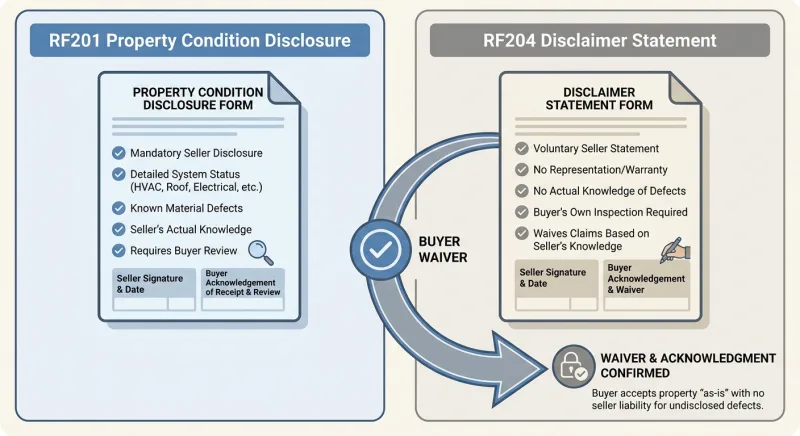
Form RF201 vs. RF204: Disclosure or Disclaimer?
Every Tennessee FSBO seller faces one early fork: do you disclose the property's condition, or disclaim it? These are two different Tennessee REALTORS® forms, and picking the wrong one — or assuming as-is lets you skip both — is a common, expensive mistake.
| RF201 (Disclosure) | RF204 (Disclaimer) | |
|---|---|---|
| What it does | You affirmatively state known conditions, system by system | The buyer knowingly agrees to accept the property without a condition disclosure |
| When it's valid | The default for most residential sales | Only on a knowing buyer waiver (§§ 66-5-202 / 66-5-210) |
| Your exposure | Lower — you documented what you knew | Higher if a latent defect surfaces and the waiver wasn't properly executed |
| Best for | Sellers who know the home well | Estates, inherited property, sellers with genuinely no knowledge |
Source: Tenn. Code Ann. §§ 66-5-201 to 66-5-213; Tennessee REALTORS® form library.
RF201 — the disclosure. The standard route. You cover the structure, roof, systems (electrical, plumbing, HVAC), water and sewer, and known defects. Most FSBO sellers use it because it's the cleanest liability shield: you documented what you knew, in writing, before closing.
RF204 — the disclaimer. This lets a buyer accept the property without a full condition disclosure — but only if the buyer knowingly waives it under §§ 66-5-202 and 66-5-210. You can't force it on a buyer; both parties have to agree. Use it because you truly have no knowledge — an estate sale, say — not because it's less paperwork. And note the trap: a disclaimer waives the general condition disclosure. It does not waive the six non-waivable disclosures below, and it does not waive federal lead-paint duty. Sign an RF204 and stay silent on a known injection well, and you've traded one liability for a worse one — now there's a signed document proving you chose disclaimer over disclosure while sitting on a mandatory item.
The exemption forms: RF203 and RF205
Some transactions are exempt from the standard disclosure requirement entirely — court-ordered sales, transfers between co-owners, certain estate and foreclosure transfers, and others under Tenn. Code Ann. § 66-5-209. When an exemption applies:
- RF203 — Exemption Notification (Property Condition Disclosure)
- RF205 — Exemption Notification (Disclaimer)
Don't conflate this with an as-is sale. An exemption removes the statutory disclosure obligation entirely; an as-is clause only removes the repair obligation. If you're selling a straightforward owner-to-buyer resale, you're in RF201 territory. Selling through a trust or estate? Check the exemption list first.
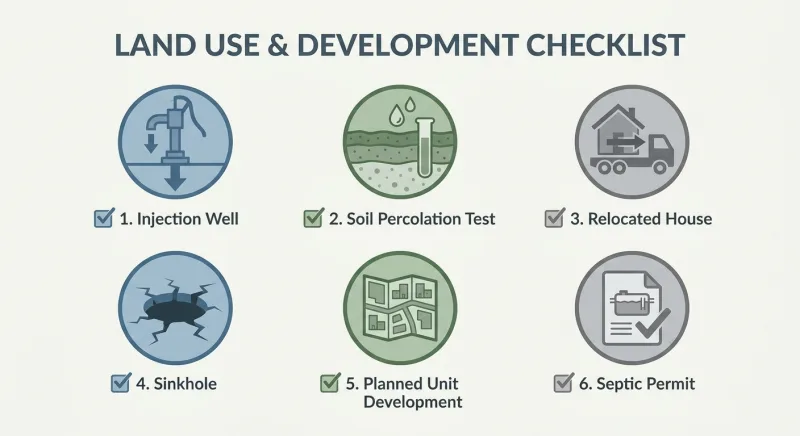
The Six Non-Waivable Disclosures in a Tennessee As-Is Sale
Here's the piece almost no national FSBO guide covers: even if a buyer signs a disclaimer, and even in a full as-is sale, Tennessee law says certain facts must be disclosed. They cannot be waived away — and each maps to a specific statute, which is exactly the precision an escrow officer checks.
- Sinkholes — under the § 66-5-212(c) definition. (Updated in 2024 — more below.)
- Exterior injection wells on the property (§ 66-5-212).
- Failed soil percolation ("perc") tests for a subsurface sewage system (§ 66-5-212).
- Relocated foundations — a home moved onto the property (§ 66-5-212).
- Planned Unit Development (PUD) status — affects HOA obligations, shared maintenance, use restrictions (§ 66-5-213).
- Septic permit issues under a sewer moratorium — where a subsurface sewage disposal permit is affected by a sewer construction moratorium (§ 68-221-409).
Confirm current statutory text before you rely on any single item; Tennessee amends this chapter regularly.
The 2024 Sinkhole Update: Public Chapter 510
This is the freshness edge national blogs haven't caught up to. Effective July 1, 2024, Public Chapter 510 revised the sinkhole definition under Tenn. Code Ann. § 66-5-212(c) and prompted Tennessee REALTORS® to update the affected forms — RF201, RF203, RF204, and RF205.
Most guides — if they mention it at all — just say "you have to disclose sinkholes." That misses the mechanism. The operative definition is broader than the picture in most sellers' heads. A "sinkhole" isn't only a dramatic collapse; it reaches subsurface conditions — depressions, subsidence, karst features common across Middle and East Tennessee limestone — that a seller knows have affected or could affect the property.
If your home sits in a karst belt (much of the Central Basin around Nashville, the Highland Rim, parts of the Ridge and Valley) and you've had any subsidence event, grouting, or a geotechnical report, that's now squarely a known material defect. An old pre-2024 RF201 pulled off a random website won't have the updated language — a quiet way to under-disclose without meaning to. Use the current form version. Check any downloaded form's revision date against July 2024.
One more thing on timing: if a report comes back after you signed the disclosure, Tennessee expects a supplemental disclosure before closing. The knowledge test runs up to the closing table, not just to the day you listed.
Federal Lead Paint Disclosure: Form RF209
State law isn't the whole story. Some disclosures aren't Tennessee's to waive.
If your home was built before 1978, you must provide a lead-based paint disclosure. This comes from the federal Residential Lead-Based Paint Hazard Reduction Act (42 U.S.C. § 4852d and 40 CFR Part 745). No state waiver, disclaimer, or as-is clause removes it — federal law wins.
The federal rule requires you to:
- Disclose any known lead-based paint or hazards, along with any records or reports you have.
- Give the buyer the EPA pamphlet "Protect Your Family From Lead in Your Home."
- Provide a 10-day opportunity for the buyer to conduct a lead inspection (waivable by the buyer, not by you unilaterally).
In Tennessee, this is Form RF209. The 1978 threshold is a hard line — one day older and you owe the disclosure. Because it's federal, RF209 sits on top of your RF201 or RF204; you don't get to choose one or the other. Penalties here are federal, not a private state suit, which is why "the buyer waived everything" is a dangerous assumption.
The Complete As-Is FSBO Paperwork Checklist
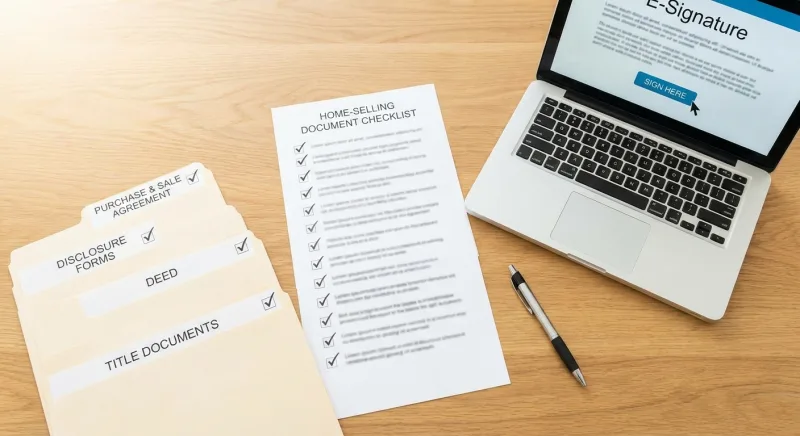
Here's the master list. When you sell house as-is without a realtor in Tennessee, this is the document stack that has to be right — and the routing matters as much as the count. Your documents move in three waves, each aimed at a different party.
Wave 1 — Disclosure & condition documents (seller → buyer, before contract):
- ☐ RF201 — Property Condition Disclosure (or RF204 disclaimer, if buyer knowingly waives)
- ☐ RF209 — Lead-Based Paint Disclosure (pre-1978 homes only)
- ☐ The six non-waivable disclosures — sinkhole, injection well, failed perc test, relocated foundation, PUD status, septic permit under moratorium (if any apply)
- ☐ Subsurface sewage disposal system permit — copy for buyer if home is on septic
- ☐ RF203 or RF205 — only if your sale qualifies for a statutory exemption
- ☐ Any known-defect supplements
Deliver these late — after the purchase agreement is signed — and you've weakened their protective value. They exist to establish informed consent before the buyer is bound.
Wave 2 — Contract documents (buyer ↔ seller):
- ☐ RF401 — Purchase and Sale Agreement (the binding contract; add a clear "as-is" provision here)
- ☐ Any counteroffers and addenda — signed and dated by both parties
The purchase agreement is the spine your title company builds the file around. Ambiguity here — a fuzzy as-is clause, an undefined contingency — is what stalls closings.
Wave 3 — Title & closing documents (seller → closing agent):
- ☐ Deed — prepared by an attorney or title company, not the seller
- ☐ Title work / owner's title commitment — ordered through the title company
- ☐ Payoff statement — from your current lender
- ☐ Settlement statement (closing disclosure) — prepared by the closing agent
- ☐ HOA/PUD documents and septic permit records where applicable
- ☐ Transfer tax payment — Tennessee levies transfer tax at $0.37 per $100 of value; a few counties (Davidson and Shelby, for example) handle collection at the register's office slightly differently, so confirm with your closing agent.
The title underwriter cares about one thing: marketable, insurable title. Skip the septic permit on a septic property and the buyer's lender or title officer will stop the closing cold — not because you broke a disclosure rule, but because the file can't clear.
One form sellers forget: the deed itself. You don't write your own deed in Tennessee. Have the title company or a real estate attorney prepare it so the conveyance is valid and title stays marketable.
How to Legally Access the Tennessee REALTORS® Forms
Here's the honest catch nobody mentions. The RF-series forms — RF201, RF204, RF209, RF401, and the rest — are copyrighted by Tennessee REALTORS® and are generally available only to licensed members. That's why you can't just download an official RF201 from a free template site. The versions floating around are often outdated (see: the 2024 sinkhole update) and aren't the current, compliant forms your closing agent expects.
So how does a for sale by owner Tennessee seller get legal, current forms without paying a full 6% listing commission? One legal route is a flat fee MLS Tennessee listing. Because the listing is placed through a licensed flat-fee brokerage, you get the current Tennessee REALTORS® forms delivered electronically — typically through TransactionDesk with DocuSign e-signature — for a flat fee instead of a percentage-based commission. Your paperwork stays compliant, and your listing goes up on RealTracs and feeds the syndication buyers actually search.
Once your paperwork's in order, the last piece is exposure — and that's exactly where a flat fee MLS Tennessee listing does double duty.
Where DIY hits its limit — a complicated title question, an estate sale, an unusual waiver, or a defect you're unsure how to disclose — talk to a Tennessee real estate attorney or your title company. That's the honest referral. A checklist handles a clean as-is sale; it doesn't handle a contested probate or a clouded chain of title.
This guide is educational, not legal advice. Tennessee forms and statutes change — this article reflects law as of the 2024 Public Chapter 510 update. Verify current form versions and statute text before you sell.
Frequently Asked Questions
Does selling a house as-is in Tennessee remove my duty to disclose?
No. Under the Tennessee Residential Property Disclosure Act (Tenn. Code Ann. § 66-5-201 et seq.), selling as-is only signals you won't make repairs — you still must disclose known material defects. As-is is a condition, not a disclosure loophole.
What's the difference between Form RF201 and Form RF204?
RF201 is the property condition disclosure statement, where you affirmatively report the home's known condition. RF204 is the residential property disclaimer statement, valid only when the buyer knowingly waives disclosure under Tenn. Code Ann. §§ 66-5-202 and 66-5-210. RF204 does not erase the six non-waivable statutory disclosures.
What changed with the 2024 Tennessee sinkhole disclosure rule?
Public Chapter 510, effective July 1, 2024, updated the sinkhole definition under Tenn. Code Ann. § 66-5-212(c) and prompted revisions to Forms RF201, RF203, RF204, and RF205. Sellers must disclose known sinkhole activity even in an as-is sale — using the current form version.
Do I still need a lead-based paint disclosure if I'm selling as-is?
Yes, if your home was built before 1978. Federal law (42 U.S.C. § 4852d and 40 CFR Part 745) requires the lead-based paint disclosure (Form RF209) and delivery of the EPA "Protect Your Family From Lead in Your Home" pamphlet. Federal rules override any state as-is waiver.
How do I legally get the Tennessee REALTORS® RF forms without a full-service agent?
The RF-series forms are copyrighted by Tennessee REALTORS® and normally require a licensed member. A flat fee MLS Tennessee listing is one legal route — it delivers compliant forms electronically through TransactionDesk/DocuSign for a flat fee instead of a roughly 6% listing commission.
Can I sell my house as-is without a realtor in Tennessee?
Yes. Tennessee allows for sale by owner transactions, and you can sell as-is without a realtor as long as you complete the required statutory disclosures and a valid purchase and sale agreement. Many FSBO sellers use a title company or real-estate attorney to handle the closing documents.
Selling a house as-is in Tennessee comes down to one truth national blogs keep getting wrong: as-is means no repairs, not no disclosure. So here's your next move. Decide between RF201 and RF204, confirm whether your home predates 1978 for the RF209 lead disclosure, address any of the six non-waivable items that apply, and build your stack around a valid RF401 through closing. When a question crosses into legal judgment, bring in a real-estate attorney or title company — that's not a weakness, it's how careful FSBO deals stay out of court.
The paperwork is where FSBO deals live or die. Get it right, and the last piece is exposure — that's where a flat fee MLS Tennessee listing comes in, delivering the compliant RF forms electronically for a flat fee.
This guide is educational, not legal advice. Tennessee forms and statutes change — verify current requirements with the primary sources or a licensed professional before you sign anything.