

You're probably handling a parent's estate and a house at the same time. Here's the order things actually happen in.
You can sell an inherited house in Tennessee without a realtor. The real work is the legal groundwork: who has authority to sign, when a title company will insure the sale, which deed to use, and what you must disclose. Get those right and the listing is the smaller job.
This guide is general information, not legal or tax advice. A Tennessee probate attorney or CPA can apply these rules to your estate.
Can You Sell an Inherited House in Tennessee Without a Realtor?
Yes. Tennessee doesn't require an executor or heirs to hire a real estate agent. Three gates decide whether the sale can happen, in order: authority (someone can legally sign), insurable title (a title company will close it), and documented value (you can show beneficiaries the price was fair).
Skip a gate and the sale usually stalls at closing, not at listing. Most online advice frames the choice as a full-service agent or a cash investor's discount. A third route, a flat-fee MLS listing, works once the first two gates are cleared.
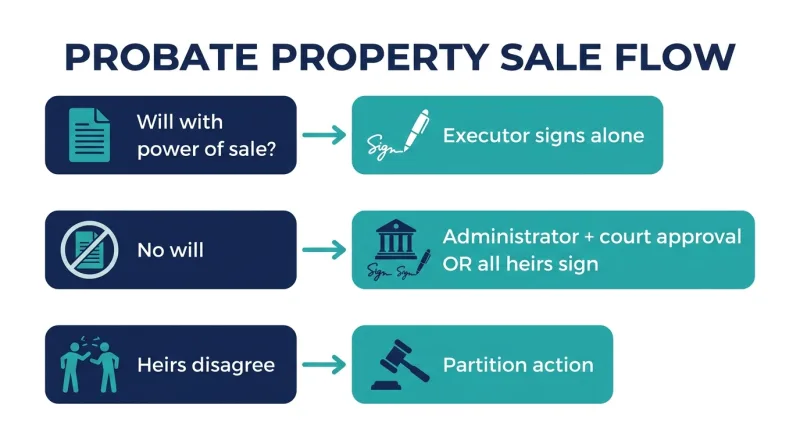
Who Has the Legal Authority to Sell?
In short: if the will names an executor and grants a power of sale, the executor usually signs alone. If there's no will, a court-appointed administrator typically needs court approval or every heir's signature. If heirs can't agree, a court can order the house sold.
The terms you'll see:
- Letters Testamentary confirm the executor named in a valid will.
- Letters of Administration do the same when there's no will.
- Personal representative is the umbrella term for either role.
Tennessee's fiduciary powers statute, TCA § 35-50-110, lets a will incorporate a broad set of powers, including the power to sell real estate. When the will grants that power, a Tennessee probate home sale generally doesn't need a separate court order. Without it, the sale may run through the court-supervised procedures in Title 30, or all heirs sign the deed together. If co-owners are deadlocked, any of them can file a partition action, and a court can order a sale under TCA § 29-27-201.
Some families skip full administration. A will can be probated as a muniment of title under TCA § 32-2-111, which records the will as proof of ownership. With no will, an affidavit of heirship is often recorded with the county Register of Deeds, though whether a title insurer accepts it is a separate question.
Where you file depends on the county. Davidson County probate runs through the Seventh Circuit Court. Shelby County has a dedicated Probate Court. Williamson, Rutherford and Montgomery counties use the Chancery Court Clerk & Master. Check your county clerk's website before filing.
Why Title Companies Make You Wait
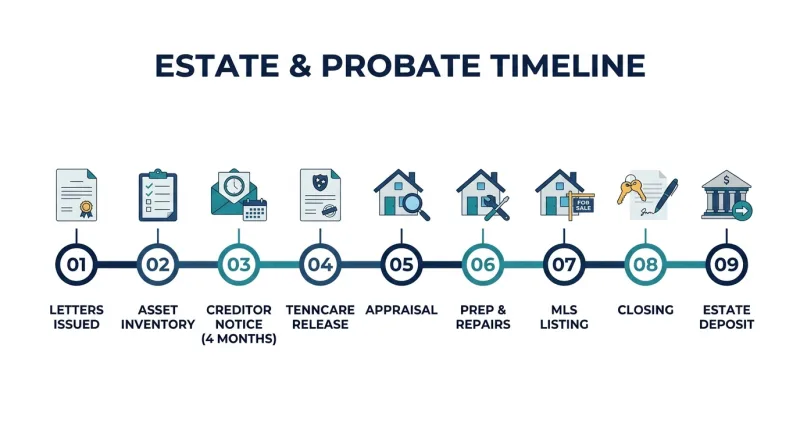
In plain terms, heirs own the house the moment the owner dies, but a buyer's title insurer won't insure that ownership until creditor claims and certain state claims are settled.
Under TCA § 31-2-103, real property "vests immediately" in heirs or devisees at death, subject to the personal representative's right to administer it. The estate can still reach the house to pay debts. That's the insurer's worry, and three items usually control timing:
- Notice to creditors. The personal representative publishes notice under TCA § 30-2-306.
- The creditor window. Claims are generally barred four months after first publication, or 60 days after a creditor receives actual notice if later (TCA § 30-2-307). An outer bar applies twelve months after death (TCA § 30-2-310).
- TennCare release. If the deceased was 55 or older or received certain TennCare benefits, the Estate Recovery Unit may have a claim under TCA § 71-5-116. Title companies commonly ask for a release.
Where people get stuck: the Small Estate Act covers personal property only, capped at $50,000 under TCA § 30-4-102. It can't transfer a house.
Which Deed Should an Executor Sign in Tennessee?
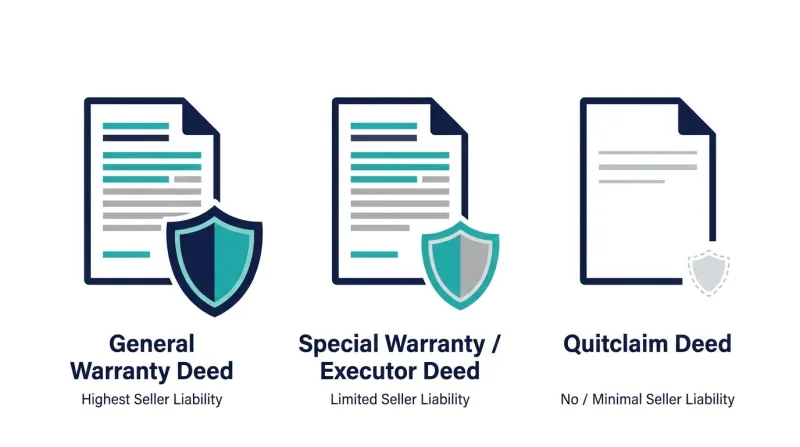
An executor should generally sign a fiduciary or special warranty deed, not a general warranty deed. A general warranty deed promises clean title all the way back, so an executor who signs one can end up personally liable for problems that started decades earlier.
| Deed type | What the signer promises | Fit for an estate sale |
|---|---|---|
| General warranty | Title is good against all claims, past and present | Poor. Personal exposure for the executor |
| Special warranty | No defects arose during the signer's ownership | Common for estates |
| Executor's / fiduciary deed | Signer has authority and acted within it | Standard where Letters exist |
| Quitclaim | Nothing beyond whatever interest exists | Between heirs, rarely to outside buyers |
An executor deed in Tennessee usually recites the Letters, the court and docket number, and the source of the power to sell. Buyers rely on their owner's title policy, which is why fiduciary deeds are widely accepted.
Worth paying a lawyer for: having a closing attorney or title company prepare the deed. It's recorded with the Register of Deeds under TCA § 66-24-101. The recordation tax is $0.37 per $100 of consideration under TCA § 67-4-409, customarily paid by the buyer.
What Disclosures Does an Executor Have to Make?
Executors are generally exempt from Tennessee's Residential Property Condition Disclosure, but not from federal lead-paint rules or the duty not to hide known defects. TCA § 66-5-209 exempts fiduciary transfers made while administering an estate.
What still applies:
- Lead-based paint. For homes built before 1978, 42 U.S.C. 4852d requires the lead disclosure form, the EPA pamphlet, and a 10-day inspection opportunity unless the buyer waives it.
- Known defects. If you know the basement floods, say so. As-is language doesn't cover concealment.
Check this before you list: use clear wording such as "Estate sale. Sold as-is. Personal representative has never occupied the property and makes no representations as to condition. Buyer encouraged to obtain inspections."
When the House Still Has a Loan
Reverse mortgages (HECM). The loan generally becomes due when the last surviving borrower dies. Heirs typically have 30 days to tell the servicer their plan and up to 6 months to sell, with two 90-day extensions possible if a sale is actively underway. HECMs are non-recourse: if the house is underwater, heirs can generally satisfy the loan for the lesser of the balance or 95% of appraised value. Answer the servicer in writing, early. An active MLS listing and a signed contract are the usual support for an extension.
Regular mortgages. The Garn-St Germain Act (12 U.S.C. § 1701j-3(d)) generally stops lenders from enforcing a due-on-sale clause when a home passes to a relative at death. Payments still have to be made. Keep the loan current from estate funds and register with the servicer as the estate's representative.
Heir Buyers and Out-of-State Executors
An executor who sells estate property to themselves, a spouse or a business partner is self-dealing. That sale is generally voidable unless the will authorizes it, every beneficiary consents in writing, or the court approves. A sale to a different heir gets similar scrutiny. Keep it clean with an independent appraisal, written consent from all beneficiaries on price and terms, a real contract through a title company, and any "against their share" credit spelled out.
Living out of state? Tennessee lets nonresidents serve as personal representative in some circumstances, which may require serving alongside a resident and appointing the Secretary of State as agent for service (Tenn. Code Ann. § 35-50-107). A bond may apply. The sale itself can usually run remotely through mail-away closings and Tennessee's remote online notarization, though some underwriters still want wet-ink signatures on fiduciary deeds. Locally, you'll still need a lockbox and someone to check the house weekly.
Use the Creditor Window as Prep Time
Those four months aren't dead time. Many estates list during the creditor window and set a closing date after it ends, so the house is ready to show when title becomes insurable.
The clock is running either way. Illustrative monthly costs: property tax $250, vacant-home insurance $150, utilities $175, lawn care $125. The math: that's $700 a month, or $7,000 over ten extra months before any loan payment. If a sibling wants to "wait for the market," that's the price. Renting the house out turns you into a landlord, rarely worth it for an estate expected to close within a year or two.
A practical sequence:
- Weeks 1–3: Re-key the locks and call the insurer. Many policies restrict coverage after a home sits vacant around 60 consecutive days, so you may need a vacant-dwelling policy.
- Weeks 2–6: Order payoff statements for any mortgage, reverse mortgage or HELOC.
- Weeks 3–8: Settle with the heirs who keeps what, then schedule the cleanout, usually the slowest step.
- Weeks 6–10: Order a date-of-death appraisal. It sets the stepped-up basis and anchors your price.
- Final weeks: Make only repairs that clearly pay back, photograph the empty house, request the TennCare release, and get the title company's requirements in writing.
Keep a sale log: valuation, listing date, showing activity, every offer (including rejected ones), price changes with reasons, and proof that proceeds went into the estate account. That log is the evidence that the price reflected fair market value.
Comparing Your Options: Agent, Flat-Fee MLS, FSBO or Cash
Cash-buyer sites lean on how hard probate is. But a cash buyer doesn't waive the need for Letters and clean title; that hassle is priced into the discount. Any inherited property FSBO in Tennessee still clears the same legal gates, so the real question is how much the marketing route costs the beneficiaries.
| Option | Upfront cost | Showings & negotiation | MLS exposure | Executor effort | Best fit |
|---|---|---|---|---|---|
| Full-service listing | Percentage commission at closing | Agent | Yes | Low | Executor can't be involved at all |
| Flat-fee MLS listing | One fixed fee | Executor | Yes | Moderate | Uncontested estate, clear title |
| FSBO without MLS | Minimal | Executor | No | High | Buyer already lined up |
| Cash / iBuyer offer | None, but a discounted price | Buyer | No | Lowest | Major damage or a cash-strapped estate |
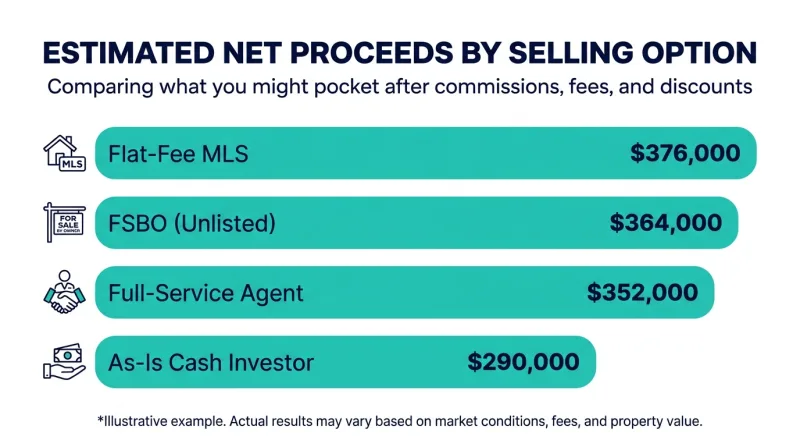
The math on a $350,000 home: cash investors commonly offer roughly 70–85% of market value. At 80%, that's $280,000, a $70,000 gap. An assumed 3% listing-side commission is $10,500. A flat-fee MLS listing is a fixed fee, a small fraction of that. Buyer-agent compensation is negotiable and separate in every scenario; since the 2024 NAR settlement changes, it's no longer offered through the MLS.
That $70,000 belongs to the beneficiaries, not the executor. Turning it down needs a reason: the house is uninhabitable, the estate can't carry it, or the heirs agree in writing that speed beats price. "Probate is complicated" isn't one.
An MLS listing on RealTracs or a regional MLS, syndicated to the major portals, also leaves a dated public record of exposure and offers, evidence that settles a family argument before it reaches a courtroom.
Pause the listing and call a probate attorney first if a beneficiary won't cooperate, an heir is living in the house, a later will surfaces, or the estate is contested. If a title search turns up liens or unpaid taxes, call the title company first. A house held in a revocable trust is a trustee sale, not a probate sale.
Frequently Asked Questions
Does selling an estate house require court approval in Tennessee?
Not always. If the will grants a power of sale, the executor can generally sell without a separate court order under Tenn. Code Ann. § 35-50-110. With no will, or a will that's silent, an administrator typically needs court approval under § 30-2-401 or the signatures of all heirs.
How long after death can you sell an inherited house in Tennessee?
You can sign a contract once Letters are issued. Title insurers commonly wait until the creditor period closes, four months from first publication under § 30-2-307, with an outer bar of twelve months from death under § 30-2-310.
Can you list an inherited house before probate closes?
Yes. The estate doesn't need to be closed. The personal representative needs Letters and authority to sell, and the closing date has to fit the title company's requirements, such as the end of the creditor window or a TennCare release.
Do all heirs have to sign, and can one heir force a sale?
If the executor holds a power of sale, other heirs usually don't sign the deed. Without it, all heirs generally must join, and an heir who wants out can ask a court for a partition by sale under § 29-27-201.
Do you pay capital gains tax on an inherited house in Tennessee?
Usually little or none if it sells near date-of-death value, because IRC § 1014 resets the basis to fair market value at death. Tennessee's inheritance tax was repealed for deaths in 2016 and later. Confirm your figures with a CPA.
How much does it cost to list an inherited house on the MLS in Tennessee?
A flat-fee MLS listing costs one upfront fee instead of the 2.5–3% listing-side commission common in full-service listings. Buyer-agent compensation is separate, negotiable, and can be paid from estate funds at closing.
Have These in Hand Before You List
- Certified copies of the Letters and the death certificate
- The title company's written list of what it needs to insure this sale
- A date-of-death appraisal
- Payoff statements for any loans, plus a vacant-dwelling insurance policy
- Signed agreement from heirs where their signatures are required
Once those are in place, a flat-fee MLS listing puts the house in front of the same buyers a full-service agent would reach. You handle the showings, and the listing-side commission stays in the estate.
Get the paperwork in order first. The listing is the easy part.