

The buyer moved in. Three weeks later they found water pooling in the crawl space, pulled up a floorboard, and saw the rot you swore you didn't know about. Now there's a letter from a lawyer on your kitchen counter.
That's the fear that brings most Knoxville FSBO sellers to this page. So let's answer it straight.
Short version: You avoid a Tennessee disclosure lawsuit by completing the Tennessee Residential Property Condition Disclosure honestly, in writing, before the buyer is contractually bound — because under the Tennessee Residential Property Disclosure Act (T.C.A. § 66-5-201 et seq.), what gets sellers sued is not the defect itself, but hiding it. Selling without an agent is legal in Tennessee. It just raises your disclosure risk, because nobody is double-checking your paperwork.
This guide is written by a Tennessee flat-fee MLS operator, not a law firm. We list Knoxville homes on the MLS every week, and disclosure is the number one question we field. What follows is educational information, not legal advice, and Tennessee statutes cited here are current as of 2026. For a decision this size, run it past a licensed Tennessee real estate attorney.
What Does Tennessee Law Actually Require You to Disclose?
The Disclosure Act governs almost every residential sale in the state and applies to you whether or not you use an agent. Being an unrepresented FSBO seller does not exempt you — it just means the responsibility sits entirely on you.
The law requires you to disclose the condition of the property, including known material defects and adverse facts that affect its value or desirability. A material defect is a problem a reasonable buyer would want to know about before deciding to purchase — a chronic roof leak, a cracked foundation, past flooding, faulty wiring, a septic system that backs up.
The standard is based on what you actually know. You are not required to inspect your home or hire experts to hunt for hidden problems. But once you know something, you cannot pretend you don't.
Timing matters as much as content. The completed disclosure must be delivered to the buyer before you accept their written offer. Hand it over after the contract is signed and you've already stepped into risk.
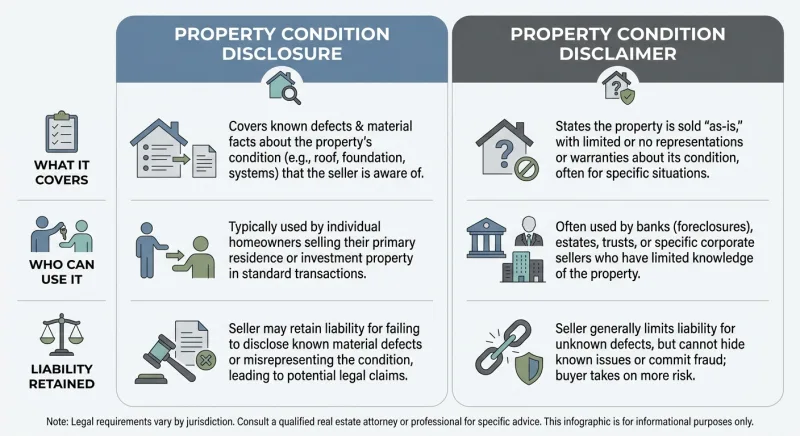
Disclosure vs. Disclaimer: Which One Actually Protects You?
Tennessee gives you two different documents, and sellers confuse them constantly.
A disclosure is you telling the buyer, in writing, what you know about the property's condition. A disclaimer (a property condition disclaimer statement) is you saying you're selling "as-is" and making no representations about condition at all. New sellers assume the disclaimer is the safer, quieter path. Often it isn't.
| Disclosure (Form RF201) | Disclaimer (as-is statement) | |
|---|---|---|
| What it does | States known conditions and defects in writing | Declines to represent condition |
| Who typically uses it | Standard residential sellers | Estates, relocation, sellers with no knowledge of the home |
| Liability for known defects | Protected if you disclosed honestly | Not protected — you still can't conceal known problems |
| Buyer perception | Transparent, builds trust | Can signal "something's being hidden" |
A disclaimer does not erase your liability for known material defects you actively conceal. You can decline to represent the property's overall condition. You cannot lie about the flooding you already know happens every spring.
The disclosure, done honestly, is usually your strongest shield. It creates a paper record proving you told the truth.
Does "As-Is" Protect You in Knoxville?
No — selling "as-is" does not protect you from a disclosure lawsuit if you knew about a defect and hid it. Tennessee law (T.C.A. § 66-5-208(b)) preserves the buyer's ability to pursue claims for fraudulent concealment and common-law misrepresentation, and "as-is" language does not override that.
"As-is" covers the unknown. It signals the buyer is accepting the property with whatever problems neither party knew about. What it never covers is the known-and-hidden.
What actually gets people sued is the seller who patched the ceiling stain, repainted over it, and answered "no known water damage" on the form. That's fraudulent concealment — and no "as-is" clause in Tennessee will save you from it.
If you genuinely don't know the home's history — an inherited property, an estate sale — an as-is disclaimer may be appropriate. But you still can't check "no" on a defect you actually know about.
How Long Can a Buyer Sue You After Closing?
Under T.C.A. § 66-5-208(a)(1), a buyer generally must bring a disclosure-based claim within one year — measured from the date the purchaser received the disclosure statement, the date of closing, or the date of occupancy, whichever occurs first.
One year. That's the core number.
But that limit applies to claims under the Disclosure Act itself. Claims grounded in fraud or the Tennessee Consumer Protection Act can carry different — sometimes longer — timelines. Actively concealing a defect can pull you into TCPA territory, where the exposure is broader. An honest, documented disclosure starts and protects that one-year clock in your favor. Concealment blows it wide open.
The Knoxville Disclosure Triangle: Three Hazards No Statewide Guide Covers
The same disclosure law applies statewide, but the facts you're required to disclose change dramatically in Knox County. When a seller asks "what will get me sued," the honest answer is almost never the leaky faucet. It's one of three geology-driven items a national FSBO template never mentions.
Corner 1 — Sinkholes and Appalachian Karst (T.C.A. § 66-5-212)
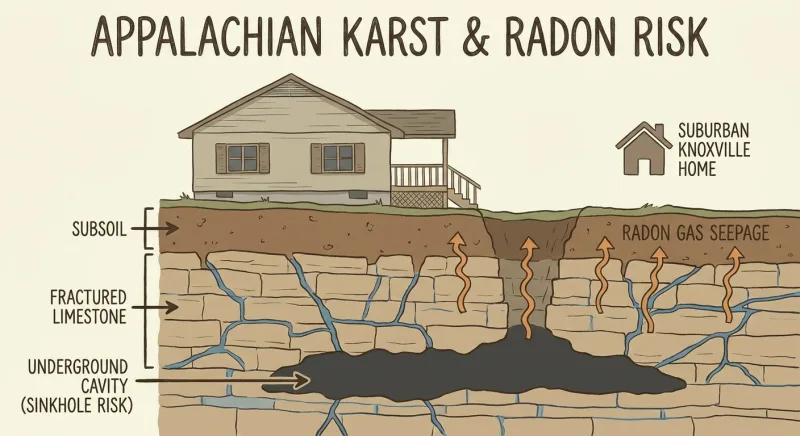
Knoxville lies in the Valley and Ridge province, built on soluble limestone bedrock. Karst dissolves over time, which is why sinkholes are a real feature of Knox County properties.
Under T.C.A. § 66-5-212, a seller must disclose the presence of any known sinkhole on the property — defined as a subterranean void created by the dissolution of limestone or dolostone, resulting in surface subsidence of soil, sediment, or rock.
That backyard depression that never drains? In Knox County karst terrain, it's a known adverse fact the moment you have reason to suspect it. Check TDEC's sinkhole and water-well records for your parcel, and disclose what you know.
Corner 2 — Radon (EPA Zone 1)
Much of the Knoxville metro falls inside EPA Radon Zone 1 — the highest predicted indoor radon category, driven by the same limestone geology that opens sinkholes.
Tennessee doesn't mandate radon testing for every FSBO sale. But if you know your home has elevated radon or you've had it mitigated, that's a material fact — disclose it. A buyer who runs a continuous radon monitor during inspection and finds an elevated reading you never mentioned has a story to tell later. TDEC distributes low-cost or free test kits. Testing before you list, then disclosing the result, converts a hidden risk into a documented fact.
Corner 3 — The Septic Bedroom Trap (T.C.A. § 47-18-104(b)(42))
This one gets FSBO sellers sued in ways they never see coming, and it lives outside the Disclosure Act entirely — inside the Tennessee Consumer Protection Act.
Septic systems in Tennessee are permitted for a specific number of bedrooms. If your county-approved subsurface sewage disposal permit says three, that's your legal bedroom count — even if there's a finished bonus room you'd love to call a fourth. Under T.C.A. § 47-18-104(b)(42), advertising more bedrooms than the permit authorizes is a deceptive act under the TCPA. For older homes, overstating the count can still expose you to common-law misrepresentation or fraud claims.
We've seen this go sideways when a seller markets "4 bed" to boost the price, and the buyer's lender or inspector pulls the permit showing three. Now the listing itself is the evidence.
The fix is simple and free: call the Knox County Health Department, verify the permitted bedroom count, and advertise that number.
Where Disclosure Liability Actually Comes From
A disclosure lawsuit almost never turns on the defect itself. It turns on what you knew and when.
Tennessee's duty is a knowledge-based standard, not strict liability. But the buyer's lawyer isn't trying to prove the crack exists — they're building a timeline that proves you knew. That timeline gets assembled from things you'd never think of as evidence:
- The contractor's invoice for "temporary" foundation shoring you paid two summers ago
- A neighbor's deposition that "everybody knew about the water in that basement"
- Your own text messages to a handyman
- Photos in an old listing showing a stain that's now painted over
- The mismatched drywall patch an inspector flags on the walkthrough
Once you've been put on notice — a prior inspection report, a repair estimate, a previous buyer who backed out over the same issue — "I forgot" stops being a defense. Dig up your records before you fill out the form.
The Silence-Plus Problem
There's a middle zone Tennessee courts treat harshly: partial disclosure. Volunteer a fact, then leave out the part that changes its meaning, and you may create liability you wouldn't have had by saying nothing at all.
Example: you disclose "roof replaced 2021" but omit that only the front slope was done and the back slope leaks. You spoke — now you owe the whole truth. If you open a topic, close it completely. Half a disclosure is often worse than an honest "unknown."
Materiality: What You Actually Have to Say
Not every quirk is disclosable. The dividing line is materiality — would this fact reasonably affect a buyer's decision or the price?
Disclose without hesitation if the item is:
- A structural, water, mechanical, or safety condition
- A repeat or recurring issue (even if "fixed")
- Something a professional ever flagged in writing
- Tied to a Knoxville-specific hazard — karst, radon, or septic
Use judgment (document your reasoning) on:
- Fully repaired, permitted, one-time cosmetic issues with no recurrence
- Neighborhood-level nuisances outside the property line
- Aesthetic preferences that aren't defects
The tiebreaker: when materiality is genuinely unclear, disclose. Over-disclosure has never lost a Tennessee seller a lawsuit. Under-disclosure is the entire lawsuit.
Building a Litigation-Proof Paper Trail
Since no agent is cross-referencing your form against your records, you have to be your own compliance check.
- Timestamp everything. Deliver the disclosure before the buyer is contractually bound, and keep proof of the delivery date. Timing is a statutory element, not a courtesy.
- Get a dated buyer signature acknowledging receipt. This one page collapses half the "I never saw that" arguments before they start.
- Attach your evidence, don't just describe it. Radon mitigation? Attach the install invoice and post-mitigation test. Septic repair? Attach the Knox County permit and pump-out receipt.
- Preserve the "unknown" honestly. If you truly don't know, write "unknown" — not "no." "No" is an affirmative representation you may have to defend.
- Keep the whole file past the one-year mark. If a claim lands, your file is your defense.
Edge Cases Knoxville FSBO Sellers Actually Hit
Inherited or estate property you never lived in. Your actual knowledge is genuinely limited, and Tennessee recognizes certain exemptions for estate transfers. But "I inherited it" is not a blanket pass. If the prior occupant's records put you on notice of a defect, that knowledge can transfer. Order a pre-listing inspection — it's cheap insurance.
The renovation you did yourself. Finished a basement, added a bathroom, or converted a garage without pulling permits? That's a disclosable fact, and it collides directly with the septic-bedroom issue. Unpermitted work isn't just a code problem — a buyer who discovers it can frame it as concealment.
Buyer waived inspection. A waived inspection weakens a buyer's "should have caught it" argument, but it never touches your disclosure duty or the fraud carve-out.
How Do You Legally Get Form RF201 as an Unrepresented Seller?
Form RF201 — the Tennessee Residential Property Condition Disclosure — is copyrighted by Tennessee REALTORS®. Random PDFs floating around the internet may be outdated, altered, or unauthorized, and using a stale version can leave gaps in your disclosure.
Two legitimate routes:
- A Tennessee real estate attorney can supply and review a compliant disclosure.
- A flat-fee MLS broker — a licensed brokerage — provides the current, authenticated form as part of the listing package, since you become their client for the limited listing service.
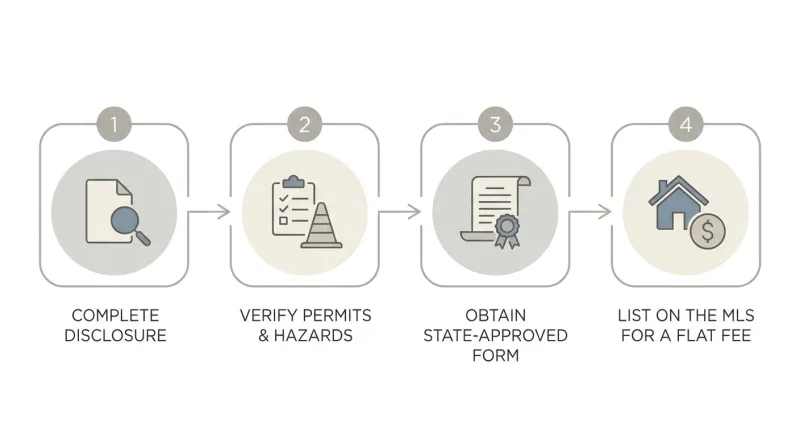
The Disclosure-First Sequence
Knoxville sellers get the order backwards — they rush to get the home in front of buyers, then scramble on paperwork. Do it the other way.
| Step | What you do | Why it goes here |
|---|---|---|
| 1. Diagnose the triangle | Walk for surface depressions, run a TDEC radon test, pull the septic permit | These three items become lawsuits, and all three take time to document |
| 2. Complete Form RF201 fully | Fill out the disclosure — sinkhole, radon, and adverse facts included | The Disclosure Act requires delivery to the buyer; honest completion is your shield |
| 3. Obtain the authenticated form | Get the copyright-compliant version, not a random PDF | A flat-fee package supplies the current, authenticated form |
| 4. List flat-fee on the MLS | Publish the accurate, permit-verified listing | You've scrubbed the two most dangerous representations before it goes public |
How Flat-Fee MLS Fits the Compliance Picture (Honestly)
Listing on the MLS without a full-service agent gives you two concrete things: the authenticated, current-version disclosure form supplied through a licensed brokerage, and actual MLS exposure so your compliant listing reaches the buyers and buyer's agents who drive the market.
What it doesn't do: reduce your legal liability, review your disclosures for accuracy, or make a hidden defect safe to hide. No product does. The liability lives with what you knew and how you handled it.
Flat-fee MLS is the compliant path to list — the right form, the right exposure, at a fraction of a listing commission. It is not a liability shield.
Ready to list? Get your Knoxville home on the MLS for a flat fee — with the authenticated disclosure form included — and skip the listing commission without cutting corners on compliance.
Frequently Asked Questions
Is it legal to sell your own house in Knoxville without a realtor? Yes. Tennessee allows for-sale-by-owner sales, and you can list on the MLS through a flat-fee MLS broker without hiring a full-service agent. You're still fully bound by the Tennessee Residential Property Disclosure Act (T.C.A. § 66-5-201 et seq.), so the disclosure duty is on you.
Can I get sued after selling my house "as-is" in Knoxville? Yes, if you knew about a defect and concealed it. Under T.C.A. § 66-5-208(b), an "as-is" sale does not shield you from fraudulent concealment or misrepresentation claims. As-is covers unknown problems, not known-and-hidden ones.
How long can a buyer sue me after closing in Tennessee? Generally one year. Under T.C.A. § 66-5-208(a)(1), a disclosure claim must be brought within one year of receipt of the disclosure statement, the closing date, or the date of occupancy, whichever occurs first. Fraud and Tennessee Consumer Protection Act claims can carry different, longer timelines.
Do I have to disclose a sinkhole or radon in Knoxville? You must disclose any known sinkhole under T.C.A. § 66-5-212. For radon — with much of Knox County in EPA Zone 1 — you must disclose known elevated levels or prior mitigation. Because of Appalachian karst geology, both are real considerations in East Tennessee.
Where do I get the official Tennessee disclosure form (RF201)? Form RF201 is copyrighted by Tennessee REALTORS®. Get a current, authenticated copy through a Tennessee real estate attorney or bundled with a flat-fee MLS listing package — not from an unverified online download.
Related Tennessee Resources
Selling elsewhere in Tennessee? See our guide on how to list on the MLS without an agent in Memphis, TN. Same Disclosure Act, same one-year clock, different geology and county offices.
Conclusion
Selling your own house in Knoxville doesn't get you sued — hiding what you know does. The Disclosure Act is the shield that protects a seller who discloses in writing, on the state-approved form, before the contract is signed.
Work the sequence: write down every material defect and adverse fact you actually know; verify the local stuff that catches Knoxville sellers off guard — karst and sinkhole history under § 66-5-212, EPA Zone 1 radon, and your septic permit through the Knox County Health Department; then obtain the authenticated Form RF201 and get your home in front of buyers.
Going FSBO means no agent is double-checking your paperwork. A flat-fee MLS listing gives you MLS access and a compliant form, not immunity. Nothing here replaces advice from a licensed Tennessee attorney, and this guide reflects the law as of 2026.
Disclose it. Every time. When your disclosure is done right, you're ready to get your Knoxville home on the MLS for a flat fee.