
Should You Offer a Buyer's Agent Concession in Nashville in 2026?
Here's the short version: in most Nashville sales in 2026, offering a modest buyer's agent concession is still the smart play — but it's no longer automatic, and the right number depends on your price point, your buyer's likely loan type, and what nearby listings are doing. Roughly 60–75% of Nashville-area sellers are offering some form of concession depending on the month, one of the highest rates among major U.S. metros according to 2026 Redfin reports. That doesn't mean you have to. It means you should decide on purpose.
We run flat-fee MLS listings across Middle Tennessee, so we see how these decisions play out on Realtracs every week — and where sellers get tripped up on the paperwork and display fields. One caveat: NAR settlement rules, Realtracs input fields, and lender concession caps are all actively evolving, so every regulatory and platform detail here carries an "as of 2026" stamp. Confirm current rules or ask a real estate attorney where flagged.
One-line rule: offer a concession when your buyer pool is financing-sensitive and your competition is offering one — skip it when you're in a cash-heavy, low-inventory pocket where buyers aren't asking.
What Changed After the NAR Settlement (and Why "Concession" Replaced "Commission")
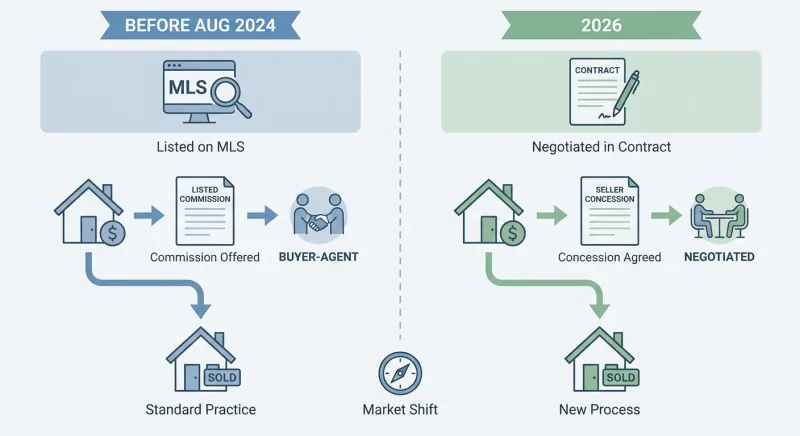
Since August 17, 2024, you can no longer advertise buyer-agent compensation directly in the MLS — sellers now use seller concessions to accomplish the same thing, structured differently.
Two practical changes hit every Nashville listing. First, offers of compensation are gone from the MLS. The old field where a seller's agent published "we'll pay the buyer's agent X%" no longer exists, and Realtracs prohibits stating it in Public Remarks. Second, buyers now sign a representation agreement up front, putting them on the hook for their agent's fee unless someone else covers it.
That "someone else" is usually you — through a concession.
In plain terms: the money didn't disappear. It moved from a hidden commission field into a negotiated seller concession the buyer can apply toward their agent's fee, closing costs, or a mortgage rate buydown. For a flat-fee or FSBO seller, this is good news. You were never paying a listing-side commission anyway, and now the buy-side number is openly negotiable instead of baked into a percentage you couldn't touch.
How to Decide: A 5-Factor Framework for Nashville Sellers
Run your listing through these five factors. If three or more point "yes," offer a concession.
1. Price band. Lower-priced homes (roughly $250K–$450K in Middle TN) draw more first-time and FHA/VA buyers who are cash-tight at closing. A concession there does real work. Above ~$750K, you see more move-up buyers and cash — the concession matters less.
2. Neighborhood financing mix. If your comps sold to FHA, VA, or high-LTV conventional buyers, those buyers need closing-cost help. If your pocket is cash-heavy — tear-down lots in East Nashville, luxury Williamson County builds — a concession is less persuasive.
3. Comparable concession activity. Pull recently sold and active listings in your area. If 7 of 10 comparable listings advertise a concession and you don't, you're the odd home out. Match the market.
4. Days-on-market risk. A concession is a lever to speed a sale. If inventory is thin and you're in no hurry, test the market without one and add it later if showings stall. If you need to move — relocation, a contingent purchase, carrying two mortgages — offer it from day one.
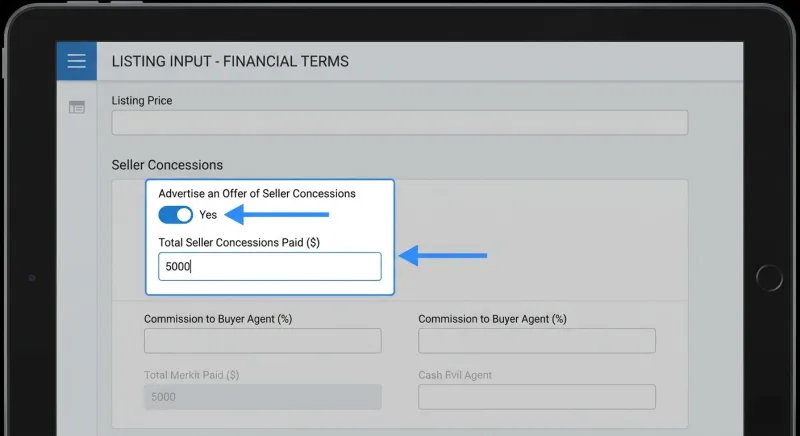
5. Net-proceeds math. A $10,000 concession and a $10,000 price cut land in roughly the same place on your bottom line, but a concession can fund a rate buydown; a price cut can't. Model both.
What a Concession Actually Costs You (and Gains You)
Three illustrative scenarios anchored to Middle TN price points. Assumptions: 6% total selling costs excluding concession; concession expressed as a flat dollar amount.
Scenario A — $350,000 home (FHA/first-time buyer pool). Concession offered: $10,500 (3%), likely funding buyer closing costs plus a partial rate buydown. Your take-home drops by $10,500, but you widen your buyer pool to the largest, most competitive group in Nashville. At this price, skipping it usually costs you showings.
Scenario B — $500,000 home (mixed conventional/first-time). Concession offered: $10,000 (2%), funding closing costs or a 2-1 temporary buydown. Compared to a straight $10,000 price cut, the concession often reads as more valuable to a rate-sensitive buyer — same cost to you, stronger perceived benefit.
Scenario C — $750,000 home (move-up/cash-leaning). Concession offered: $0–$7,500 (0–1%). At this level, a clean price and strong condition frequently outperform a concession. Offer a modest one only if comps show buyers expecting it.
The pattern: concessions do the most work at lower prices and the least at high ones. Model this against a price reduction before you commit.
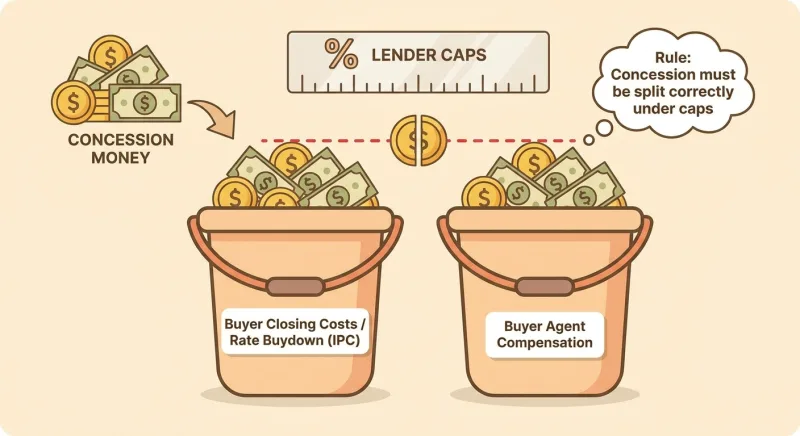
The "Double Bucket" Rule: Why a Buyer's Loan Can't Absorb Just Any Concession
There's a ceiling on how much of your concession a buyer's mortgage will actually allow. Cross it, and the excess gets wasted or the deal gets restructured at closing. Lenders sort every seller dollar into two buckets, each with a hard cap.
Bucket 1 — Interested Party Contributions (IPC). Seller-paid money covering buyer closing costs, prepaids, escrows, discount points, a rate buydown. Every major loan program caps how much the buyer can accept.
Bucket 2 — Buyer-agent compensation. Post-settlement, how a seller contribution toward the buyer's agent fits under IPC rules is still being clarified across investors in 2026. Treat it as separate, and confirm with the lender per file.
IPC caps by loan type (as of 2026)
| Loan type | Occupancy / LTV | IPC cap | Primary source |
|---|---|---|---|
| Conventional (Fannie) | Primary/second, LTV > 90% | 3% | Fannie Mae Selling Guide B3-4.1-02 |
| Conventional (Fannie) | Primary/second, LTV 75.01–90% | 6% | Fannie Mae Selling Guide B3-4.1-02 |
| Conventional (Fannie) | Primary/second, LTV ≤ 75% | 9% | Fannie Mae Selling Guide B3-4.1-02 |
| Conventional | Investment property (any LTV) | 2% | Fannie Mae Selling Guide B3-4.1-02 |
| FHA | All | 6% | HUD Handbook 4000.1 |
| VA | All (seller concessions) | 4% | VA Lender's Handbook |
Freddie Mac's caps mirror Fannie's under the same LTV tiers. Read the cap against the lesser of sales price or appraised value. Confirm current limits with the buyer's lender.
Why this matters: offer a $30,000 concession on a $350K FHA deal, and the buyer can only use about $21,000 (6%). The rest doesn't refund to you — it gets renegotiated or stripped at closing review. Before you name a number, ask the buyer's lender: what's the LTV tier, and how is agent compensation being categorized on this file?
Structuring the Concession So It Survives a Low Appraisal
When you offer a $15,000 concession on a $500,000 contract, you and the buyer may raise the price to $515,000 to absorb it — a common move so the buyer finances more of their costs. That home now needs to appraise at $515,000. If the appraiser comes back at $505,000, the buyer must cover the $10,000 gap in cash or you renegotiate.
Do the math before you agree to a price bump. In parts of Davidson and Rutherford County where values have flattened, a padded price is an appraisal risk, not a favor.
Two clauses worth adding: make sure the concession language and the appraisal contingency reference the same price. And offer a fixed dollar amount ("$15,000") rather than a percentage, so the figure doesn't float if the price gets renegotiated mid-deal.
Concession vs. Price Cut vs. Nothing: The Honest Comparison
| Strategy | Best for | Effect on net | The catch |
|---|---|---|---|
| Buyer's-agent / closing-cost concession | Payment-sensitive buyers, first-timers, FHA/VA; markets where most sellers already offer | Reduces net by the amount, preserves headline price and appraised value | Must fit inside IPC/agent-comp caps; must display correctly on Realtracs |
| Straight price cut | Broad buyer pools, overpriced-vs-comps, cash and high-down buyers | Reduces net by the cut, and lowers the comp for the neighborhood | Doesn't help a cash-short buyer at closing; can signal "motivated" |
| Offer nothing | Hot micro-markets, unique/low-supply homes, strong appraisal margin | Highest gross and net if it sells | Risks longer DOM where most listings advertise a concession |
A $15,000 price cut and a $15,000 concession are not equal to the buyer. A price cut trims their monthly payment by a small amount. A concession routed to closing costs or a rate buydown attacks the exact obstacle keeping many 2026 Nashville buyers on the sidelines: cash-to-close and monthly affordability. If nearly every comparable listing shows a concession and yours shows none, a buyer's agent running a payment-first search notices the gap — your listing carries a hidden affordability penalty even at an identical price.
Plain-English rule: if your buyers are payment-constrained, concede. If your price is the problem versus comps, cut. If neither is true and supply is tight, hold.
How to Display a Buyer Concession on a Realtracs Listing (Step by Step)
Advertise a concession using the dedicated concession fields — never in Public Remarks, and never as a stated commission. Here's the process as of early 2026 (verify current input rules before you list):
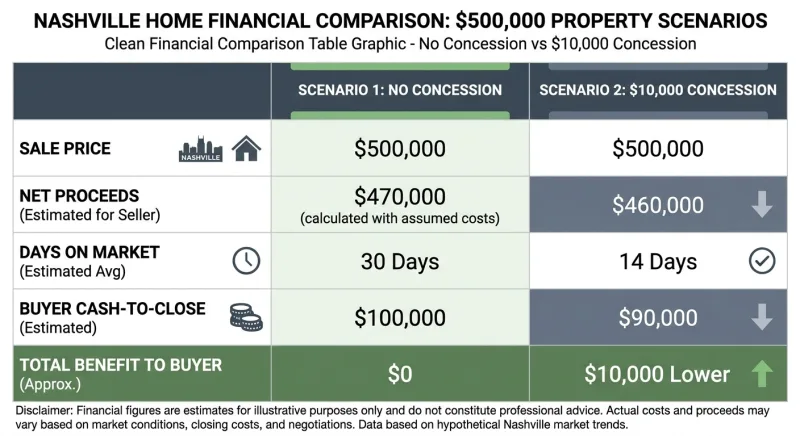
- Set the "Advertise an Offer of Seller Concessions" toggle to Yes. This is the compliant on-MLS way to signal that you're offering.
- Enter the amount in the "Total Seller Concessions Paid" field. Use the structured field so it displays and filters correctly for buyer's agents searching Realtracs.
- Do not state a buyer-agent commission anywhere in the MLS. Writing "3% to buyer's agent" in the remarks is a compliance violation. Keep agent-specific compensation in off-MLS communication and the offer/addendum.
- Document the actual agreement on the right forms. Concession and compensation terms belong in the purchase contract and addenda — for example, Tennessee REALTORS® Form RF401 and the relevant compensation addendum. Verify current form numbers before use.
The MLS field says "concession available"; the contract says who gets what. Keep those two jobs separate.
The FSBO / Flat-Fee Angle Nobody Underwrites Correctly
You can offer and display a buyer's agent concession on a flat-fee MLS listing — the Realtracs mechanics are identical. Two failure modes we see with flat-fee sellers:
- Toggling "yes" but leaving the dollar field blank. Buyers' agents filter on that field. A "yes" with no number is a soft signal at best.
- Writing "will pay buyer agent 3%" in Public Remarks. That's the prohibition, and the fastest way to get a listing flagged.
Two things to get right on the paperwork side. Draft a clear compensation addendum spelling out the exact concession, what it funds, and how it's paid at closing — have your title company or a real estate attorney review it. And add a commission-shortfall clause defining who covers the gap if underwriting trims your contribution to fit the IPC cap. Without it, you can end up on the hook for a difference you never intended to pay.
There's also a genuine upside: if a buyer arrives unrepresented, there's no agent to pay — that concession dollar can convert to a closing-cost concession or straight savings. Structure your listing so an unrepresented buyer doesn't trigger a payout to no one. Confirm current Realtracs rules and have a Tennessee attorney review your addendum language.
When Not Offering a Concession Is the Smart Call
Skip the concession when your comps aren't offering one and inventory is scarce. Skip it when your buyer pool is equity-rich and doesn't need closing help. Skip it when a sharper price gets you more offers than a quiet concession ever would.
The concession is a tool for a specific obstacle: buyer cash and buyer-agent comp friction. When that obstacle isn't present, spending on it is spending for its own sake. Model your net proceeds with and without it against your realistic days-on-market. If the concession doesn't buy you speed, offers, or a solved buyer-cash problem, it hasn't earned its place on your listing.
Frequently Asked Questions
How do I offer a buyer agent concession in the Tennessee MLS?
Set the "Advertise an Offer of Seller Concessions" toggle to Yes on Realtracs and enter the amount in the "Total Seller Concessions Paid" field. Do not state any commission in Public Remarks — that's prohibited. Finalize the actual terms in the purchase contract and a compensation addendum. On a flat-fee listing, your provider enters it for you and you sign the addendum yourself.
How much should I offer as a buyer concession in Nashville?
Most Nashville sellers who offer concessions land in the 1%–3% range of the sale price, commonly covering buyer-agent compensation or a mix of closing-cost help and a rate buydown. Match what comparable listings in your Davidson, Williamson, or Rutherford County pocket are offering, and never exceed what the buyer's loan type allows as an IPC (3–9% conventional depending on LTV, 6% FHA, 4% VA).
Can I display a buyer concession on a flat-fee MLS listing?
Yes. A flat-fee listing on Realtracs uses the same concession fields as any other, so your offer displays to buy-side agents exactly the way a full-service listing's would. You'll draft your own compensation addendum and commission-shortfall clause — have a title company or attorney review them.
Is a concession better than just lowering my price?
For a financing-sensitive buyer, often yes — a concession can fund closing costs or a rate buydown, which a price cut can't, and it keeps your headline price higher to support neighborhood comps. For a cash buyer, a price cut is simpler and just as effective. At the same dollar amount, your net is nearly identical, so choose based on your buyer pool.
What's the difference between a concession and buyer-agent commission now?
Since the NAR settlement took effect August 17, 2024, you can't advertise buyer-agent commission in the MLS. A seller concession is the compliant replacement — a negotiated dollar amount the buyer can apply toward their agent's fee, closing costs, or a buydown.
The Bottom Line
In the Nashville market right now, a buyer's-agent concession is a tool, not an obligation. Run the five-factor check first. If you do offer one, execute it cleanly: set the amount in writing, stay inside your buyer's loan-type IPC caps, enter it in the "Total Seller Concessions Paid" field with the toggle set to Yes, and keep commission language out of Public Remarks. Because Realtracs input rules, NAR practice guidance, and IPC treatment are all still evolving, verify current field names before you list and loop in a Tennessee real estate attorney for your addendum language.
When you're ready to list and display your concession correctly, our flat-fee MLS Nashville service puts it on Realtracs the right way, at your direction. You set the strategy. You keep the savings.