
Tennessee RF 201 vs RF 203: Does a FSBO Seller Have to Fill Out Disclosures?
General information, not legal advice. Tennessee disclosure statutes and forms change — confirm the current version with Tennessee Realtors or a Tennessee real estate attorney before you sign anything. Last reviewed: July 2026.
Short answer: most Tennessee FSBO sellers still have to disclose. Form RF 203 is not a get-out-of-disclosure card for everybody. Under the Tennessee Residential Property Disclosure Act (Tenn. Code Ann. § 66-5-201 et seq.), a for-sale-by-owner seller carries the same disclosure duty as a seller with an agent. RF 201 is the full condition disclosure. RF 203 is a narrow exemption notification for sellers who legally qualify to skip it.
Even when you're exempt from RF 201, Tennessee law can still require you to disclose specific hazards. Selling your own home doesn't make the paperwork disappear. It just puts you in charge of getting it right.
In the listings we help Tennessee owners put on the MLS, this question comes up almost every time. Which form? Whose signature? What happens if a buyer finds something later? Let's walk it plainly — and cover the trap nobody talks about: even exempt sellers still owe a companion hazard disclosure on Form RF 205.
The Tennessee Residential Property Disclosure Act, in Plain Terms
The Disclosure Act lives in Tenn. Code Ann. Title 66, Chapter 5, Part 2. It governs the sale of residential real property with one to four dwelling units, and it applies to the transaction — not to whether an agent is involved.
That's the piece FSBO sellers get wrong most often. Under § 66-5-201 and § 66-5-202, the obligation attaches to the seller of the property, whether represented by a licensee, listed on a flat-fee MLS, or handling the whole thing at the kitchen table. FSBO doesn't mean no paperwork — it means you own the paperwork.
The Act works through three form paths published by Tennessee Realtors:
- RF 201 — Residential Property Condition Disclosure. The default. You disclose the property's known condition.
- RF 203 — Exemption Notification. For sellers who legally qualify to skip full disclosure.
- RF 204 — Disclaimer Statement. A negotiated "as-is" waiver the buyer agrees to.
Form RF 201: The Full Residential Property Condition Disclosure
RF 201 is the standard form the majority of sellers complete. You're reporting the condition of major systems and any known defects: structural, roof, foundation, plumbing, electrical, HVAC, water intrusion, pests, and similar items. Tennessee law requires disclosure of known material defects and adverse facts — problems a reasonable buyer would want to know about and that affect value or safety.
Two distinctions matter for a FSBO seller. First, you disclose what you know. The Act generally doesn't force you to hire inspectors, but you can't bury a defect you're aware of. Latent defects — hidden ones you know about that a buyer wouldn't spot on a walkthrough — are exactly what this form exists to capture.
Second, timing. You're expected to deliver the disclosure before the buyer is bound under a purchase contract. Tennessee gives the buyer a right to terminate within three days if you hand over the disclosure after they've signed. Fill RF 201 out honestly and completely; blank lines and "unknown" everywhere invite the disputes disclosure is meant to prevent.
Form RF 203: The Exemption Notification (Not an Eraser)
RF 203 lets sellers who qualify notify the buyer that an exemption applies. It's a unilateral statement — the buyer doesn't sign it for it to function. It's an exemption, not an eraser.
Who actually qualifies
The exemptions under § 66-5-209 are specific and narrow:
- Court-ordered or foreclosure transfers
- Transfers by an executor, administrator, or trustee during estate administration
- New construction covered by a warranty when the buyer receives it
- Sellers who have never occupied the property, or haven't within a defined lookback period
- Certain transfers between co-owners or family members
If none of these describe you — and for most owner-occupants, none do — RF 203 isn't your form. You use RF 201.
The trap sellers walk into
A seller reads "exemption," files RF 203, and assumes they've disclosed nothing. Not true. Qualifying for RF 203 removes the full condition disclosure. It doesn't remove every duty the statute imposes.
The Exemption Trap: RF 203 Still Owes You RF 205 Hazards
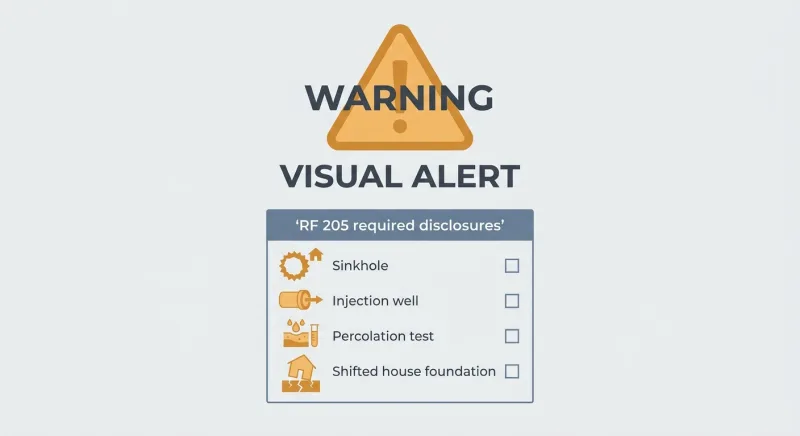
Even if you legally qualify for the RF 203 exemption, Tennessee law can still require disclosure of serious hazards. The companion form is RF 205.
Under Tenn. Code Ann. § 66-5-212, these conditions must be disclosed regardless of an exemption:
- Known sinkholes on the property
- Any exterior injection well located on the property
- Results of any percolation test or soil absorption rate performed
- Whether the dwelling was moved from another location
- Whether the property is subject to a sewer construction moratorium under Tenn. Code Ann. § 68-221-409
Exempt from RF 201 does not equal exempt from RF 205. These hazards are knowledge-triggered, not condition-triggered — a percolation test result from 2009 sitting in a drawer is a disclosable fact even though nothing about the yard looks different.
The correct FSBO move when you qualify for the exemption is usually two forms: RF 203 to notify the buyer, and RF 205 to disclose any listed hazard you know about. If any § 66-5-212 items are unfamiliar — most sellers have never heard "exterior injection well" — confirm with a Tennessee closing attorney before deciding you owe nothing.
Public Chapter 510: The 2024 Sinkhole Change Nobody Else Mentions
Public Chapter 510, effective July 1, 2024, changed how sinkhole disclosure works. Previously, many sellers relied on whether a sinkhole showed on the recorded plat map — no contour line, no perceived duty. The amendment tightened that.
The duty now reaches known sinkholes, not just sinkholes documented by a contour line. If you know there's a sinkhole, the fact that it never made the recorded map is no longer your cover.
This isn't theoretical. Sinkholes are common across Middle and East Tennessee's karst geology — the limestone belt through Rutherford, Wilson, and Williamson counties. Blank-form downloads floating online predate this change. Confirm the current § 66-5-212 language before you close.
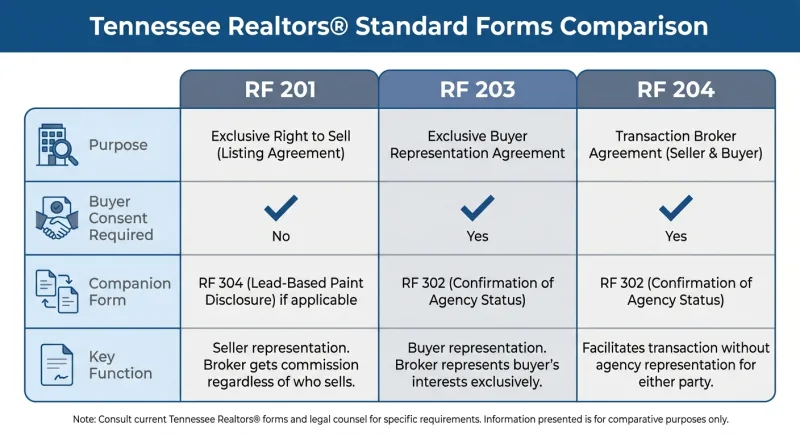
RF 201 vs RF 203 vs RF 204: Side-by-Side
| RF 201 Property Condition Disclosure | RF 203 Exemption Notification | RF 204 Disclaimer Statement | |
|---|---|---|---|
| Purpose | Full disclosure of the home's known condition | Notifies buyer that a statutory exemption applies | Negotiated "as-is" sale; buyer waives condition disclosure |
| Who uses it | Most sellers, including FSBO owner-occupants | Sellers who qualify under § 66-5-209 | Sellers and buyers who agree to an as-is deal |
| Buyer signature required? | Buyer signs to acknowledge receipt | No — unilateral notification | Yes — bilateral; buyer must consent |
| Hazard duty still applies? | Hazards disclosed within RF 201 | Yes — RF 205 still required for § 66-5-212 hazards | Yes — hazard duty is not waived |
| Best fit | Standard owner-occupied resale | Estate, foreclosure, never-occupied, PUD, etc. | Buyer knowingly accepting the property as-is |
RF 203 is unilateral — you notify, and the buyer doesn't sign. RF 204 is bilateral — it's a waiver requiring the buyer's signature. If your buyer never signs RF 204, you don't have a waiver. And across all three paths, the § 66-5-212 hazard disclosures are never waived away.
Both forms share one timing rule: they must reach the buyer before the contract becomes binding. Keep a delivery timestamp — email receipt, text, or a dated buyer initial.
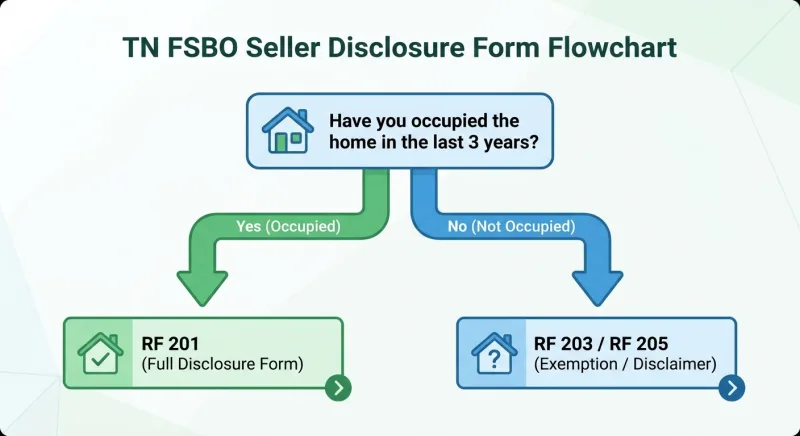
Which Form Should a Tennessee FSBO Seller Use?
Run your situation through four questions in order. Stop at the first "yes" that controls.
1. Have you occupied this property within the statutory lookback? Yes → Use RF 201. The exemption path is closed to you.
2. Does your transaction fit a named exemption — estate, foreclosure, court order, qualifying non-occupancy, certain PUD transfers under § 66-5-209/213? Yes → File RF 203 instead of the full condition disclosure. Then go to question 4.
3. Do you want a mutual "as-is" waiver where the buyer knowingly accepts no condition disclosure? Yes → That's RF 204, and it requires the buyer's signature.
4. Do you know of any § 66-5-212 hazard — sinkhole, injection well, percolation test, moved structure, sewer moratorium? Yes → RF 205 is mandatory, stacking on top of whichever path above applies.
The order matters. Sellers who start at question 2 — "am I exempt?" — often never reach question 4 and file a clean RF 203 while sitting on a known percolation result.
A note on exemptions: they're snapshots, not permanent status. Moving into an inherited house for four months before relisting arguably restarts your clock. Selling through an LLC or trust creates no automatic exemption. The exemption attaches to how and by whom the property is transferred, not to the tax wrapper on title.
Remedies: What a Missed Disclosure Actually Costs
Under § 66-5-208, a buyer harmed by a seller's failure to disclose has a claim for actual damages — the measurable gap between what the property was worth as disclosed versus its true condition, plus related costs. A missed sinkhole or undisclosed sewer moratorium can generate remediation figures that dwarf whatever you saved by filing the shorter form.
The buyer's most immediate lever isn't a lawsuit — it's the pre-closing right to terminate. A defective or late disclosure may hand the buyer a clean exit during their contingency window, costing you a re-list, fresh showings, and a market that's watched your listing fall through.
The paperwork is cheap; the mistake is expensive. Complete disclosure is almost always the lower-risk move even when an exemption is available.
Getting Compliant Forms Onto the MLS Without Overpaying
The disclosure duty is the same whether an agent lists your home or you do it yourself. FSBO means you're steering the paperwork — that's a fine position once you know which form your situation calls for and how the consent and hazard layers interact. A flat-fee MLS listing is simply the compliant, low-cost way to put a self-directed Tennessee sale on the MLS without a full-service commission.
If you've worked through the framework above and you're ready to list, ResultsMLS gets Tennessee owners onto the MLS on a flat fee. The disclosure obligations stay yours by law. We just make the listing part affordable.
Reminder: this is general information, not legal advice. Confirm the current forms and statute for your specific sale.
Frequently Asked Questions
Does a FSBO seller in Tennessee have to fill out disclosures?
Yes, in most cases. The Tennessee Residential Property Disclosure Act (Tenn. Code Ann. § 66-5-201 et seq.) binds the seller regardless of whether an agent is involved. Selling by owner doesn't remove the duty — it just means you complete Form RF 201 yourself.
What is the difference between RF 201 and RF 203?
RF 201 is the full Residential Property Condition Disclosure most sellers use. RF 203 is a unilateral exemption notification for sellers who legally qualify to skip full disclosure under § 66-5-209 — for example, an estate or a foreclosing lender. The buyer doesn't sign RF 203, and it is not a substitute condition report.
If I qualify for the RF 203 exemption, am I off the hook for all disclosures?
No. Under Tenn. Code Ann. § 66-5-212, exempt sellers must still disclose specific hazards on Form RF 205 — known sinkholes, exterior injection wells, percolation test results, a moved dwelling, and sewer moratoriums. Exemption from RF 201 is not exemption from these.
Does the buyer have to sign RF 203?
No. RF 203 is a unilateral exemption notification — the seller notifies the buyer, and no buyer signature is needed. That's different from RF 204, the as-is Disclaimer Statement, which is a bilateral waiver the buyer must sign to be effective under § 66-5-202.
What changed with Tennessee sinkhole disclosure in 2024?
Public Chapter 510, effective July 1, 2024, expanded sinkhole disclosure to cover known sinkholes even without a contour line on the recorded plat map. If you know a sinkhole exists, disclose it — on RF 201, or on RF 205 if you're otherwise exempt.
What happens if a Tennessee seller fails to disclose a known defect?
A buyer may pursue remedies including actual damages under § 66-5-208. Failing to disclose a known material defect — whether on RF 201 or the RF 205 hazard list — can expose a FSBO seller to liability after closing.
The Bottom Line
Going FSBO doesn't cancel your disclosure obligations. Tennessee treats an owner selling alone the same as one working with a listing agent. For most sellers who've lived in the home, that's RF 201. If you genuinely qualify for an exemption, RF 203 lets you notify the buyer instead — but RF 205 still requires disclosure of § 66-5-212 hazards, and after Public Chapter 510, a known sinkhole counts whether or not it shows on your plat map.
Confirm the current form versions with Tennessee Realtors, pick the right form, disclose honestly, and keep signed copies. When you're ready to get your listing in front of buyers, ResultsMLS is the low-cost, compliant way onto the Tennessee MLS.
General information, not legal advice. Statutes cited here — including § 66-5-201, § 66-5-202, § 66-5-208, § 66-5-209, § 66-5-212, § 66-5-213, and Public Chapter 510 — are subject to amendment. Confirm the current form versions and statutory text before you sign, and consult a Tennessee real estate attorney for your specific facts. Last reviewed: July 2026.