

Can You Really List on RealTracs Without an Agent?
Short version: not directly, and no honest guide will tell you otherwise. RealTracs is a broker-gated database, which means only licensed brokers can enter listings into it. There's no consumer login, no "list your home" button, no way to walk in off the street and post your house yourself. That surprises a lot of Middle Tennessee sellers who assume the MLS works like Zillow.
But here's the part nobody tells you: you can absolutely get your home on RealTracs without hiring a traditional listing agent or paying a full listing-side commission. The legal path is a flat-fee, limited-service broker. You pay a one-time flat fee, a licensed broker enters your listing on your behalf, and you keep control of the sale.
Direct answer: You cannot list on RealTracs yourself because it's restricted to licensed brokers. To get your home on the MLS without a full-service agent in Tennessee, you hire a flat-fee MLS broker who enters your listing for a fixed cost, giving you the same RealTracs exposure and Zillow/Realtor.com syndication a traditional agent provides, without the listing commission.
That's the whole game. The rest of this guide walks you through how it works, what it costs, and the 2026 compliance details national blogs skip entirely.
What Is RealTracs and Why It Matters in Middle Tennessee
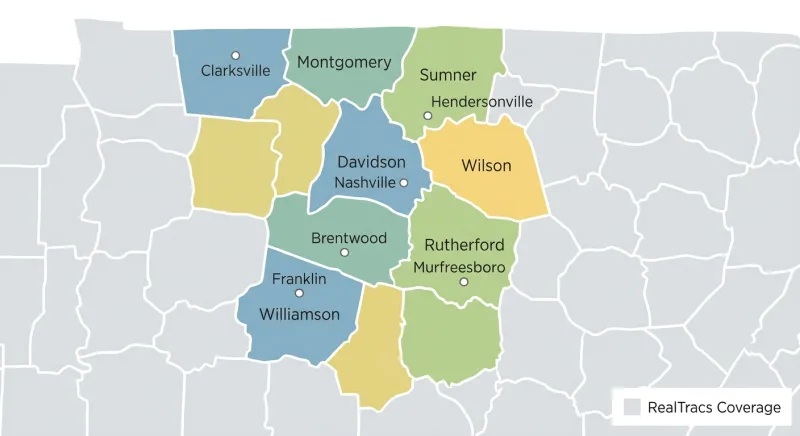
RealTracs is the multiple listing service that most of Middle Tennessee runs on. If you're selling in Nashville, Franklin, Murfreesboro, Brentwood, Clarksville, or Hendersonville, this is the database serious buyers and buyer's agents are searching.
When a home hits RealTracs, its details flow out to the big consumer portals through syndication, so your listing shows up on Zillow, Realtor.com, and dozens of other sites without you posting to each one separately.
RealTracs anchors the core Middle Tennessee counties:
- Davidson (Nashville)
- Williamson (Franklin, Brentwood)
- Rutherford (Murfreesboro)
- Montgomery (Clarksville)
- Sumner (Hendersonville)
- Wilson (Mount Juliet, Lebanon)
It also participates in a broader data-sharing network with other regional MLSs. For a "realtracs fsbo" seller, that reach is the entire point. A yard sign gets you your street. RealTracs gets you every buyer's agent whose client is house-hunting in your zip code.
How Flat-Fee MLS Listing Works (The Legal Workaround)
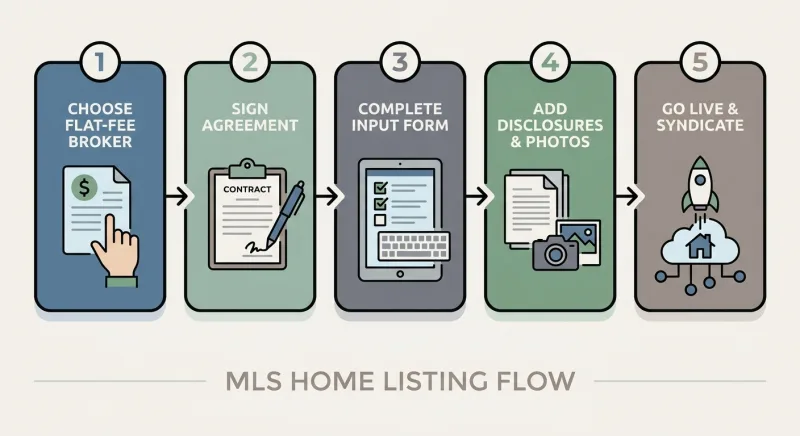
You sign a limited-service listing agreement with a licensed Tennessee broker. Instead of the broker handling everything and charging a percentage, they perform one narrow job: entering and maintaining your listing on RealTracs. Showings, negotiations, and the day-to-day of selling stay with you.
Tennessee law permits this. The Tennessee Real Estate Commission (TREC) licenses brokers and allows limited-service brokerage, where broker and client agree in writing to a reduced scope. That written agreement is what makes the arrangement legal — and why a "get on the mls tennessee without agent" strategy must route through a licensed broker rather than around one.
In practice:
- You pay a flat fee upfront instead of a listing commission at closing.
- The broker inputs your listing using your photos, description, and property data.
- You stay the decision-maker on price, showings, and offers.
- You still decide whether to offer any buyer-agent compensation.
The catch is that "limited-service" is exactly that. The broker isn't pricing your home, hosting open houses, or negotiating your contract.
How to List on RealTracs Without an Agent: Step-by-Step
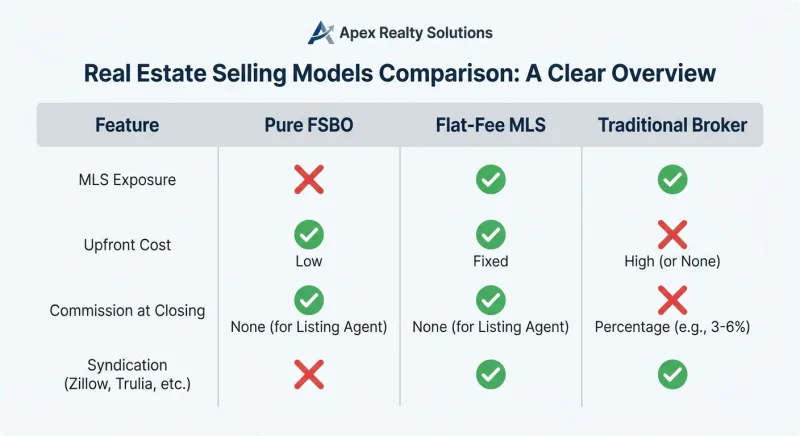
Step 1: Choose a flat-fee MLS broker licensed in Tennessee
Pick a TREC-licensed broker that offers flat-fee RealTracs entry and confirm they cover your county. Check what's in the base fee versus what costs extra (photo limits, listing changes, syndication scope).
Step 2: Sign the limited-service listing agreement
This written agreement defines the broker's narrow role and your responsibilities. Read the term length and cancellation terms before you sign.
Step 3: Complete the RealTracs listing input form
You'll provide structured property data your broker enters, using the Residential Listing Input Form or the broker's equivalent intake. This covers beds, baths, square footage, lot size, features, and public remarks. Accuracy matters — errors in the data are the most common cause of delays.
Step 4: Handle Tennessee disclosures
Tennessee generally requires a residential property disclosure from sellers, with limited exemptions. Complete the required form (or the disclaimer/exemption form if you qualify) before your listing goes active.
Step 5: Upload strong photos
Shoot in daylight, declutter, and lead with your best exterior and main living space. Check your broker's photo count limit.
Step 6: Review the listing and go live
Your broker submits the listing to RealTracs. Under RealTracs rules, listings generally must be entered within a set window of the effective date, commonly cited as 48 hours. Once active, syndication pushes your listing to Zillow, Realtor.com, and partner sites.
Step 7: Verify your listing everywhere
Confirm the data is correct on RealTracs, then check syndication to Zillow and Realtor.com within a day or two. Fix any errors through your broker right away.
What Actually Happens After You Sign
RealTracs is a broker-managed system with input rules, validation logic, and a data-quality review layer. Once your broker enters your property, the listing runs through field validation before it goes active — square footage source, bedroom count, tax record cross-checks. Conflicts with county tax records can trigger flags or require correction.
Syndication then fires on a feed cycle, not instantly. When your listing shows on RealTracs but not yet on Zillow, that's usually a feed-timing gap, not a broken listing.
The 48-Hour Rule Is a Trap Door, Not Just a Deadline
The clock is tied to your listing agreement's effective date, not the day paperwork lands in your broker's inbox. Two things trip people up.
First, if you sign with an effective date of the 1st but don't send photos and disclosures until the 4th, your broker may be forced to enter the listing incomplete — or hold it — to stay inside the window.
Second, "Coming Soon" is not a parking spot for a listing that isn't ready. Using it to buy prep time can backfire and inflate your Days on Market once you flip to Active.
Short version: get your assets done before the effective date, not after.
Choosing Your Listing Status Strategically
Coming Soon / Hold builds a showing queue before your first weekend so your Active debut draws multiple showings in 72 hours. Days on Market do not accumulate in Coming Soon under RealTracs rules.
The DOM Protection Principle: enter Active only when your photos, price, and disclosures are all buyer-ready. DOM is public. A high number signals "problem house" whether or not anything's wrong.
The Exempt listing and non-disseminate form. If you want your sale recorded for MLS statistical purposes but not marketed publicly — say you're selling to a known buyer and only want closed-comp credit — RealTracs offers an Exempt pathway paired with the Seller's Instruction Not to Disseminate Property Information form. That form is your written direction to keep the listing off public distribution. A quick reality check: Exempt means no Zillow, no Realtor.com, no open-market exposure. It's a narrow tool for a narrow situation.
Buyer-Agent Compensation in 2026: The Off-MLS Framework
Since the National Association of Realtors settlement took effect on August 17, 2024, MLSs can no longer display offers of buyer-broker compensation in listing fields. RealTracs removed those fields to comply.
You can still offer to help cover the buyer's agent commission, but you can't advertise that offer in the MLS. Two things trip people up: assuming you must offer buyer-agent pay (you don't), and assuming you can post it on the MLS (you can't).
1. Seller concessions field. RealTracs retained a seller-concessions field that expresses dollars toward the buyer's costs generally, not steered to the agent specifically. This is the compliant on-MLS signal.
2. Off-MLS marketing. State compensation on your own listing website, a flyer, or in direct conversation with an agent who calls. The rule governs the MLS record, not your private marketing.
3. Direct negotiation at offer. Buyer agents increasingly bring written buyer-agency agreements stating what their client owes; that number gets negotiated into the purchase contract as a concession.
Decide before you list. Set your net-to-seller floor first and determine the maximum buyer-side help you'll fund as a concession dollar amount. The sellers who struggle are the ones who never decided their maximum and end up reacting under pressure.
Edge Cases That Break the Standard Playbook
New construction and missing tax records. A missing parcel ID can bypass auto-population, requiring manual entry with source documentation. Have your builder's specs and the recorded plat ready.
Multi-parcel and acreage listings. RealTracs needs a primary parcel designation and correct acreage entry, or the listing miscategorizes in search filters. Buyers searching "5+ acres" won't find you if the field's wrong.
Condos and HOAs. These carry mandatory association fields and specific Tennessee disclosure obligations. Gather your HOA docs before the effective date.
The withdrawn-and-relist trap. MLS records typically preserve prior price and DOM data that agents can pull. Price it right the first time instead of banking on a reset.
The Middle-TN Reality: One Label, Six Different Markets
RealTracs is dominant across Davidson, Williamson, Rutherford, Montgomery, Sumner, and Wilson counties, and those six markets don't move together.
- Nashville (Davidson) — deep, fast buyer pool; clean pricing matters more than status sequencing.
- Franklin / Brentwood (Williamson) — higher price points, selective buyers; presentation and photo quality carry disproportionate weight.
- Murfreesboro (Rutherford) — steady growth, price-sensitive; the seller-concessions lever does real work here.
- Clarksville (Montgomery) — military-influenced turnover near Fort Campbell; DOM protection matters because buyer cycles move with orders.
- Hendersonville (Sumner) / Wilson County — commuter markets; buyers filter hard on location and commute-time proxies.
Data Quality: The Overlooked Ranking Factor
Portal search algorithms and buyer-agent MLS searches reward complete, accurate data. A listing with 40 filled fields, correct room dimensions, and full remarks surfaces in more filtered searches than a bare-minimum entry. When an agent filters for "3-car garage" or "primary on main," an empty field makes you invisible — even though your home qualifies.
Your broker enters what you give them. Fill every field you honestly can. That's free exposure most FSBO sellers leave on the table.
Cost Comparison: Pure FSBO vs. Flat-Fee MLS vs. Traditional Broker
| Feature | Pure FSBO | Flat-Fee MLS | Traditional Broker |
|---|---|---|---|
| On RealTracs MLS | ❌ No | ✅ Yes | ✅ Yes |
| Zillow / Realtor.com syndication | Limited / manual | ✅ Yes | ✅ Yes |
| Upfront cost | ~$0 | ~$100–$500 (flat fee) | $0 upfront |
| Listing-side commission at closing | $0 | $0 | ~2.5%–3% |
| You control showings & negotiation | ✅ Yes | ✅ Yes | ❌ Agent handles |
| Full-service support | ❌ No | ❌ Limited | ✅ Yes |
Dollar ranges as of early 2026; confirm current pricing before listing.
Pure FSBO is cheapest on paper, but you lose the MLS entirely — the exposure most buyers' agents actually search. Flat-fee MLS is the middle path built for sellers who are comfortable running their own sale but still want to be where the buyers are.
Is Flat-Fee MLS Right for You?
It fits you if:
- You're comfortable handling showings, calls, and offer logistics yourself.
- Your home is in normal condition and a mainstream price band for your submarket.
- You can produce clean photos and complete disclosures on schedule.
- You want RealTracs exposure and syndication without a listing-side commission.
Reconsider the pure-DIY portion if:
- You have a complex property (the edge cases above).
- You're uneasy negotiating buyer-agent compensation face to face.
- You can't hit your own timeline for photos and paperwork, putting the 48-hour rule against you.
Frequently Asked Questions
Can I list on RealTracs without an agent?
Not directly. RealTracs is a broker-gated database, so a TREC-licensed broker must enter your listing. A flat-fee, limited-service broker gets you on the MLS without paying a listing-side commission while you handle showings and negotiations.
How long does a RealTracs listing take to go live?
Once you've submitted your data, photos, and signed agreement, RealTracs generally requires listing data to be input within a short window of the effective date, commonly cited as 48 hours. Most flat-fee listings appear the same day or within one business day. Syndication to Zillow and Realtor.com usually follows within a day or two.
How much does flat-fee MLS cost in Tennessee?
As of early 2026, flat-fee MLS packages typically run about $100 to $500 upfront, depending on photo count, listing term, and add-ons. You avoid the listing-side commission, which on a median-priced home would otherwise cost thousands.
Will my RealTracs listing show on Zillow and Realtor.com?
Yes. RealTracs syndicates member listings to major consumer portals including Zillow and Realtor.com, plus partner sites, so a flat-fee listing gets the same portal exposure as an agent-listed home.
Can I cancel a flat-fee RealTracs listing?
Usually yes, though terms vary. Check your limited-service listing agreement for the cancellation clause and any non-refundable upfront fee before you sign.
What forms do I need to list FSBO in Tennessee?
You'll need a signed limited-service listing agreement, a completed RealTracs Residential Listing Input Form, and Tennessee's required residential property disclosure (or the applicable disclaimer/exemption form). Your flat-fee broker confirms which apply, since form numbering changes over time.
Conclusion
You can't log into RealTracs yourself, but you don't need a full-commission listing agent to get there either. A flat-fee, limited-service broker is the legal bridge — a licensed professional enters your home, RealTracs pushes it to Zillow and Realtor.com, and you keep control of the sale.
Pick a Tennessee flat-fee broker and read the limited-service agreement closely, especially the cancellation clause and what's included in the upfront fee. Gather your structural details, decide whether you'll offer buyer-agent compensation (that offer now lives off-MLS), shoot strong photos, complete the input form, sign your disclosures, and expect the listing live within the 48-hour window.
Two things worth repeating: confirm every disclosure applies to your specific sale — Tennessee law is precise, and skipping a required form creates real liability. And price it right, because MLS exposure amplifies your listing but won't fix a bad number.
Confirm exact form names/numbers and status labels against live RealTracs documentation.