
How to Sell FSBO in Tennessee: The 2026 Step-by-Step Guide (Forms, MLS & Closing)
Selling your own house in Tennessee isn't just legal—it's how thousands of owners keep the listing-side commission in their own pockets every year. If you're working out how to sell FSBO in Tennessee, the hard part isn't the yard sign. It's pricing the home right, filling out the correct disclosure forms, getting on the MLS, and closing without the mistake that eats up the savings you came for.
This guide follows the actual workflow a Tennessee flat-fee practitioner runs every week: the sequence, the real numbers, and the exact statutes—like the Residential Property Disclosure Act (T.C.A. § 66-5-201 et seq.) and the $0.37 per $100 transfer tax (T.C.A. § 67-4-409)—that decide whether your sale holds up at the closing table.
Eight chronological steps. Along the way we'll compare Form RF 201 versus RF 204, work the transfer-tax math, and tell you plainly when FSBO isn't the right move.
Fast Answer: How to Sell FSBO in Tennessee (2026)
The short answer: price the home with real comps, complete the required Tennessee Residential Property Disclosure (Form RF 201) or a valid as-is disclaimer (Form RF 204), get it on your local MLS through a flat-fee listing, negotiate a purchase and sale agreement, then close through a Tennessee title company or closing attorney.
Here's the 8-step version:
- Price it with a comparable market analysis, not a Zillow guess.
- Prep, photograph, and market the home.
- Complete Tennessee's mandatory disclosures (RF 201) or a legal disclaimer (RF 204).
- Get on the MLS without a realtor via flat-fee listing (typically $99–$499).
- Decide your buyer-agent commission stance under the 2024 NAR rules.
- Handle offers, earnest money, and the contract.
- Budget closing costs, including Tennessee's transfer tax of $0.37 per $100 (T.C.A. § 67-4-409).
- Close with a licensed Tennessee title company or closing attorney.
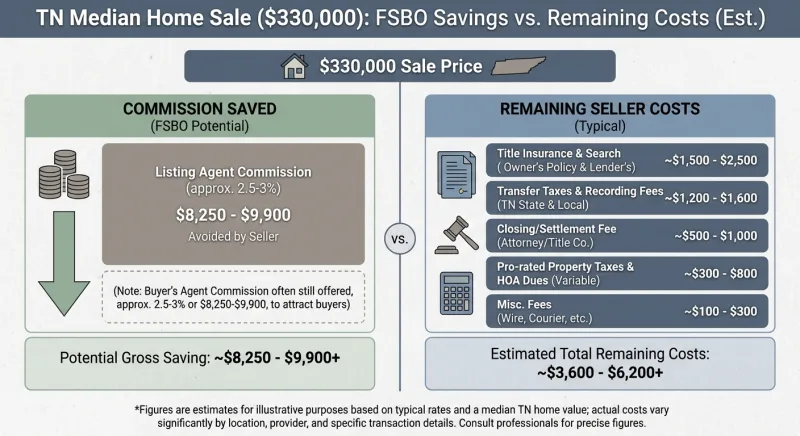
On a median Tennessee home around $330,000 as of early 2026, skipping the listing-side commission alone saves roughly $8,250–$9,900 (about 2.5–3%).
Is FSBO Worth It in Tennessee? Costs vs. Savings
FSBO makes sense when you're willing to do the work of an agent—pricing, marketing, showings, negotiation, paperwork—and your home sits in a market with enough buyer demand to move without a full-service listing.
On a $330,000 sale, the listing-side commission runs about $8,250 to $9,900. Handle the four hard parts—pricing, disclosures, MLS access, and closing—correctly, and most of that stays with you. Out-of-pocket costs are modest: a flat-fee MLS package ($99–$499), professional photos ($150–$400), and possibly an appraisal or attorney review.
What you trade for those savings is time and responsibility. You field the calls, schedule the showings, and keep the disclosures accurate—and in Tennessee, getting a disclosure wrong carries legal exposure, not just an awkward conversation.
This might not be for you if your home is under about $250,000. The commission you'd save shrinks against fixed costs, so the payoff thins out. It's also a harder path when title is complicated—an estate, a divorce, unresolved liens—where a mistake costs more than any commission. For most sellers in Nashville, Franklin, Knoxville, Memphis, and Chattanooga sitting on typical equity, the numbers favor doing it yourself.
Step 1: Price With a Real CMA, Not Just Zillow
Most FSBO sellers get tripped up right here. Zillow's Zestimate and Redfin's estimate are starting points, not asking prices. They pull from public records and broad models and don't see your updated kitchen or the busy road behind the fence.
A proper comparable market analysis (CMA) looks at recently sold homes—not just listed—within roughly a mile, similar in square footage, beds, baths, age, and condition. In Tennessee, that sold data lives inside the MLS: RealTracs across Middle Tennessee, MAAR in Memphis, KAAR in Knoxville, Greater Chattanooga REALTORS® in the southeast. Public sites lag behind those closed numbers.
Set your asking price on the last three to six comparable closings, adjusted for condition. Price too high and the listing goes stale; price a hair under a round number and you invite more showings. No showings in two weeks means the price is the problem, not the photos.
Step 2: Prep, Photograph, and Market the Home
Buyers decide from the photos whether to walk through the door. Get the house show-ready first: declutter, deep-clean, fix the obvious stuff (leaky faucet, chipped paint, cracked outlet cover), and boost curb appeal. Then hire a professional real estate photographer. Phone photos read as "cheap listing" to buyers scrolling Zillow. Good photography runs $150–$400 and pays for itself in showing traffic.
Your marketing plan should cover three things. First, syndication—once you're on the MLS, your listing flows to Zillow, Realtor.com, and Redfin automatically. Second, a clear description: lead with what's rare (lot size, school zone, recent roof), name the neighborhood, stay factual. Third, showings—many flat-fee MLS listings include ShowingTime scheduling so buyer agents can book without phone tag, plus an optional open house your first weekend.
Step 3: Complete Tennessee's Mandatory Disclosures
Educational, not legal advice—consult a licensed Tennessee closing attorney for your specific situation.
Tennessee law requires most residential sellers to give buyers a written property condition disclosure before the contract is binding, under the Tennessee Residential Property Disclosure Act (T.C.A. § 66-5-201 et seq.). This applies to FSBO sellers exactly the same as to agents.
You disclose what you actually know—roof, foundation, systems, water, past repairs. You're not required to inspect for defects you don't know about. But "I didn't want to know" isn't the same as "I didn't know," and buyers' attorneys understand the difference.
Tennessee singles out specific hazards that generic national forms never ask about:
- Sinkholes. Tennessee requires disclosure of any known sinkhole under T.C.A. § 66-5-212. Middle Tennessee's karst geology runs through the Nashville, Murfreesboro, and Franklin corridor—document what you know, disclose it in writing, keep a dated copy.
- Septic bedroom limits. A septic permit is written for a specific number of bedrooms. Advertise a "4-bedroom" on a 3-bedroom permit and you've created a misrepresentation problem under T.C.A. § 47-18-104(b), plus a live TDEC compliance issue. Pull the actual permit before you list—that number is your legal bedroom count.
- Airport noise zones. Homes inside a mapped airport influence area may carry disclosure exposure. Selling near BNA or MEM? Check before you list.
- Methamphetamine contamination. Known meth-production history is a material fact a knowing seller can't omit.
Fill the disclosure out completely and keep a signed copy. It's the first document a buyer's attorney reads if anything goes wrong after closing.
Step 4: RF 201 vs. RF 204 — Disclosure or As-Is Disclaimer?
Educational, not legal advice. A Tennessee closing attorney can confirm which form fits your sale.
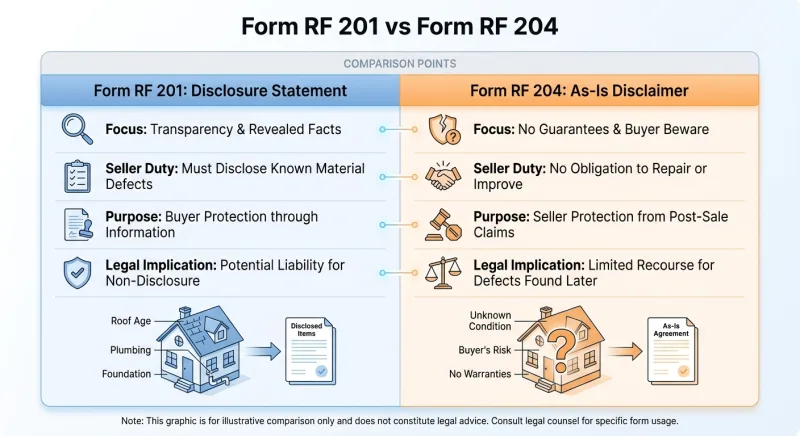
Form RF 201 is the full Residential Property Condition Disclosure—completed with what you know. Form RF 204 is the Disclaimer, an "as-is" statement where you decline to make condition representations. The critical catch: the disclaimer isn't a magic shield. It waives the buyer's right to a completed condition report. It does not waive Tennessee's baseline rule against active concealment or misrepresentation. Painting over a water stain and signing RF 204 is still concealment.
There's also a timing rule sellers get backward: the disclosure or disclaimer must be delivered before the buyer is bound. Hand it over after they've signed and you've created a defect the buyer may use to walk—and potentially claim earnest money.
| Situation | Use | Why |
|---|---|---|
| You've lived there, know the systems | RF 201 | Full disclosure builds trust and closes cleaner |
| Estate, inherited home, out-of-state owner who never lived there | RF 204 | You genuinely lack knowledge to certify condition |
| Investor flip with known-but-repaired issues | RF 201 | Disclaim nothing you actually know; document repairs |
| "I'd rather not deal with it" | Neither—reconsider | Convenience isn't a legal basis; liability remains |
For a normal seller who lives in the house, RF 201 is usually the stronger play. Full disclosure kills the biggest FSBO deal-killer—the post-inspection renegotiation—because the buyer already knew about the water heater. Reserve RF 204 for when it's genuinely true, and confirm it with an attorney first.
Step 5: Get on the MLS Without a Realtor (Flat-Fee MLS)
RealTracs, MAAR, KAAR, and Greater Chattanooga REALTORS® are broker-locked—only a licensed member broker can enter a listing. There's no homeowner login. You can't list on the MLS without a realtor in the literal sense—but you can list without hiring a full-service agent.
Flat-fee MLS is the bridge. A licensed broker of record enters your listing on the correct regional MLS for a flat fee, typically $99–$499, instead of a percentage commission. That listing then syndicates to Zillow, Realtor.com, and Redfin automatically—the same distribution a full-commission listing gets. You keep control of pricing, showings, disclosures, and negotiation. You just rent the one thing you can't legally access on your own: broker entry to the MLS.
If you're ready to list, our Tennessee flat-fee MLS packages route your home onto RealTracs (or your local board) through a broker of record and syndicate it everywhere buyers search.
Step 6: Buyer-Agent Commission After the 2024 NAR Rules
As of August 17, 2024, the NAR settlement changed how buyer-agent commissions work. Offers of buyer-agent compensation can no longer be advertised in the MLS, and commission is now openly negotiable and decoupled from the listing. Offers of compensation left the MLS—they didn't leave the deal. They now live in the purchase agreement or a separate compensation agreement, negotiated deal-by-deal.
That creates a genuine fork for FSBO sellers:
- Offer nothing to buyer agents. Widest savings, narrowest buyer pool.
- Offer a concession the buyer directs toward their agent. You keep buyer-agent traffic without a listing-side commission—where most 2026 FSBO deals actually land.
- Offer a flat buyer-side amount (say $X, not 3%). Predictable, and increasingly common now that percentages aren't the MLS default.
Post-settlement, buyers must sign a written representation agreement before touring, often stating an amount the buyer owes their agent. Expect a request that you cover it as a seller concession. Run both versions (you cover it vs. the buyer covers it and offers less on price) and pick the higher net-to-seller.
Step 7: Structure Offers So the Deal Survives Inspection
Earnest money is your first filter. It sits in escrow—typically held by the title company or closing attorney, not you. A thin deposit signals a buyer who can walk cheaply. Meaningful earnest money weeds out tire-kickers before they tie up your listing for weeks.
When you read an offer, don't just read the price. Read the exits, ranked by kill-risk:
- Financing contingency — real, expected, hard to negotiate away.
- Appraisal contingency — the one that reopens price. Come in under contract price and you're renegotiating whether you like it or not.
- Home inspection contingency — the most common renegotiation trigger. Set your walk-away line before the inspection, not during the emotional 48 hours after the report lands.
- Sale-of-buyer's-home contingency — the highest kill-risk. Treat it as softer than a clean offer at the same price.
A lower clean offer often nets more than a higher contingent one. Price is what they write. Net-to-close is what you keep.
Step 8: Budget Closing Costs and Close Clean
Most FSBO sales close through a title company or licensed closing attorney who handles the deed, title search, and escrow. Deed drafting and title curative work are legal tasks in Tennessee—don't DIY the deed.
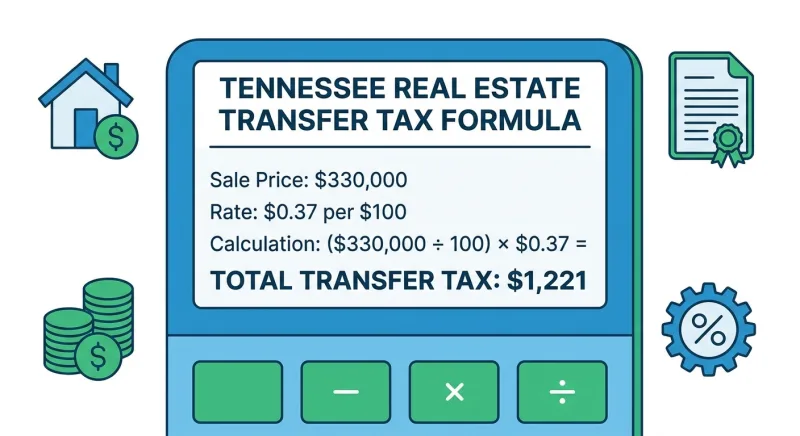
Budget for Tennessee's realty transfer tax of $0.37 per $100 of sale price under T.C.A. § 67-4-409. On a $330,000 home, that's about $1,221. Add title work, recording fees, and any prorated taxes.
Run a title check early, not at closing. Several situations turn a smooth FSBO into a legal project:
- Inherited property without clean probate. An estate that was never formally closed can freeze a sale.
- A prior lien or judgment. Old contractor liens, tax liens, or an unreleased second mortgage must clear before you convey.
- Divorce or co-owner disputes. Every owner on the deed signs the deed. No exceptions.
- Boundary or survey conflicts. A fence in the "wrong" spot for 20 years can become a title objection.
The commission you'd save shrinks fast next to the attorney hours a knotted title demands. For a straightforward, single-owner, lien-free home, the title work is routine and the savings hold—that's the FSBO sweet spot.
The Sub-$250K Math Nobody Wants to Say Out Loud
FSBO savings scale with price because the commission you're avoiding is a percentage. On a $330,000 median Tennessee home, that's clearly worth the effort. But your fixed costs don't shrink with price. Flat-fee MLS, professional photos, title work, transfer tax—those cost roughly the same on a $200,000 house as a $400,000 one.
If your home is under about $250,000, run the numbers before you commit. The commission you'd save shrinks relative to fixed costs, and the hours you'll spend on showings and paperwork start to look expensive. FSBO still works down there—but the case is closer, and you deserve to know that going in.
Frequently Asked Questions
Is it legal to sell your house FSBO in Tennessee?
Yes. Tennessee has no law requiring you to hire a real estate agent. You can legally sell your own home as long as you complete the mandatory disclosures under the Tennessee Residential Property Disclosure Act (T.C.A. § 66-5-201 et seq.) and close through a proper deed transfer.
What forms do I need to sell a house by owner in Tennessee?
At minimum: a property condition disclosure (Form RF 201) or a valid as-is disclaimer (Form RF 204), a written purchase and sale agreement, and the deed prepared for recording. Federal law also requires a lead-based paint disclosure for homes built before 1978.
Can you list on the MLS without a realtor in Tennessee?
Not directly—RealTracs, MAAR, KAAR, and Greater Chattanooga REALTORS® restrict MLS entry to licensed broker members. A flat-fee MLS service (typically $99–$499) gives you broker-of-record access so your listing lands on RealTracs and syndicates to Zillow, Realtor.com, and Redfin without a listing commission.
How much is the transfer tax when selling a home in Tennessee?
Tennessee charges a realty transfer tax of $0.37 per $100 of the sale price under T.C.A. § 67-4-409. On a $330,000 home, that's about $1,221.
Do you need a lawyer to sell FSBO in Tennessee?
Tennessee doesn't legally require an attorney, but most FSBO sales close through a title company or licensed closing attorney who handles the deed, title search, and escrow. For complex title issues or unusual financing, hire one—this guide is educational, not legal advice.
How long does a Tennessee FSBO sale take?
From accepted offer to closing, expect roughly 30 to 60 days, depending on the buyer's financing and inspection timeline. Cash deals can close in as little as two weeks.
Conclusion
Selling FSBO in Tennessee comes down to doing four things right: pricing off real comps, disclosing honestly with the correct form, getting genuine MLS exposure, and closing clean through a title company or attorney. Miss one and you either leave money on the table or invite a lawsuit. Get all four right and you keep the listing-side commission.
Start with the paperwork. Pull your property condition disclosure (RF 201) or as-is disclaimer (RF 204) before you accept a single offer, and know the difference—a disclaimer isn't always valid when you're aware of a defect. Then nail your price, prep your photos, and get on the MLS through a flat-fee listing.
If your home is under roughly $250K, run the numbers first. Everyone else: this is a workflow, not a gamble. Sell it yourself—just sell it right. And when the stakes get complicated, a licensed Tennessee closing attorney earns their fee.