
Short version: A 2026 Tennessee bill tracked as SB1707 / HB1762 tried to require a sworn preparer declaration on every deed. It didn't pass. But here's what trips people up — the existing rules already stop most FSBO sellers from using an anonymous online deed generator. Tennessee law requires every recorded deed to name the person who prepared it [TCA § 66-24-115], and a faceless website can't be that person. So if you're selling for sale by owner, you've got two real paths: draft the deed yourself and put your own name on it, or pay a licensed professional.
This isn't legal advice. It's a plain-English walkthrough of how the rules actually work at the recording counter. For your specific deed, talk to a Tennessee real estate attorney or title company.
Last verified: [DATE — confirm current statute text with capitol.tn.gov and your county Register of Deeds before relying on this.]
What SB1707 Was — and Why It Doesn't Change Your Deed
Most "how to prepare a Tennessee deed" pages online still describe the old world of paper size, black ink, and one-inch margins [TCA § 66-24-121]. Those formatting rules are real and still apply.
In 2026, lawmakers introduced SB1707 (companion HB1762) as a deed-fraud measure. Its proposed core mechanism was a sworn preparer declaration — a statement, made under penalty of perjury, naming an authorized preparer on the face of every deed. The bill did not pass.
So there's no 2026 effective date, no Public Chapter number, no new sworn-oath requirement. What governs your deed today is the standard Tennessee recording law already on the books — and that existing law is already enough to sink the click-to-generate shortcut.
Who Can Prepare a Deed in Tennessee?
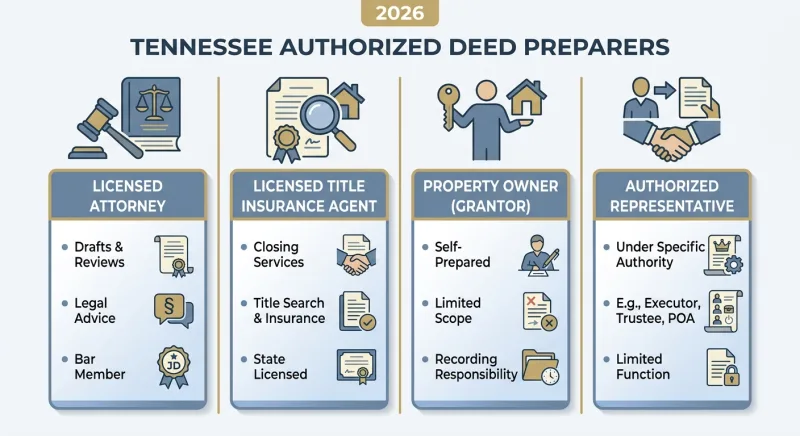
Direct answer: You can prepare your own deed for your own property (pro se). Preparing deeds for other people, for pay is restricted to licensed attorneys and other authorized parties, because drafting documents for compensation is the practice of law [TCA § 23-3-101]. Tennessee also requires every deed to name its preparer on the document [TCA § 66-24-115] — and that requirement quietly ends the anonymous-generator era.
The authorized preparers
- You, the owner (pro se). You may draft your own deed for your own property and put your own name on the preparer line [TCA § 66-24-115].
- A licensed Tennessee attorney. Can prepare the deed and identify themselves as preparer.
- A licensed title insurance agent. Title agents run closings, but because drafting deeds for pay is the practice of law, the actual document is typically prepared by a licensed attorney they employ or contract with.
- A party to the transaction. In some conveyances, a directly involved party may prepare the instrument.
The question isn't only "who typed the deed?" It's "whose name goes on the preparer line — and are they allowed to be there?"
Why Online Deed Generators Don't Complete the Job
Direct answer: Sites like Deeds.com, DeedClaim, and US Legal Forms can produce a formatted document, but none acts as your preparer, your attorney, or your legal representative. Tennessee requires a named preparer on every deed [TCA § 66-24-115] — and a form-filling website is a tool, not a person.
No statute says "online deed generators are banned." The reality is quieter: the generator hands you a document and steps back. Somebody still has to fill the preparer line, and it can only be filled three ways:
- Your own name, as the pro se owner — meaning you drafted it and the website was just a word processor.
- A licensed attorney's name and credentials.
- A licensed title agent's name and credentials.
Leave that line blank and your paperwork bounces at the counter. The generator isn't outlawed — it's been demoted to a typewriter. Use one, and understand that legally you became the preparer, with everything that carries.
Preparing Your Own Deed: What You're Taking On
Direct answer: Tennessee lets you prepare your own deed pro se, but the moment you list yourself as preparer [TCA § 66-24-115], you own the document being accurate, properly formatted, and legally effective.
When you're the preparer, you own every part:
- The legal description must match the property exactly, usually pulled from the prior recorded deed, not the mailing address.
- The grantor and grantee names must be correct and consistent.
- The deed type must give the buyer what they expect.
- The notarization/acknowledgment and original signatures must be right.
- The preparer statement [TCA § 66-24-115] must be completed.
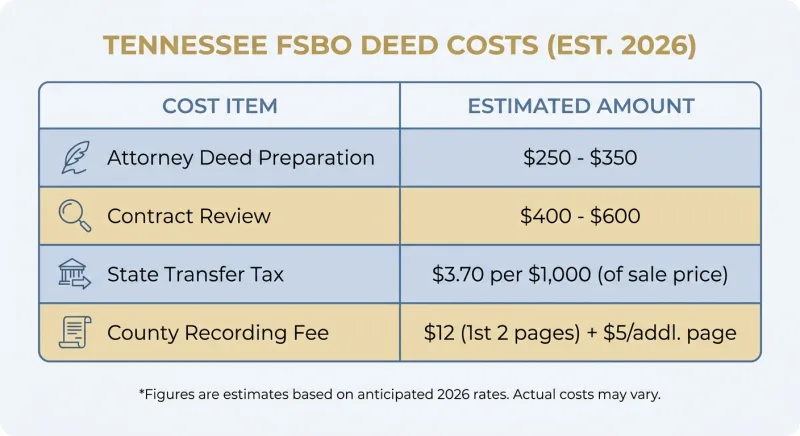
A small error in the legal description or a missing acknowledgment doesn't just get rejected — it can cloud the buyer's title for years after closing. That's the kind of mistake a $250–$350 attorney deed fee (2026 market estimate) is built to prevent. If there's a trust, an estate, a divorce, or multiple owners, hire a professional.
Why the Recorder Accepting a Deed Doesn't Mean It's Clean
The Register of Deeds has a ministerial job: confirm a document meets the statutory conditions for recording, then index it. One of those conditions is a valid preparer statement [TCA § 66-24-115]. The clerk isn't reading your deed for accuracy.
That creates two separate failure points:
- The counter failure — the deed bounces at the window before recording. Usually fixable same-day if you know why.
- The substantive failure — the deed records, then surfaces years later as a title cloud when the buyer tries to sell or refinance.
A garbled legal description still records — it just records garbled. "It got accepted" is not the same as "your title is clean." An online generator produced formatting, not review. That's the gap a licensed preparer exists to close.
Quitclaim vs. Warranty Deed for a Tennessee FSBO Sale
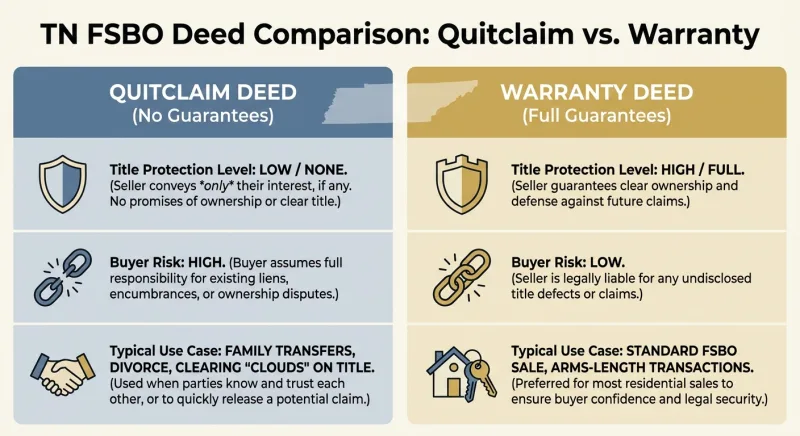
A quitclaim conveys whatever interest you happen to have, with zero promises. A general warranty deed carries covenants reaching back through the entire chain of title — prepare one wrong and you've created warranties you can't back.
The special warranty deed most FSBO guides skip
A special warranty deed warrants only against defects that arose during your ownership, not the whole chain. For many clean FSBO sales it's the right instrument: real protection for the buyer, contained liability for you. Buyers who'd never take a quitclaim will often accept a special warranty deed once their attorney explains the difference.
Don't hand a buyer a quitclaim to save $40 of drafting complexity. Most lenders won't finance against one, most title companies won't insure it cleanly, and most informed buyers walk.
Edge Cases the Recorder Won't Warn You About
Trusts and LLCs. If title is held in a revocable trust or LLC, the grantor isn't you — it's the entity. The signature block, authority recital, and preparer line all have to reflect that.
Divorce and estate transfers. A deed executing a property settlement or estate distribution often needs supporting instruments referenced correctly.
Multiple parcels, one deed. Each legal description has to close and match the source deed. One transposed call and the whole instrument is defective, even if it records.
Marital-status recitals. Tennessee deeds routinely need the grantor's marital status stated. Married-since-purchase sellers who leave it off create exactly the cloud that surfaces at a future refinance.
The recorder catches almost none of these. These defects record cleanly and detonate later — which is precisely the risk an attorney or title agent exists to absorb.
A Framework for Deciding Who Prepares Your Deed
- Is title in your individual name, free of trust/LLC/estate complications? No → hire an attorney.
- Cash or financing? Financing means a lender and a title policy, so the title company is preparing or reviewing the deed anyway.
- Will the buyer accept a special warranty deed? If yes and #1 is clean, a title agent handling your closing can often prepare it as part of their fee.
- Anything unusual about the chain, parties, or parcel? Any yes → attorney.
Clear all four cleanly, and you have a genuinely simple single-parcel, individual-to-individual sale? Pro se drafting is legally available — but you're now the accountable preparer who owns every defect.
The honest math
An unbundled attorney deed prep runs roughly $250–$350 as of 2026 (market estimate — verify locally). Set that against the full-service listing commission you're not paying by selling FSBO on a flat-fee MLS listing. The smart FSBO play isn't "cut the lawyer to save money." It's "list flat-fee, keep the commission, and spend a few hundred of it making your deed bulletproof."
Frequently Asked Questions
Who can prepare a deed in Tennessee?
Any adult can draft their own deed pro se to convey their own property, but preparing deeds for other people for pay is restricted to licensed Tennessee attorneys and other authorized parties under the state's unauthorized-practice-of-law rules [TCA § 23-3-101]. Every deed must also name its preparer on the document [TCA § 66-24-115].
What is SB1707, and does it apply to my deed?
SB1707 (companion HB1762) was a 2026 Tennessee deed-fraud bill that proposed a sworn preparer declaration on deeds of conveyance. It did not pass, so standard Tennessee recording rules still govern. Confirm current requirements on capitol.tn.gov or with an attorney before relying on any version of the bill.
Why was my deed rejected by the Tennessee Register of Deeds?
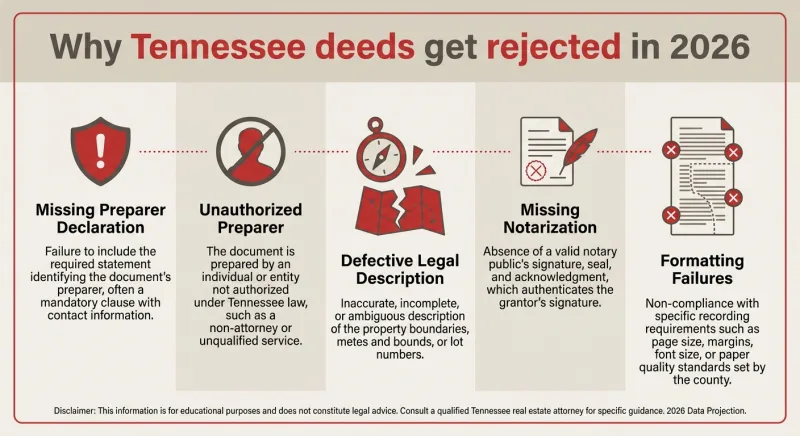
Common reasons include a missing or unauthorized preparer statement, a defective legal description, missing notarization or acknowledgment, and formatting failures under the recording statute [TCA § 66-24-121]. Each county can flag its own local requirements, so call your Register of Deeds before you file.
Quitclaim vs. warranty deed for a Tennessee FSBO sale — which do I need?
A warranty deed guarantees clear title and is what most buyers and lenders require. A quitclaim transfers only whatever interest you happen to hold, with zero title protection. Most arm's-length buyers won't accept a quitclaim, so a warranty deed is usually the right call for an actual sale.
How much does deed preparation cost in Tennessee?
As of 2026, a flat-fee attorney or title company typically charges roughly $250–$350 to prepare a deed (market estimate — verify locally), plus Tennessee's realty transfer tax of $0.37 per $100 of value [TCA § 67-4-409 / TN Dept. of Revenue — confirm current rate] and county recording fees that often start around $12 for the first two pages but vary by county.
Is this article legal advice?
No. This is general information for Tennessee FSBO sellers, not legal advice. Talk to a licensed Tennessee real estate attorney or title company before you sign or record any deed.
The Bottom Line
SB1707's sworn-preparer proposal didn't become law, but the existing rule still stands: every deed has to name an authorized preparer, and a website can't be one. That leaves two honest paths — draft it yourself pro se and carry the full liability, or pay a licensed Tennessee attorney or title agent a flat fee to do it right.
Skipping a full-service commission saves most FSBO sellers thousands. A $250–$350 deed-prep fee is a rounding error against that. List flat-fee, keep the commission, and route the deed to a professional. Get the deed right, list it lean, and keep more of what your house is worth.
This isn't legal advice, and no article can be. County practice varies, and statutes change. Before you record anything, confirm current requirements with a licensed Tennessee real estate attorney, a title company, and your county Register of Deeds. Last verified: [DATE].
Once your deed strategy is sorted, the listing side is the easy part. See our guides on flat fee MLS in Tennessee, for sale by owner in Tennessee, and how to list on the MLS without an agent — plus city walkthroughs for Nashville, Memphis, Knoxville, and Chattanooga.