
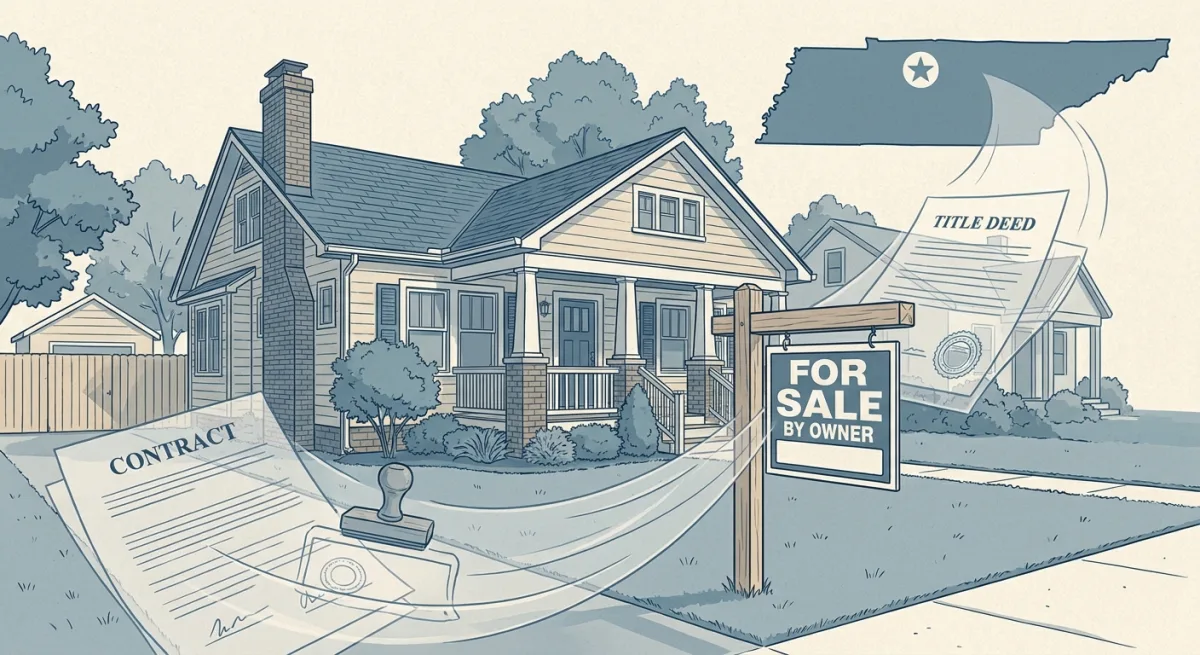
Tennessee's Settlement Agent Law Just Rewrote the Closing Table
If you're selling your home yourself in Tennessee, the Tennessee settlement agent law (SB 394/HB 569) changes one thing that matters on almost every deal: who gets to pick the title company. And it's probably not who you'd guess.
Under Tennessee Public Chapter 769 — enacted as Senate Bill 394 and companion House Bill 569, effective July 1, 2026 — the buyer holds the right to choose the settlement agent, subject to mortgage lender approval. A settlement agent is simply the party that handles title and escrow at closing: ordering title insurance, holding funds, and recording the deed. For FSBO sellers, that single rule reshapes how you negotiate, who prepares the deed, and how you protect your own money through escrow.
This is general information, not legal advice. Let's get into it.
Last reviewed: [DATE] • Verified against Tennessee Public Chapter 769 (SB 394/HB 569)
This is general information, not legal advice. For your specific transaction, consult a licensed Tennessee attorney.
Tennessee's New Settlement Agent Law at a Glance
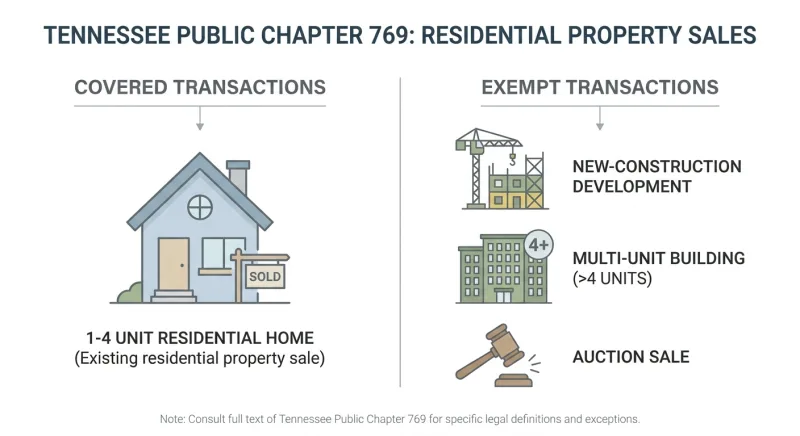
The bill was carried by Rep. Andrew Farmer and Sen. Rose in the 114th Tennessee General Assembly, signed on April 21, 2026, and covers real estate transactions involving one to four residential dwelling units.
Short version: if you're selling your home yourself, you can no longer require the buyer to use your title company.
Who Chooses the Title Company in Tennessee in 2026?
The buyer chooses. Under Public Chapter 769, for residential closings on or after July 1, 2026, the buyer holds the exclusive right to select the title and escrow provider, subject only to the mortgage lender's approval. A seller can suggest a company, but can't mandate one.
The buyer's right isn't unlimited. If the buyer is financing the purchase, the mortgage lender can still vet and approve (or reject) the proposed settlement agent for its own underwriting and title-insurance reasons. What the buyer's right does override is any seller demand. Before this law, a seller — or a seller's agent — could steer the closing to a preferred title company, sometimes for affiliated-business reasons. Under the new law, that steering is no longer enforceable against a residential buyer.
The relevant framework sits in Tenn. Code Ann. Title 56, Chapter 35 and the conveyance provisions in Title 66. The practical takeaway: the person buying the home gets to pick who closes it.
What Public Chapter 769 Actually Changes (and What It Doesn't)
The change is narrow but meaningful.
Before Public Chapter 769:
- Either party could push for a specific settlement agent; whoever held contract leverage often won.
- Sellers (and their agents) could condition acceptance on using a particular title company.
- Buyers sometimes accepted the seller's agent without realizing they could ask for their own.
After Public Chapter 769 (July 1, 2026 forward):
- The buyer holds the exclusive right to choose the settlement agent in covered residential sales.
- That right can't be waived away by contract language the seller inserts.
- A lender can still require approval of the buyer's chosen agent for financed purchases.
- When a sale uses a split closing, any fee-sharing arrangement must be disclosed and acknowledged in writing.
What doesn't change:
- You still sign a purchase contract, order title work, and record a deed the same way.
- The seller can still have their own attorney review documents and prepare the deed.
- Commercial and larger multi-unit deals sit outside the covered scope.
This is a rights law, not a process law. It reshuffles who decides — not how the closing mechanically works.

Scope & Exemptions: Which Sales the Law Covers
The buyer's settlement-agent right applies to residential sales involving one to four dwelling units.
| Transaction type | Covered by buyer's right? |
|---|---|
| Single-family home (owner-occupied or not) | Yes |
| 2–4 unit residential (duplex/triplex/fourplex) | Yes |
| Properties of 5+ units | No |
| Commercial / non-residential property | No |
| Transactions under a stated statutory exemption | No |
If you're selling a standard Tennessee house without an agent, assume you're covered. If your property is larger or unusual, check the statute — or ask a Tennessee attorney — before assuming otherwise.
Why the Buyer's Right Is Non-Waivable
A non-waivable right stays with the buyer no matter what the contract says. You might draft a professional purchase agreement and include a clause naming your preferred closing company. Under Public Chapter 769, that clause is unenforceable to the extent it strips the buyer's statutory choice.
Don't build your FSBO contract around controlling the title company. Build it around the fact that you can't. That reframing saves friction at the closing table and keeps your deal clean if a buyer or their lender ever pushes back.
Split Closings & the Fee-Sharing Disclosure Mandate
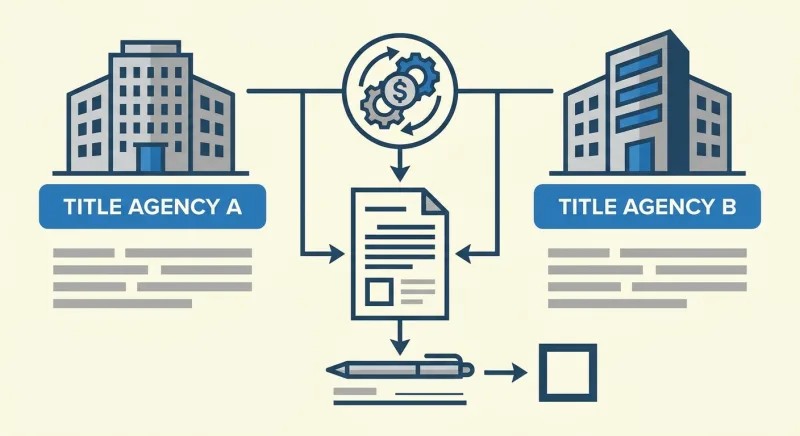
When the buyer picks their own settlement agent and the seller wants a different one, you get a split closing — two agents, each handling their side. Public Chapter 769 doesn't ban them. It regulates how the money gets shared.
When two settlement agents handle one transaction, they often split certain charges — the title insurance premium, portions of the escrow or closing fee. Under the new law, that arrangement can't happen silently. The parties must be told in writing, and must acknowledge it in writing.
The compliance sequence
- A split is proposed. Either side wants a different agent.
- Written disclosure is delivered. A written notice that fees will be shared between the two settlement agents, and how.
- Signed written acknowledgment is collected. The disclosure alone isn't enough; the law calls for a signed acknowledgment from the parties.
- The signed acknowledgment goes in the file. Kept with the closing documents.
Short version: disclose the shared fee, get it signed, keep the paper.
In a traditional deal, a brokerage or title agency's compliance team runs this checklist automatically. When you sell FSBO, you are the party on the seller side making sure the disclosure got delivered and signed before closing. A missing or unsigned fee-sharing disclosure is a compliance gap on the transaction, not just on one party.
How FSBO Sellers Keep Control of Title & Escrow (Legally)
The law takes away your ability to dictate. It doesn't take away your ability to influence, coordinate, and protect your own side.
Recommend, don't require
You can suggest a title company. What you can't do is write "Seller shall select the settlement agent" into the contract. Three moves let you use that recommendation to stay in control:
- Pre-vet a settlement agent before you list. Find a title company or closing attorney you trust, confirm they handle split closings cleanly, and have them on standby. When a buyer shows up with no title company of their own — which happens constantly on unrepresented deals — your pre-vetted agent is the easy "yes."
- Phrase it right in the contract. "Seller recommends [Agent]; Buyer may select the settlement agent of Buyer's choice." That respects the buyer's statutory right and plants your preferred option.
- Make the buyer's job frictionless. Hand over a short list of reputable Tennessee settlement agents and you look helpful, not controlling — and usually get your recommendation picked anyway.
Buyers almost always default to the agent who's already engaged and ready. The law gives them the choice. Convenience usually makes it for them.
What you control no matter what
- Your own representation. Retain your own attorney for deed prep and document review.
- Your seller-side documents. Your deed, mortgage payoff statement, proceeds and wiring instructions — all yours to prepare and verify.
- Your side of the fees. The buyer's choice doesn't force you to accept unreasonable seller-side closing costs.
- The timeline and contingencies. Closing date, title-clearance deadlines, and what happens if title isn't clean are all still seller-negotiated terms.
Read the settlement statement line by line. If a fee-sharing arrangement is in play, that signed acknowledgment is your record of what was disclosed.
Deed Preparation & the Seller-Retained Attorney
The party that closes the deal and the party that prepares your deed don't have to be the same party. In Tennessee, drafting the deed is generally considered the practice of law, prepared by a licensed attorney — not simply by whoever's running escrow. The settlement agent runs escrow, recording, disbursing, and the title policy. Drafting the deed is a separate task you can keep on your side of the table.
When the buyer controls the settlement agent, you don't want to also hand a stranger the job of drafting the document that conveys your property rights. Retain your own attorney for:
- The deed. Make sure it's drafted correctly and conveys exactly what you intend.
- Review of the closing figures. A second set of eyes on the settlement statement catches fees that drifted onto your side.
- Any split-closing paperwork. Your attorney confirms your half is handled right.
Watch for deed-prep fees. If a title agency offers to prepare the deed, confirm who's doing it, whether it's attorney-prepared, and what it costs — with your written consent to the charge. A deed draft fee you didn't agree to shouldn't appear on your settlement statement by surprise.
Flat-Fee MLS: The Smart FSBO Companion Under the New Law
The new settlement-agent law shifts title and escrow choice toward the buyer. It doesn't shift the economics of selling — and that's where you still win big as a Tennessee FSBO seller.
Going flat-fee MLS instead of full-service listing keeps the listing-side commission in your pocket. That saved money funds the smart things this law rewards: your own attorney for deed prep, a careful read of the fee-sharing disclosure, and a split closing coordinated without sweating the extra cost. You're not cutting corners. You're reallocating.
You still get the thing that actually sells a house — MLS exposure to every buyer agent and listing portal pulling the feed — without surrendering control of your closing to a full-service brokerage. You don't need a full-service agent to run a clean, compliant Tennessee closing in 2026. You need MLS exposure, a good settlement-agent recommendation, and your own attorney on the deed.
Ready to list on the MLS in Tennessee without an agent and keep control of your closing? See also our guides on flat fee MLS in Nashville and how to list on the MLS without an agent.
Frequently Asked Questions
Who chooses the title company in Tennessee in 2026?
Under Tennessee Public Chapter 769 (SB 394/HB 569), the buyer holds the exclusive right to choose the settlement agent for most residential sales closing on or after July 1, 2026, subject only to mortgage lender approval. The seller can suggest, but can't require.
Can a seller require a specific title company in Tennessee?
No. A seller cannot condition the sale on the buyer using the seller's preferred settlement agent for covered residential transactions. The buyer's right is non-waivable, so even a signed contract clause requiring one can't override it.
What does HB 569 do at a Tennessee closing?
HB 569 is the House companion to Senate Bill 394, and together they enact Public Chapter 769, effective July 1, 2026. At closing, the practical effect is simple: the buyer selects who handles title and escrow, not the seller or the seller's agent.
Which home sales does the settlement agent law cover?
The law applies to residential transactions involving 1 to 4 dwelling units, with a short list of exemptions. Properties outside that range, and the specific exempt categories named in the Public Chapter, fall outside the buyer's statutory choice right.
Can FSBO sellers still use their own attorney for the deed?
Yes. The settlement-agent choice sits with the buyer, but preparing the deed is separate legal work you can keep on your side. Retaining your own attorney for deed preparation stays fully available to unrepresented FSBO sellers under the law.
What happens in a split closing under the new law?
Each side can use a different settlement agent. When agents share fees, the parties must receive a written disclosure and provide a signed written acknowledgment before closing. Keep that signed acknowledgment with your closing file.
The Bottom Line
Starting July 1, 2026, the buyer picks the settlement agent, and no contract clause you write can take that choice away. That's not a loss of control. It's clarity.
Three moves. First, build your purchase contract to recommend a closing company without requiring one. Second, if you'd rather close with your own trusted agent, use a split closing and put any fee-sharing in writing with a signed acknowledgment. Third, budget for your own deed prep and document review — the savings from listing flat-fee instead of paying a full commission more than cover a few hours of a Tennessee attorney's time.
Last reviewed: [DATE] • Verified against Tennessee Public Chapter 769 (SB 394/HB 569). This article is general information for Tennessee FSBO and flat-fee sellers, not legal advice. Statutory specifics — including the effective date, scope, exemptions, and fee-sharing mechanics — should be confirmed against the enrolled bill, and any specific transaction should be reviewed with a licensed Tennessee attorney.
Sources (primary)
- Tennessee General Assembly — SB 394 bill page (capitol.tn.gov)
- Tennessee General Assembly — HB 569 bill page (capitol.tn.gov)
- Public Chapter 769, filed with the Tennessee Secretary of State
- Tenn. Code Ann. Title 56, Chapter 35 (title insurance)
- Tenn. Code Ann. Title 66 (property and conveyances)