
Last verified: [month/year of publication]. Fees change — confirm current terms with each provider before you sign.
A "cheap" flat fee MLS listing that skims 1% at closing costs a Tennessee seller about $3,800 on a $380,000 home. That's not a listing fee anymore. That's a commission wearing a costume.
If you're hunting for a zero fee flat rate MLS listing in Tennessee, you've probably hit the confusing part: two listings both advertised as "flat fee" can cost wildly different amounts by settlement day. One charges you once, upfront, and never again. The other charges a small number upfront, then quietly deducts a percentage from your proceeds at escrow.
The short answer: an upfront-only flat fee is cheaper than a percentage-at-escrow model on any normal Tennessee sale above roughly $150k, because a fixed dollar fee doesn't grow with your sale price — a 0.5%–1.25% escrow "success fee" does.
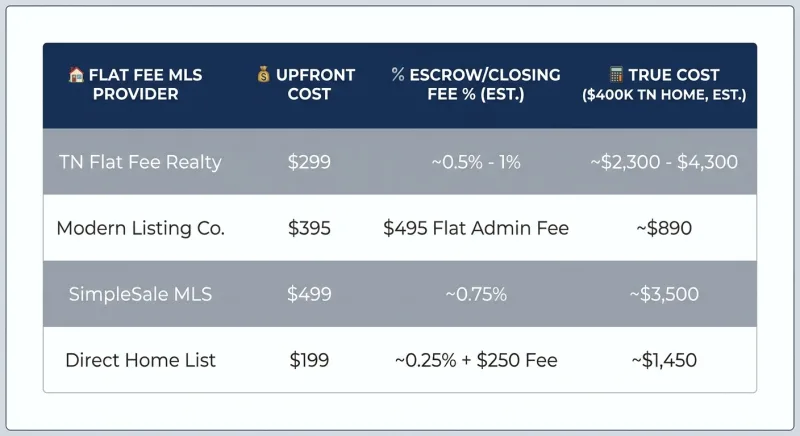
Is a zero-fee upfront flat fee MLS cheaper than a percentage-at-escrow model in Tennessee? For most sales, yes. A fixed upfront fee ($99–$1,200) stays flat no matter the sale price. A percentage-at-escrow model charging 0.5%–1.25% costs $1,900–$4,750 on a $380,000 home. The higher your sale price, the more the percentage model costs — and it's collected at closing, not disclosed upfront.
We built ResultsMLS as upfront-only on purpose. So we'll show our own pricing openly — including the fallback — and let the math decide.
The Two Pricing Models, Named Plainly
Every flat fee MLS company in Tennessee falls into one of two camps.
Upfront-only (fixed fee)
You pay one flat amount to get your listing on the MLS — and that's the end of the brokerage's charge to you. No cut at closing. That's what flat fee MLS upfront only tennessee actually means: the fee is decoupled from your sale price entirely.
The honest tradeoff: you pay it whether or not the home sells.
Percentage-at-escrow (low upfront + backend cut)
The upfront number is small — sometimes $0 — but the brokerage takes a percentage of your sale price at closing. It goes by different names: success fee, transaction fee, compliance fee, closing fee. Same mechanism, different wording. The percentage typically runs 0.5% to 1.25%.
In plain terms: an upfront-only model bets on itself getting your listing seen. A percentage-at-escrow model gets paid a slice of your equity when the deal closes. One is a flat cost. The other is a variable one dressed up as "cheap."
A flat fee should stay flat.
Where the Escrow Success Fee Actually Hides
The percentage fee doesn't show up when you list. It shows up on your closing paperwork — in a section most people never read closely.
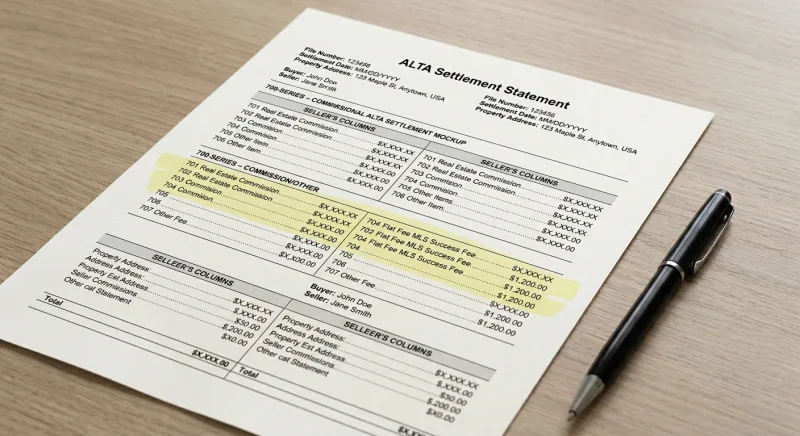
Where does the escrow success fee appear at closing? On the ALTA Settlement Statement, in the Commission section corresponding to the traditional 700-series broker-commission lines. Percentage-based "success," "transaction," or "compliance" fees are recorded here as a seller-side deduction — grouped with commission lines, not itemized as the flat MLS fee you thought you paid.
That placement is the whole trick. A $2,850 "compliance fee" (0.75% on a $380,000 sale) reads like part of the commission block, not a surprise. You've already signed. The funds are already allocated.
You can't decline it at the table, because you didn't agree to it there. The authorization lives in your listing agreement: "Broker is entitled to X% of the gross sales price, payable at settlement." The title company honors that clause and withholds the money before the wire hits your bank.
The single most important point in this guide: read your listing agreement before you sign — specifically the compensation and closing clauses. If it references any percentage of the sale price, a transaction fee, a compliance fee, or a "success" charge, that money leaves your equity at escrow. Verify by asking one direct question, in writing: "Is there any fee, of any name, collected at closing?"
Let's Do the Actual Math
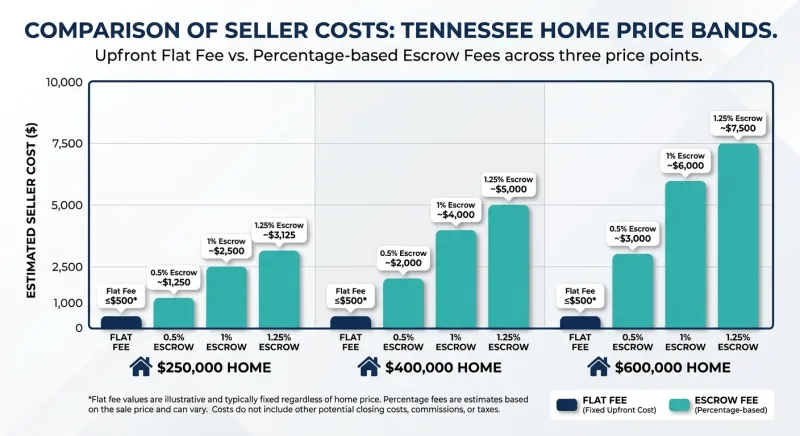
| Sale Price | 0.5% fee | 1.0% fee | 1.25% fee |
|---|---|---|---|
| $250,000 | $1,250 | $2,500 | $3,125 |
| $400,000 | $2,000 | $4,000 | $5,000 |
| $600,000 | $3,000 | $6,000 | $7,500 |
Hold that against a fixed fee that doesn't change with sale price. Whether your home closes at $250,000 or $600,000, an upfront-only listing at $399 stays $399.
At $600,000, a 1% escrow fee is $6,000 — for the identical MLS service. The brokerage did no more work to list a $600,000 home than a $250,000 one. You paid more because the fee is pinned to your equity, not to the service.
At the Tennessee median of roughly $380,000, common rates land at $1,900 (0.5%), $3,800 (1.0%), and $4,750 (1.25%). That $3,800 is the number no competitor puts on its homepage.
The honest counterpoint: if you aren't sure your home will sell, a $0-upfront model shifts risk. For a seller testing the market with real doubt, that can be rational. But for a normal sale that closes at a normal price, the percentage model costs more — often thousands more.
The Break-Even Line Nobody Draws For You
The formula is simple:
Break-even sale price = fixed upfront fee ÷ escrow fee percentage.
Run a $399 upfront fee against a 1% escrow model: $399 ÷ 0.01 = $39,900. Any Tennessee home selling above roughly $40,000 makes the 1% escrow model more expensive than the $399 flat fee. Against a 0.5% fee, break-even climbs to $79,800. Against 1.25%, it drops to $31,920.
On any Tennessee home worth more than $40,000 — which is nearly every home in the state — the "cheap" percentage listing is the expensive one.
The real decision variable is certainty of sale:
- High confidence you'll close → upfront-only almost always wins on total cost.
- Low confidence / testing the market → deferring cost to a percentage-at-escrow model caps your downside at $0 if it never sells.
That's the honest line most competitors won't draw, because it forces them to admit the percentage only wins on the risk dimension — never the cost dimension on a real sale.
Reading the Contract for Hidden Percentage Triggers
Four clauses to hunt for before you sign:
1. The dual-variable fee. Some agreements advertise a flat upfront number plus a "minimum commission" buried in fine print. Both fire. That fee is not flat.
2. The buyer-agent commission "recommendation." After the 2024 NAR settlement changed how buyer-agent compensation is displayed, some brokerages fold their own cut into what looks like a standard buyer-agent field. Keep them separate: the buyer-agent commission is a cost you choose; a brokerage compliance percentage is a cost the broker takes off your side.
3. The cancellation fee. Percentage models sometimes charge a penalty to exit early — because they've bet on the backend and you're threatening to leave before they collect.
4. The protection-period stack. Many agreements keep the fee alive for 60–180 days after the listing ends if you sell to any buyer introduced during the listing window. Pair that with an auto-renewal and a percentage obligation can outlive the listing you thought you ended.
The Out-of-State Referral Structure and Why It Changes Your Cost Exposure
Some of the cheapest-looking national flat-fee brands don't hold a Tennessee brokerage license. They operate as referral front-ends that hand your listing to an in-state partner broker.
Why this matters for cost: under Tennessee real estate law (TREC / TN Code Title 62, Ch. 13), the entity earning compensation for brokering a Tennessee transaction must be properly licensed. When the compensation chain runs through an out-of-state referral network, the party managing your file — ALTA statement review, commission disbursement authorization — may be someone you never chose and can't reach.
If a percentage fee is disputed at closing, you want to negotiate with the licensed Tennessee broker of record, not a referral desk in another state. Confirm the brand holds an active Tennessee brokerage license and names the licensed broker managing your file.
Isolate the Two Variables That Actually Differ
| Cost component | Who sets it | Varies by provider? |
|---|---|---|
| MLS listing fee | The flat-fee brokerage | Yes — flat vs. % |
| Brokerage/compliance % at escrow | The flat-fee brokerage | Yes — the hidden variable |
| Buyer-agent commission | You (your offer) | No — your choice |
| Title/escrow/settlement fees | Title company | No |
| TN transfer tax & recording | State/county | No |
Only the top two rows change between models. Every provider hopes you'll conflate the whole stack so the escrow fee blends into charges you'd owe anyway. Isolate rows one and two.
How to stress-test any quote in 60 seconds
- Ask: "What is my total cost if the home sells for $600,000?" — then for $250,000.
- If the two answers are the same, it's genuinely flat.
- If the answer scales with price, ask them to name the percentage and the clause number.
- Confirm the fee dies if the home doesn't sell — and if it survives, get the protection-period length in writing.
- Confirm the licensed Tennessee broker of record by name.
The Option Most Comparisons Pretend Doesn't Exist
Every flat fee comparison frames the choice as two boxes: pay upfront, or pay a percentage at escrow. There's a third structure: pay nothing upfront and nothing at closing — with no percentage anywhere in the contract.
ResultsMLS's Tennessee true-zero-fee path is contractually defined: $0 upfront and $0 at closing when you also buy your next Middle Tennessee home (over $200,000) through our agent. The listing-side cost is offset by the buy-side representation — a disclosed structure, not a teaser.
If you don't buy through us, the fee falls back to a transparent $1,200 flat — no percentage, ever.
There is no escrow percentage in either branch. Your total cost is either zero or a fixed, knowable number the day you list.
The escrow-fee models ask you to accept a variable you can't see until closing. The upfront-only models make you pay even if the sale falls through. The contractually-defined true-zero-fee path removes both bets — you know your number, and one branch of it is nothing at all.
Frequently Asked Questions
Is a flat fee MLS upfront only in Tennessee actually cheaper than a percentage-at-escrow plan?
On a normal sale, yes. A fixed upfront fee stays flat regardless of sale price, while a 1% escrow fee on a $380,000 Tennessee home costs about $3,800 at closing. The percentage plan only wins if you're genuinely unsure your home will sell.
What is an escrow success fee on a flat fee MLS listing?
An escrow success fee (also labeled a "transaction," "success," or "compliance" fee) is a percentage deduction taken from your proceeds at closing rather than paid upfront. It typically ranges from 0.5% to 1.25% and appears in the Commission section of the ALTA settlement statement, corresponding to the traditional 700-series broker-commission lines.
Where does the escrow success fee hide on my closing documents?
It sits in the Commission section of the ALTA settlement statement — corresponding to the traditional 700-series broker-commission lines — listed as a seller-side deduction. Read that section line by line before you sign.
What's the cheapest flat fee MLS in Tennessee 2026 for a seller who wants no backend commission?
The cheapest true cost comes from an upfront-only or contractually-defined zero-fee model that takes no percentage at closing. Compare providers on total cost at settlement, not the headline listing price — a $99 listing with a 1% escrow fee is far from the cheapest flat fee MLS in Tennessee for 2026.
Do I still owe a buyer's agent commission with a flat fee MLS listing?
The buyer's agent commission is a separate cost you choose to offer — it is not part of your flat MLS fee. In Tennessee you set that amount (or offer nothing) in your listing, and it's independent of what you pay the flat-fee broker.
Bottom Line
The number on the pricing page is not the number that matters. What matters is what leaves your account at closing.
A percentage-at-escrow plan can look like the bargain — low or no upfront cost is easy to say yes to. But on a standard Tennessee sale, 0.5% to 1.25% deducted in the ALTA settlement's Commission section quietly outgrows any fixed fee. On a $380,000 home, 1% is roughly $3,800 gone from your equity.
Pull up each provider's pricing page and find the closing-cost language. Confirm whether there's a "success," "transaction," or "compliance" percentage in the fine print. Verify the broker is licensed in Tennessee through TREC. Then compare true cost at settlement across your actual price band.
The percentage model isn't a scam — it can suit a seller who doubts the home will move. Just price both paths honestly before you sign. Run your numbers against the tables above, confirm current terms directly with each provider, and choose the plan where what you pay is what's on the page.
Figures last verified [Month 2026]; re-confirm current provider terms and TN median price before deciding.